Written by Uzma Aslam
TL;DR
Most mainstream cat food contains haram ingredients like pork. Islamic scholars advise that Muslims should not purchase these products, as the restriction applies to trade, not just consumption. Owners are encouraged to seek certified halal alternatives to ensure religious compliance.
Most Muslims who keep cats already suspect the answer before they search for it. The worry is not abstract. It sits at the moment you pour kibble into a bowl and wonder what, exactly, you are bringing into your home.
Mainstream cat food in the UK is not formulated with Islamic dietary law in mind. That is not a criticism; it simply reflects the market it was built for. The consequence is that the ingredients in the most widely sold cat food brands, the ones available in every supermarket and pet shop, routinely include pork derivatives, non-zabiha meat meals, unnamed animal fats, and by-products with no traceable source.
For a Muslim household, this is not a minor footnote. It is a question that sits at the intersection of religious responsibility, daily practice, and care for an animal that many Muslim families love deeply.
This article addresses the question directly. It covers what mainstream cat food typically contains, what Islamic scholars say about feeding and purchasing non-halal pet food, and what a genuine halal alternative looks like in practice. It does not overstate the ruling. It does not sensationalise. It gives you the information to make an informed, considered decision.
What Haram Means in the Context of Food You Buy, Not Just Food You Eat
The term haram is often understood narrowly: food that is forbidden to consume. But Islamic guidance on haram extends beyond what enters the mouth. It addresses what is purchased, what is traded, and what is brought into a Muslim home.
The Quran instructs believers to eat from what is lawful and good, a directive that Muslim scholars have interpreted as applying to the entire chain of acquisition, not just the act of eating. This is why Islamic law addresses the buying and selling of forbidden substances, not only their consumption. A Muslim who purchases pork for their pet is, in most scholarly interpretations, engaged in a transaction involving a haram substance, regardless of whether they eat it themselves.
This has a direct implication for cat food. If a product contains pork fat, pork gelatin, or meat from an animal not slaughtered in accordance with Islamic law, the act of purchasing that product sits uneasily within Islamic guidance on permissible trade. The full Islamic framework on this question, including the relevant Quranic references and scholarly positions, is documented in detail for anyone who wants to examine the textual basis.
What Mainstream Cat Food Actually Contains
Understanding the concern requires knowing what is in the product. Most conventional dry and wet cat food sold in UK supermarkets and pet shops uses a category of ingredients described as “meat and animal derivatives.” This is a legal umbrella term that can include any combination of rendered meat, blood products, bone meal, organ tissue, and fat from any species, including pigs.
“Animal fat” on a label does not specify the source. It can be lard. It frequently is. “Palatants,” which are flavour-enhancing coatings applied to kibble to make it appealing to cats, are often pork-based. Gelatin used in some wet food and treat products is commonly derived from pork collagen.
None of this is hidden. It is permitted under UK pet food labelling regulations because pet food is not produced for human consumption. Manufacturers are not required to specify the species source of their derivatives. For a Muslim buyer reading a label, “animal fat” provides no information about whether the ingredient is permissible.
Named protein sources, chicken, salmon, tuna, listed as the first ingredient, are a better starting point, but they do not guarantee the rest of the formula is free from haram derivatives. A chicken-based dry food can still contain pork fat as a palatant or binding agent further down the ingredient list.
What Islamic Scholars Say About Pet Food
The scholarly position on halal pet food is consistent in its direction, even where the detailed reasoning varies between schools of thought.
The majority position among contemporary scholars is that a Muslim should not purchase cat food containing haram ingredients because the act of buying involves a transaction with a forbidden substance. The Prophet, peace be upon him, prohibited not only the consumption of haram items but also their sale and trade. As recorded in both Sahih al-Bukhari and Sahih Muslim, he explicitly named prohibited categories of commercial exchange, a principle scholars have applied to modern consumer behaviour.
The question of whether the cat itself must eat halal food is treated separately. Scholars generally note that animals are not held to the obligations of Islamic law in the way humans are, and a cat that eats non-halal meat is not committing sin. However, the act of purchasing that food falls on the Muslim owner, and it is that transaction which most scholars identify as the area of concern.
Some scholars have issued rulings specifically on pet food. The position recorded in Fatawa Hindiya and affirmed by several contemporary scholars advises that purchasing food for pets that contains haram meat is not permissible, and that Muslims should seek alternatives that are made from halal ingredients. The guidance given in those rulings includes preparing food from halal sources at home, or purchasing certified halal pet food where available.
This is not a fringe opinion. It reflects a considered application of standard principles of Islamic commercial law to a modern consumer situation. It also explains why the existence of certified halal cat food in the UK carries weight beyond convenience.
The Difference Between Ingredients and Certification
Knowing that a product should be halal is not the same as knowing that it is. This is where the distinction between self-declaration and verified certification becomes practically important.
A product labelled “natural,” “premium,” or even “halal” without independent verification carries no enforceable guarantee. The manufacturer’s claim is legal in the UK, but it is not audited, inspected, or confirmed by a third party. There is no mechanism to ensure the claim holds at every stage of production.
Certified halal cat food carries verification from a recognised body. In the UK, HMC, the Halal Monitoring Committee, is considered the most rigorous certifying authority. HMC certification requires unannounced site inspections, documented traceability from farm to finished product, and confirmation that no cross-contamination with haram substances occurs at any point in the supply chain. The certification is not awarded and forgotten. It is ongoing and repeatable.
For a Muslim buyer, the difference between a self-declared halal label and a verifiable HMC certificate is meaningful in exactly the same way that the difference between “I think it is halal” and “a qualified body has checked and confirmed it is halal” is meaningful. Both may be sincere. Only one is independently verifiable.
What Halal Cat Food Should Actually Contain
Once the decision to seek a halal alternative is made, the question becomes what to look for. Halal certification addresses the sourcing and processing of ingredients. Nutrition is a separate, equally important consideration.
Cats are obligate carnivores. Their bodies require animal protein to synthesise essential amino acids, including taurine and arginine, that they cannot produce from plant matter. A cat fed an insufficient protein diet, or one where the protein comes from low-quality, unnamed sources, may not show deficiency immediately. Over time, the effects become visible: poor coat condition, reduced muscle tone, low energy, and eventually organ stress. Understanding what protein deficiency looks like in cats helps distinguish between a cat that is simply adjusting to a new food and one that is genuinely undernourished.
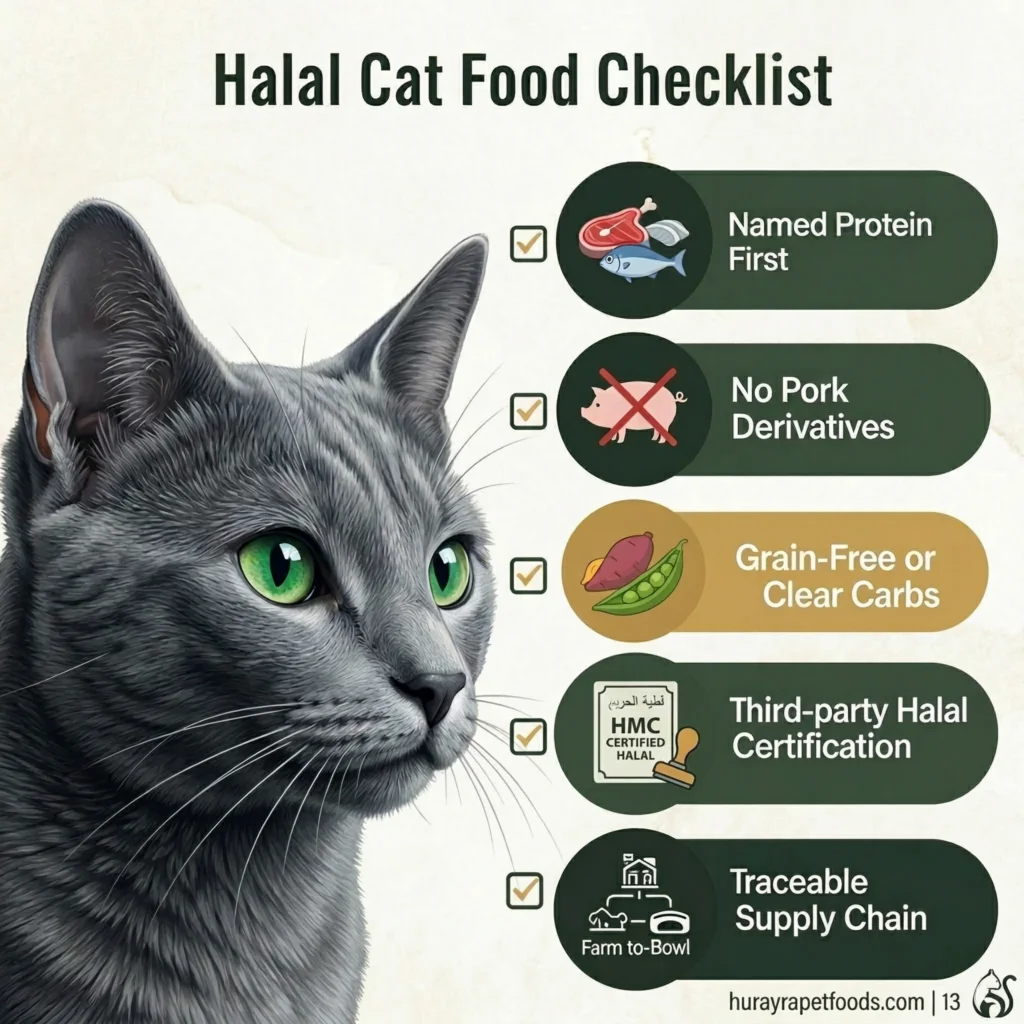
Good halal cat food should carry named animal protein as the first ingredient. The protein percentage should meet or exceed FEDIAF’s recommended minimum of 25% on a dry matter basis for adult cats, with 30 to 35% being more appropriate for active cats. It should be free of pork derivatives, unnamed animal fats, artificial colours, preservatives, and flavourings. And it should carry third-party certification rather than a self-applied label.
The full ingredient profile of Hurayra’s formulas, including protein sources, fatty acids, and vitamin content, is documented publicly. Every component has a function and a traceable source.
Practical Guidance for Muslim Cat Owners in the UK
Until recently, the practical answer to the halal cat food question in the UK was limited to two options: cook halal meat at home or accept the uncertainty of conventional products. Neither was entirely satisfactory.
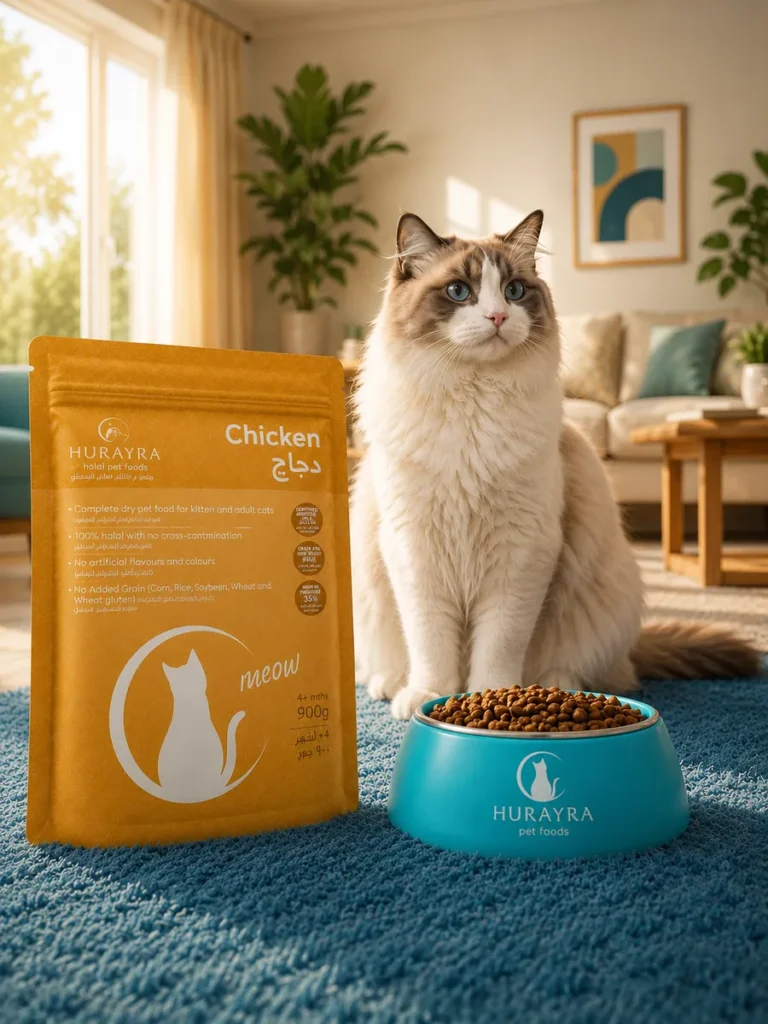
The landscape has shifted. HMC-certified dry cat food is now available both online and in mainstream retail. Hurayra is stocked in Morrisons stores across the UK and is available online with delivery across the country. For households that want to maintain a consistent feeding routine without the preparation involved in home cooking, a certified, nutritionally complete dry food removes the uncertainty entirely.
For owners managing multiple cats or concerned about continuity of supply, a subscription model removes the risk of running out and maintains the dietary consistency that cats benefit from. Cats do not adapt well to frequent food changes. A settled, consistent formula supports gut health and reduces the stress that comes with repeated transitions.
If you are switching your cat from a conventional food to a halal alternative, a gradual transition over 7 to 10 days is the right approach. Mixing increasing proportions of the new food with the old, over that window, helps the digestive system adjust without disruption.
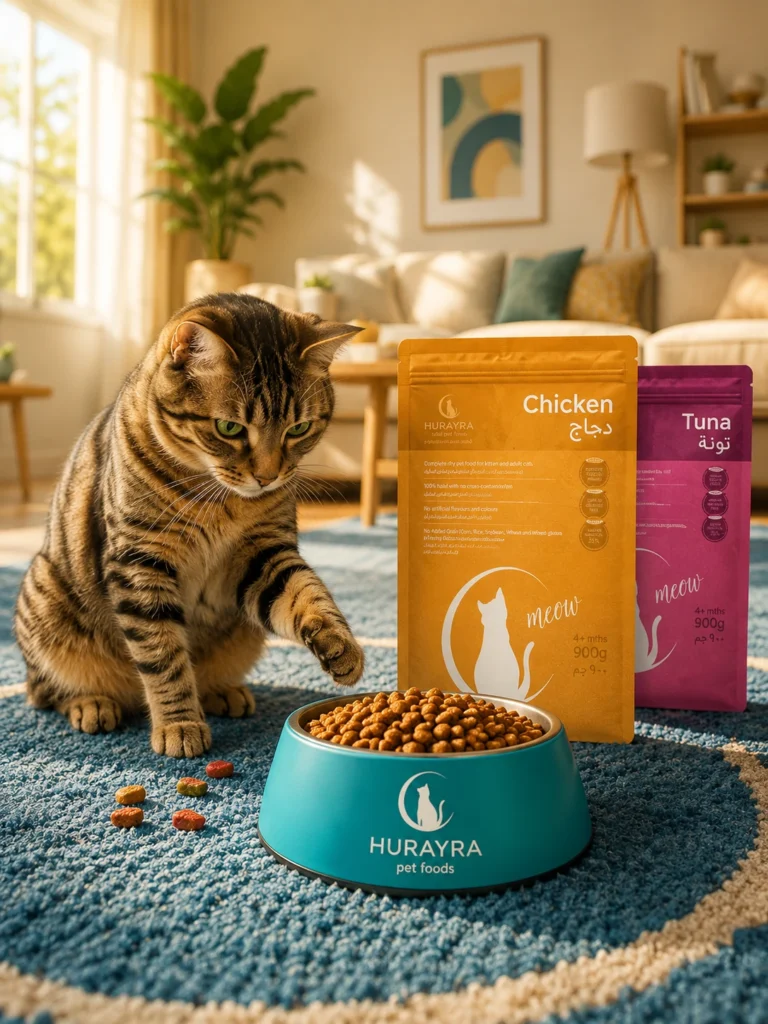
Tuna and Chicken Combo
Subscribe & Save 25%
Common Misconceptions, Addressed Directly
“My cat does not eat it, I just serve it, so it does not count.” The Islamic concern is not primarily about who consumes the product. It is about the act of purchasing a substance that involves a haram transaction. Serving is the downstream consequence of buying. Most scholars address the purchasing decision rather than the serving act specifically.
“Cats in the wild eat whatever they catch, so halal does not apply to them.” This conflates what cats do in a state of nature with what a Muslim household chooses to bring into its home and purchase from a market. The obligation under Islamic law applies to the believer making the purchase decision, not to the animal’s biology.
“Halal cat food is automatically more nutritious.” It is not. Halal certification governs sourcing, slaughter method, and production conditions. It does not guarantee superior nutritional content on its own. A halal-certified product still needs to be evaluated for protein quality, completeness of nutrition, and absence of unnecessary fillers. The two questions, is it halal and is it nutritionally sound, are separate and both matter.
“Fish-based cat food is fine because fish is always halal.” Fish is generally considered permissible in Islamic law without requiring zabiha slaughter. However, a fish-based cat food may still contain pork-derived palatants, animal fat from unnamed species, or other haram derivatives in the remaining ingredient list. The primary protein source being fish does not make the whole formula permissible.
The Straightforward Answer
Is cat food haram? The direct answer is: most conventional cat food sold in the UK contains ingredients that are not permissible under Islamic dietary law, and the act of purchasing those products sits within the scope of what Islamic scholars advise against.
This is not a minor or theoretical concern. It has a practical resolution: certified halal cat food, produced under a verifiable standard and available in UK retail, now exists. The question no longer has to end with uncertainty or compromise.
For Muslim cat owners who have been managing this quietly, buying whichever product seemed least problematic, the clearer path is now accessible. A certified alternative with a named protein, a documented supply chain, and a standard that Islamic scholars recognise is available at the price point and convenience of mainstream pet food.
The full range is a starting point.
Chicken Cat Food
Subscribe & Save 25%
Frequently Asked Questions
1 Is cat food haram in Islam?
Most conventional cat food in the UK contains haram ingredients, including pork derivatives, unnamed animal fats, and non-zabiha meat products. Islamic scholars generally advise that purchasing such products is not permissible, as the act of buying involves a transaction with a forbidden substance. The obligation applies to the Muslim owner making the purchase, not to the cat.
2 Do cats need halal food?
Animals are not held to the obligations of Islamic law, so a cat is not required to eat halal food in the sense that a Muslim is required to. However, the act of buying non-halal food for a cat involves a transaction with haram products, which most scholars advise against. The practical solution is to choose a certified halal alternative rather than reasoning that the cat’s status exempts the owner’s purchasing decision.
3 Can Muslims buy non-halal cat food?
The majority scholarly position is that purchasing cat food containing haram ingredients is discouraged, as it constitutes a commercial transaction with a forbidden substance. Scholars have advised seeking halal alternatives, whether through preparing food at home from halal sources or purchasing certified halal pet food. Now that certified options exist in the UK, this is no longer a question requiring compromise.
4 What is halal cat food made of?
Halal cat food uses meat from animals slaughtered in accordance with Islamic law, with no pork derivatives, unnamed animal fats, or haram by-products. A genuinely halal product will also be produced in a facility verified to prevent cross-contamination, under the oversight of a recognised certification body. Named protein sources, grain-free formulation, and documented traceability are the practical markers to look for.
5 Is fish-based cat food halal?
Fish itself is permissible in Islam without requiring zabiha slaughter. However, a cat food where fish is the primary protein may still contain pork-derived palatants, animal fat from unspecified sources, or other haram ingredients further down the ingredient list. The protein source being fish does not make the full formula permissible. Third-party certification of the complete product is the reliable way to confirm its status.
6 What is the Islamic ruling on feeding pets non-halal food?
Scholars are consistent that the concern lies with the Muslim owner’s act of purchasing a product that contains haram ingredients. The cat itself is not the subject of the ruling. The guidance from scholars including those referenced in Fatawa Hindiya is that purchasing pet food containing haram meat is not permissible, and that Muslims should seek permissible alternatives. The availability of certified halal cat food in the UK now makes that alternative accessible without significant inconvenience.
Most conventional cat food in the UK contains haram ingredients, including pork derivatives, unnamed animal fats, and non-zabiha meat products. Islamic scholars generally advise that purchasing such products is not permissible, as the act of buying involves a transaction with a forbidden substance. The obligation applies to the Muslim owner making the purchase, not to the cat.
Animals are not held to the obligations of Islamic law, so a cat is not required to eat halal food in the sense that a Muslim is required to. However, the act of buying non-halal food for a cat involves a transaction with haram products, which most scholars advise against. The practical solution is to choose a certified halal alternative rather than reasoning that the cat’s status exempts the owner’s purchasing decision.
The majority scholarly position is that purchasing cat food containing haram ingredients is discouraged, as it constitutes a commercial transaction with a forbidden substance. Scholars have advised seeking halal alternatives, whether through preparing food at home from halal sources or purchasing certified halal pet food. Now that certified options exist in the UK, this is no longer a question requiring compromise.
Halal cat food uses meat from animals slaughtered in accordance with Islamic law, with no pork derivatives, unnamed animal fats, or haram by-products. A genuinely halal product will also be produced in a facility verified to prevent cross-contamination, under the oversight of a recognised certification body. Named protein sources, grain-free formulation, and documented traceability are the practical markers to look for.
Fish itself is permissible in Islam without requiring zabiha slaughter. However, a cat food where fish is the primary protein may still contain pork-derived palatants, animal fat from unspecified sources, or other haram ingredients further down the ingredient list. The protein source being fish does not make the full formula permissible. Third-party certification of the complete product is the reliable way to confirm its status.
Scholars are consistent that the concern lies with the Muslim owner’s act of purchasing a product that contains haram ingredients. The cat itself is not the subject of the ruling. The guidance from scholars including those referenced in Fatawa Hindiya is that purchasing pet food containing haram meat is not permissible, and that Muslims should seek permissible alternatives. The availability of certified halal cat food in the UK now makes that alternative accessible without significant inconvenience.