Written by Uzma Aslam
TL;DR
Wheat-free removes one grain; grain-free removes all of them. Cats are obligate carnivores with limited ability to digest grains, so grain-free is the more thorough option. Always check labels for named animal protein in the first position and at least 26% crude protein.
They look the same on the shelf. They sound almost identical in the marketing. But wheat-free and grain-free cat food are not the same thing, and confusing them is one of the most common mistakes cat owners make when switching to a cleaner diet.
If you have searched for wheat-free cat food in the UK and found yourself reading grain-free packaging instead, this article will explain exactly why that matters, what to look for, and how to make a more confident decision for your cat.
Why the Distinction Actually Matters
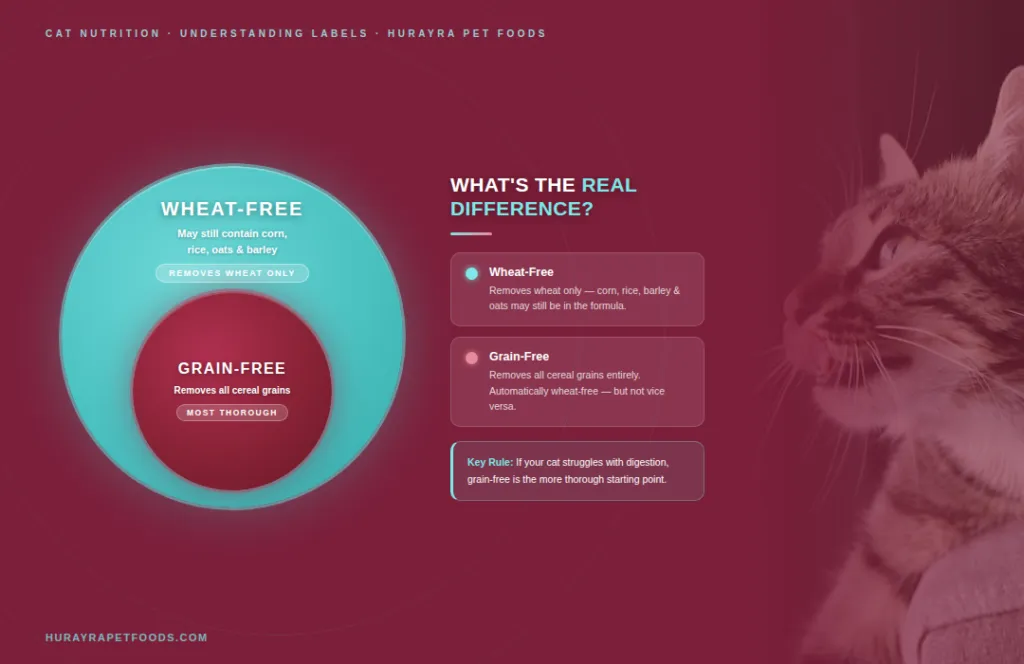
Wheat is one grain among many. When a food is labelled wheat-free, it has removed wheat specifically, but it may still contain corn, barley, oats, rice, or rye. All of those are grains. A food labelled grain-free, on the other hand, removes the entire category: no cereal grains at all.
This is not a technicality. If your cat has a reaction to wheat and you switch to a wheat-free kibble that still contains corn or barley, the problem may not resolve. You have removed one ingredient, but the broader group of ingredients that your cat’s digestive system struggles with remains.
The reverse is also worth knowing. Every grain-free cat food is automatically wheat-free, because wheat is a grain. But wheat-free cat food is not automatically grain-free. That asymmetry matters when you are reading labels under supermarket lights trying to do the right thing.
What Wheat Is Doing in Cat Food in the First Place
Wheat and other grains are not inherently sinister ingredients. They are inexpensive, they add structure to dry kibble, and they contribute calories. The problem is not that they are harmful; it is that they are not particularly useful to a cat.
Cats are obligate carnivores. Their digestive systems evolved around animal protein and fat, not cereal grains. They produce limited quantities of amylase, the enzyme that breaks down starch, which means grains pass through their gut less efficiently than they would through a dog’s or a human’s. For a more detailed breakdown of how cat physiology shapes food choices, Hurayra’s guide on why grain-free dry cat food differs from standard kibble covers the biological reasoning in full. The result, particularly in cats with sensitivity, can be loose stools, flatulence, dull coat condition, or persistent low-level digestive discomfort.
Wheat specifically is one of the more commonly implicated grains. It contains gluten, a protein composite, which some cats struggle to process, and it is a frequent filler in standard kibble precisely because it is cheap and abundant. You will often find it listed third, fourth, or fifth on an ingredients panel under a less obvious name: wheat flour, wheat middlings, wheat gluten.
That last one is worth pausing on. Wheat gluten is a concentrated protein extract. Some manufacturers use it to boost the crude protein percentage on the guaranteed analysis without increasing the amount of actual meat in the formula. A food that shows 30% crude protein on the label may be drawing a meaningful portion of that figure from wheat gluten rather than from chicken, fish, or another animal source. Named animal protein and total protein are not the same number.
Wheat Intolerance in Cats: What It Looks Like
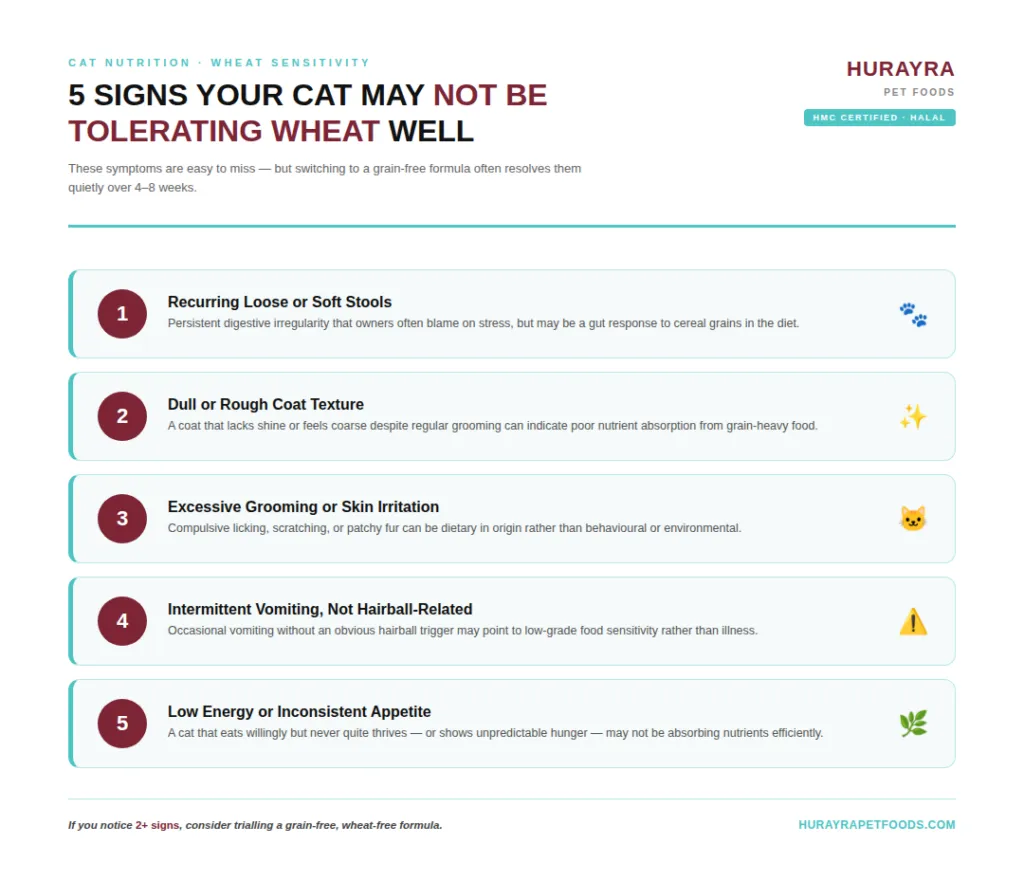
True wheat allergy in cats is less common than the marketing suggests. Genuine immune-mediated food allergy affects a small proportion of cats. What is considerably more common is digestive sensitivity: a non-immune response where the gut simply does not process certain ingredients well.
The distinction matters because sensitivity does not always produce dramatic symptoms. It can look like recurring loose stools that owners attribute to stress. A coat that is dull but not obviously unhealthy. A cat that eats willingly but never quite thrives. Mild chronic flatulence. These are easy to miss or misattribute, which is why many owners only notice the improvement after switching to a cleaner formula.
Gluten-Free Cat Food: A Third Term Worth Clarifying
You will also see gluten-free cat food on shelves and online. Gluten is a protein found specifically in certain grains (wheat, barley, and rye) but not in all grains. Rice, corn, and oats do not contain gluten in the conventional sense (though oats can be contaminated in processing).
This means a cat food labelled gluten-free may still contain rice or corn. It is more restrictive than wheat-free, but less restrictive than grain-free. For a cat with a confirmed sensitivity to gluten specifically, it may be sufficient. For a cat whose owner wants to remove the entire grain category, grain-free remains the clearest formulation.
The short version:
- Wheat-free: removes wheat only
- Gluten-free: removes wheat, barley, and rye (but may include rice, corn)
- Grain-free: removes all cereal grains
If you are reading this because your cat has been struggling and you want to rule out dietary causes, grain-free is the most thorough starting point.
If you want to explore Hurayra’s grain-free formulation, which removes wheat, corn, soy, and all cereal fillers, the Ingredients page sets out exactly what is and is not in each recipe.
How to Read a Cat Food Label Properly
The order of ingredients on a pet food label reflects weight before processing. The ingredient listed first is present in the largest amount. This matters because it tells you what the food is fundamentally made of.
A well-formulated cat food will list a named animal protein (chicken, tuna, salmon, or chicken meal) as the first ingredient. Chicken meal, despite sounding like a lesser option, is actually a concentrated protein source with the moisture removed, which means it can deliver more protein per gram than fresh chicken listed first.
What to watch for immediately:
Check the first three ingredients. If you see corn, wheat, or rice in the first three positions, the formula is grain-heavy regardless of what the front-of-pack claim says.
Look for named protein, not category protein. “Fish” or “chicken” is more transparent than “meat and animal derivatives.” The named source tells you something. The vague category tells you very little.
Find the crude protein percentage. FEDIAF, the European pet food industry’s nutrition authority, recommends a minimum crude protein content of 26% for adult cats on a dry diet. A premium dry formula will typically exceed this. Hurayra’s recipes contain 35% protein, sourced from named animal ingredients, which sits meaningfully above the recommended floor.
The protein percentage alone does not tell the whole story. Source and digestibility matter too. But it is one of the cleaner signals when comparing products in a crowded market.
Tuna and Chicken Combo
Subscribe & Save 25%
What Halal Certification Actually Means for Ingredient Transparency
For Muslim cat owners in the UK, halal certification is a matter of values rather than nutrition. A halal-certified cat food does not claim to be healthier than a non-halal formula. What it does claim is full supply chain transparency: how animals were raised, how they were slaughtered, and what entered the recipe at every stage.
That level of traceability is meaningful regardless of religious conviction. Knowing exactly what is in your cat’s food, rather than a vague category or blended derivative, is what ingredient transparency looks like in practice.
Hurayra is the first cat food in the UK to receive certification from the Halal Monitoring Committee (HMC). HMC certification operates at the supply chain level, not just at the finished product. That distinction is what separates it from a label claim. You can read more about the formulation philosophy on Hurayra’s grain-free and wheat-free page.
For non-Muslim cat owners, HMC certification functions as a third-party sourcing audit. It confirms that the meat in the formula is what it says it is, sourced from identifiable animals processed under documented conditions. In a market where “meat derivatives” remains an acceptable term on a label, that level of specificity has value beyond any single religious context.
Feeding Consistency and What to Expect When You Switch
If you decide to move your cat to a wheat-free or grain-free formula, transition gradually. Most nutritionists recommend a seven-to-ten-day switch: beginning with roughly 25% new food mixed into 75% of the current diet, and shifting the ratio incrementally over the following week. This reduces the risk of digestive upset from an abrupt change in ingredient profile.
What you can reasonably expect from a well-formulated switch, over four to eight weeks: improved stool consistency, better coat texture, and a more settled digestive pattern. Dramatic transformations in a week are less likely than quiet, incremental improvement, which is also how you know it is working rather than a placebo effect.
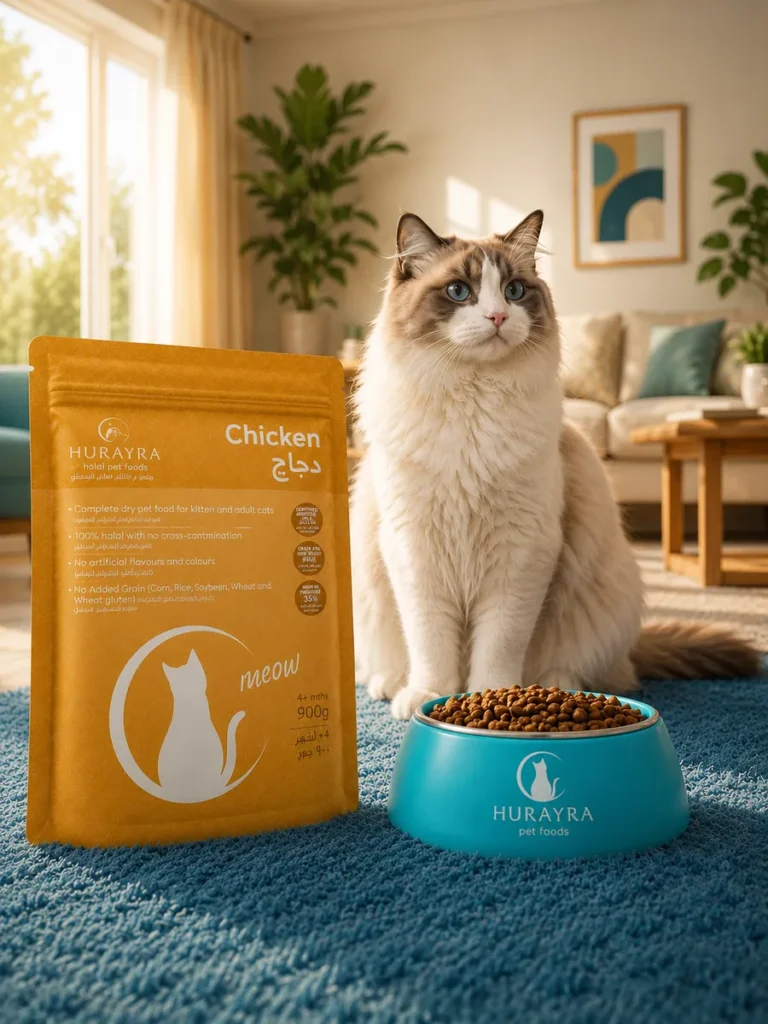
If you are looking at Hurayra’s two flavours, Halal Chicken Cat Food and Halal Tuna Cat Food, both are grain-free, wheat-free, and soy-free, with 35% protein from named animal sources. Both are available online with a subscription option and, for owners who prefer physical retail, in selected Morrisons stores across the UK.
Morrisons’ decision to stock Hurayra provides a form of independent retail validation that matters. Buyers for major retailers apply their own quality gatekeeping before listing a product. That process is separate from the brand’s own claims.
In Summary
Wheat-free and grain-free are not interchangeable terms. Wheat-free removes one ingredient. Grain-free removes the category. For cat owners who want to address digestive sensitivity thoroughly, or who simply want a formula that reflects their cat’s biology as an obligate carnivore, grain-free is the more complete approach.
When evaluating any formula, whether wheat-free, grain-free, or otherwise, the label is your primary tool. Named animal protein in the first position, crude protein at or above 26%, and transparency about what replaces the grains are the three signals worth prioritising.
Hurayra is formulated specifically for those standards. If you want to review what goes into each recipe in detail, the Ingredients page is a useful starting point. The products page has both current flavours and the option to subscribe.
Your cat does not need a complicated diet. They need a consistent one that is built around their actual nutritional requirements. That is a straightforward brief, it just takes some care to find food that meets it.
Chicken Cat Food
Subscribe & Save 25%
Frequently Asked Questions
1 Does wheat-free cat food mean healthier cat food?
Not necessarily. A wheat-free formula could still be full of corn, rice, artificial additives, and meat derivatives of unknown origin. Removing wheat is a single variable. What replaces it determines whether the food is actually better.
2 Is grain-free right for every cat?
No. The majority of cats on standard kibble will not have a diagnosable sensitivity. For those cats, grain-free food may offer marginal benefit rather than a dramatic transformation. Where grain-free tends to make a more noticeable difference is in cats with documented digestive sensitivity, dull coat condition that has not responded to other interventions, or owners who want a formula that more closely reflects their cat’s biological needs as an obligate carnivore.
3 Can I mix wheat-free and standard cat food?
Yes, and for many households this is a practical approach. If cost is a factor, using a wheat-free or grain-free food as the primary diet while supplementing with a quality wet food is a reasonable strategy. What tends to matter more than complete purity is consistency: feeding the same core formula reliably, rather than rotating frequently between very different ingredient profiles.
The subscription model offered by Hurayra (which includes a 25% saving on regular deliveries) exists precisely because consistency in diet is one of the clearest indicators of long-term digestive stability. Cats do not adapt well to constant change, and a predictable supply reduces the temptation to switch back to whatever is available.
4 What about the budget?
Grain-free and wheat-free kibble typically costs more per kilogram than standard formulas. That is a genuine consideration. It is worth factoring in, however, that higher protein content means lower feeding quantities for the same nutritional yield. A 35% protein formula fed in appropriate quantities may last longer than a 22% formula fed to compensate for lower satiety, and the vet visits that recurring digestive issues generate are not free either.
Not necessarily. A wheat-free formula could still be full of corn, rice, artificial additives, and meat derivatives of unknown origin. Removing wheat is a single variable. What replaces it determines whether the food is actually better.
No. The majority of cats on standard kibble will not have a diagnosable sensitivity. For those cats, grain-free food may offer marginal benefit rather than a dramatic transformation. Where grain-free tends to make a more noticeable difference is in cats with documented digestive sensitivity, dull coat condition that has not responded to other interventions, or owners who want a formula that more closely reflects their cat’s biological needs as an obligate carnivore.
Yes, and for many households this is a practical approach. If cost is a factor, using a wheat-free or grain-free food as the primary diet while supplementing with a quality wet food is a reasonable strategy. What tends to matter more than complete purity is consistency: feeding the same core formula reliably, rather than rotating frequently between very different ingredient profiles.
The subscription model offered by Hurayra (which includes a 25% saving on regular deliveries) exists precisely because consistency in diet is one of the clearest indicators of long-term digestive stability. Cats do not adapt well to constant change, and a predictable supply reduces the temptation to switch back to whatever is available.
Grain-free and wheat-free kibble typically costs more per kilogram than standard formulas. That is a genuine consideration. It is worth factoring in, however, that higher protein content means lower feeding quantities for the same nutritional yield. A 35% protein formula fed in appropriate quantities may last longer than a 22% formula fed to compensate for lower satiety, and the vet visits that recurring digestive issues generate are not free either.