
- Cat Health, Cat Nutrition, Halal Pet Food
Best Halal Cat Food UK 2026: What to Look For, What to Avoid, and What Has Changed
- uzma
Table of Contents
TL;DR
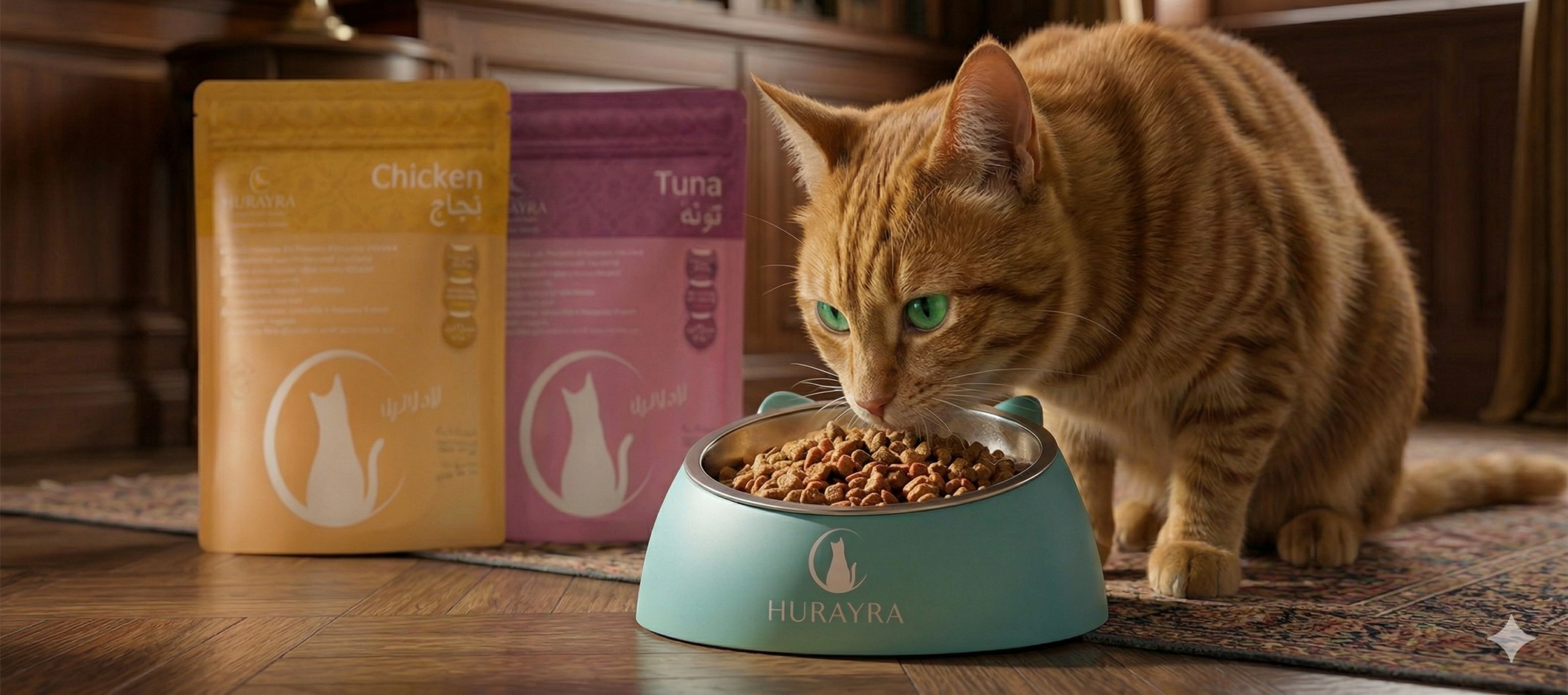
In the UK, HMC certification is the only verified halal standard for cat food, not self-declared labels. Look for named protein first on the ingredient list, above 25% crude protein, and third-party verification. Currently, Hurayra is the only dry cat food meeting all three.
Best Halal Cat Food UK 2026: What to Look For, What to Avoid, and What Has Changed
Most cat owners in the UK assume they can trust any product labelled “natural” or “premium.” The reality is more complicated. For Muslim households, and increasingly for non-Muslim owners who care about traceability and ingredient transparency, the question of what qualifies as genuinely halal cat food in the UK has never been more relevant or more poorly answered.
This guide does not rank brands for the sake of it. It explains what makes halal cat food worth buying in 2026, what the certification process actually involves, and how to evaluate any product against a clear standard.
What Halal Actually Means for Cat Food in the UK
The word halal means permissible in Arabic. In the context of food, for humans or animals, it describes not just what is in a product but how it was sourced, processed, and handled from farm to shelf.
For cat food specifically, halal compliance involves several requirements that go beyond labelling. The meat must come from animals slaughtered in accordance with Islamic guidelines. The facility must prevent cross-contamination with haram substances, including pork derivatives, which appear in a surprising number of conventional pet foods as unnamed “meat meals” or “animal fat.” The production process must also be verified by a recognised certifying body, not simply claimed by the manufacturer.
This matters because Islamic dietary principles apply to what enters the household, not only what is consumed by the person, a point that Islamic scholars and a growing number of Muslim pet owners take seriously.
The Difference Between HMC Certification and Self-Declaration
This is where the UK halal pet food market has a clarity problem. A number of products available online describe themselves as halal or label their ingredients as permissible without third-party verification. Self-declaration is legal. It is not the same as certification.
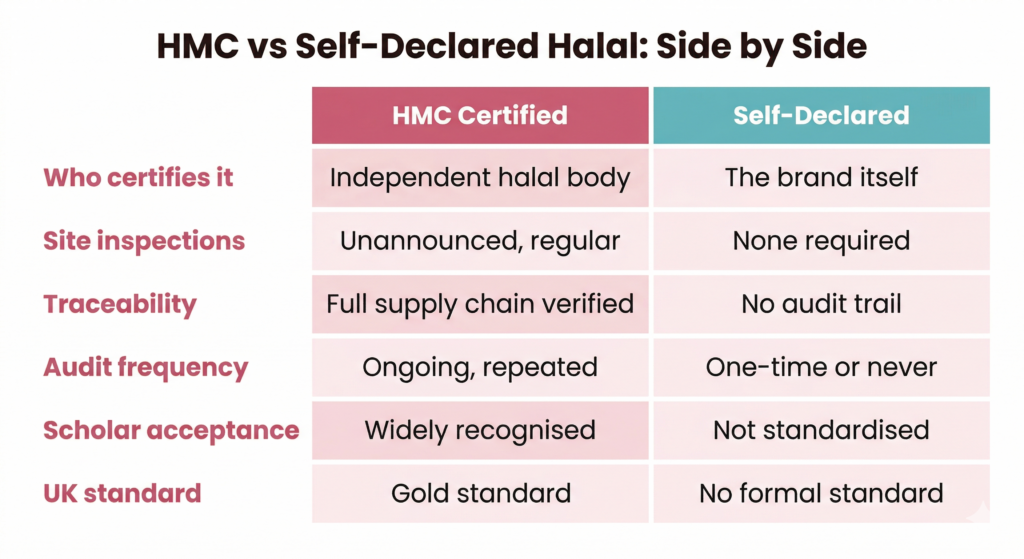
HMC, the Halal Monitoring Committee, is the most rigorous halal certification body operating in the UK. Unlike self-declaration, HMC certification requires regular unannounced site inspections, full traceability of every ingredient from source to finished product, and confirmation that no cross-contamination occurs at any stage of manufacturing. Scholars across the UK and internationally recognise HMC as the gold standard for halal verification.
For a Muslim cat owner, the distinction is not academic. A product that claims halal on its packaging without independent verification offers no auditable guarantee. HMC certification means a third party has physically inspected the facility, reviewed the supply chain, and confirmed compliance, repeatedly, not just at launch.
Hurayra is currently the only dry cat food in the UK to carry full HMC certification, a fact verified and covered by outlets including the Yorkshire Evening Post and Islam Channel. That is not a marketing claim. It is a traceable, checkable fact.
What to Look For in the Ingredients
Certification matters. So do the actual ingredients, and for cats, the nutritional requirements are more specific than most people realise.
Cats are obligate carnivores. Unlike dogs or humans, they cannot synthesise certain amino acids, including taurine and arginine, from plant matter. They must obtain them from animal protein. A cat fed a diet low in animal protein, or high in plant-based fillers, may appear healthy for a period and then show deficiency signs: dull coat, muscle loss, lethargy, and eventually more serious organ dysfunction. The signs of protein deficiency in cats are often gradual enough to miss until they become significant.
The first three ingredients on any cat food label tell you what the product is actually made of, because ingredients are listed by weight. If the first three include animal protein, chicken, tuna, salmon, the formula is protein-led. If they include “cereals,” “vegetable protein extracts,” or “meat and animal derivatives,” the product is using lower-cost fillers to pad out the nutritional profile.
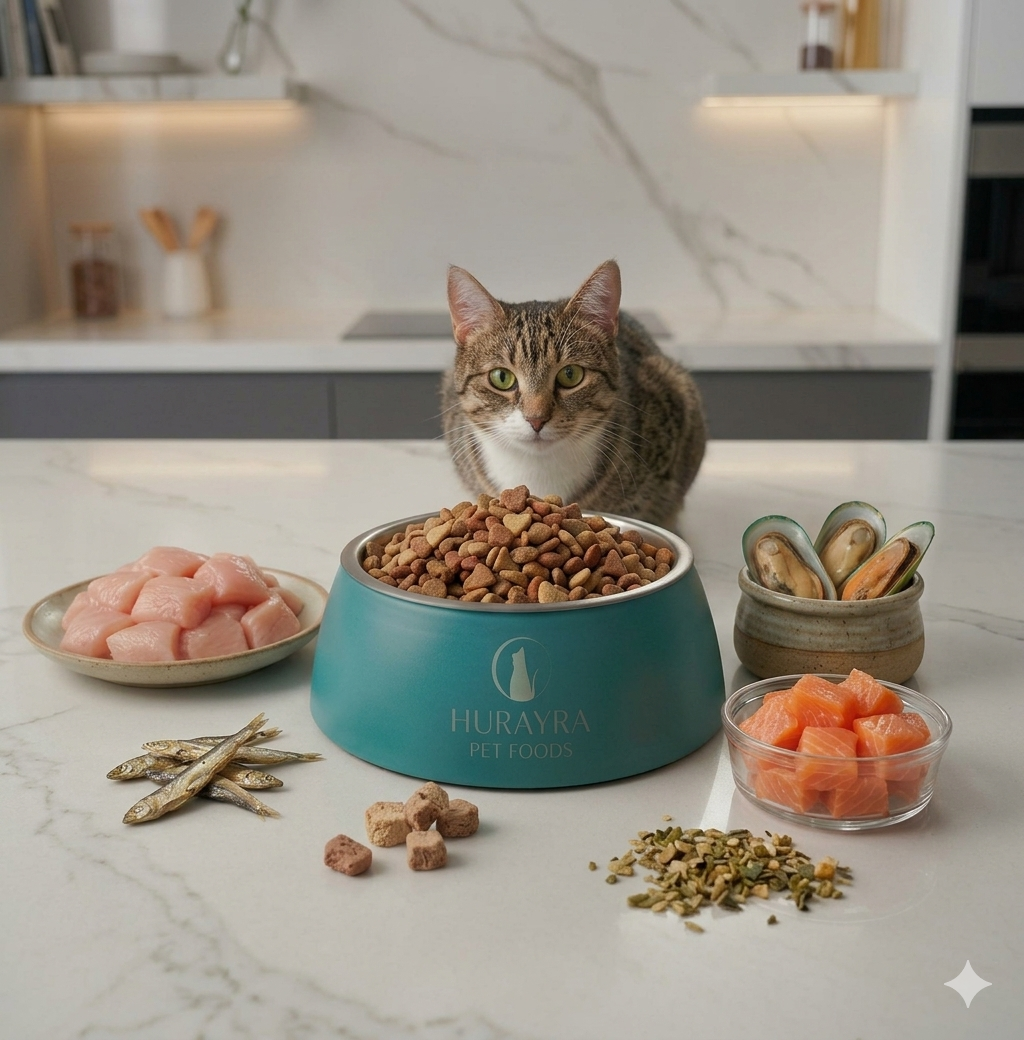
Hurayra’s formulas list protein, chicken or tuna, as the primary ingredient, with a 35% crude protein content. FEDIAF, the European body that sets nutritional standards for pet food, recommends a minimum of 25% protein on a dry matter basis for adult cats. 35% sits comfortably above that threshold and supports lean muscle maintenance across life stages, including from four months onwards. For a more detailed look at what sits behind those numbers, the full ingredient breakdown sets out each component and its function.
Chicken Cat Food
Subscribe & Save 25%
Grain-Free Halal Cat Food: Who It Serves and Who It Does Not
Grain-free has become a loaded term. Used carefully, it describes a formula that removes unnecessary carbohydrate fillers, wheat, corn, soy, that cats have no biological requirement for. Used carelessly, it becomes a marketing badge applied to products that simply swap one filler for another.
For cats with grain sensitivity or digestive issues, grain-free formulas often produce a clear improvement: firmer stools, less bloating, better coat condition. For cats without those sensitivities, the removal of grains matters less as long as the protein content is adequate and the carbohydrate load is not excessive.
Grain-free is not automatically the superior choice for every cat. The relevant question is whether a formula’s macronutrient profile matches what an individual cat’s body actually needs. A cat scoring between 6 and 9 on the body condition score scale, where 5 is ideal, would benefit from a lower-carbohydrate, higher-protein formula. A cat already at ideal body condition simply needs consistency and nutritional completeness.
What grain-free formulas do offer is the absence of common allergens and fillers that have no functional role in feline nutrition. Wheat and soy are common allergy triggers in cats and contribute to caloric density without proportionate nutritional value. Removing them is a sound decision for most cats. It should not, however, be framed as a health cure or a universal upgrade. If you want to understand what actually replaces grains in these formulas and why it matters, this breakdown of grain-free cat food ingredients covers the alternatives and their roles in feline digestion.
Halal Cat Food in the UK in 2026: What Has Changed
When Hurayra launched in 2024, the category of certified halal cat food in the UK was effectively empty. Products existed that were described as permissible or natural, but none carried third-party HMC verification or had achieved mainstream retail presence.
Two years on, the market has not expanded significantly in terms of certified options, but awareness has. The UK’s Muslim population includes an estimated 800,000 cat owners, a figure the pet food industry had largely ignored. Hurayra’s appearance in Morrisons stores alongside its online subscription model changed the accessibility picture considerably, making certified halal cat food available without a specialist order or extended delivery window.
The Trustpilot reviews reflect a consistent pattern. Owners who switched cite coat improvement, better digestion, and cats eating with noticeably more interest. Those outcomes are attributable to the nutritional profile as much as the certification, which is the point. The two things work together.
The full story behind how Hurayra’s recipes were developed, including the founder’s process of visiting 82 manufacturers before settling on the current supply chain, is worth reading for anyone interested in how a certified product actually comes to exist.
What Good Halal Cat Food Looks Like in Practice
Strip away the language and the certification marks, and the practical standard is consistent: named animal protein in the first three ingredients, a protein percentage above FEDIAF’s minimum recommendation, no unnamed meat derivatives, and third-party verification of the halal claim, not just a label on the packaging.
For Muslim households, HMC certification is the clearest marker of genuine compliance available in the UK today. For non-Muslim owners who simply want a traceable, ingredient-transparent product with a strong nutritional profile, those same markers apply. The certification process that makes a product halal, full supply chain traceability, absence of undisclosed by-products, regular third-party audits, produces exactly the kind of ingredient accountability that any conscientious owner would want regardless of faith.
In 2026, the gap in the UK halal pet food market remains wide. One certified option exists at retail scale. If you are comparing options or considering switching, the current product range is a reasonable starting point, and the subscription model offers a 25% saving alongside the dietary consistency that cats benefit from nutritionally.
Tuna and Chicken Combo
Subscribe & Save 25%
Frequently Asked Questions
1 Is halal cat food automatically healthier than conventional cat food?
No. Halal certification governs sourcing, slaughter method, and production standards. It does not guarantee nutritional superiority on its own. A halal-certified product could still be low in protein or high in fillers. The two questions, whether it is halal and whether it is nutritionally sound, are separate and both worth asking.
2 Does grain-free cat food suit every cat?
Not necessarily. Cats with no digestive sensitivities may not experience a dramatic difference switching from a high-quality conventional formula to a grain-free one. That said, removing non-essential fillers is generally a neutral-to-positive change, and most cats adapt well.
3 Can dry halal cat food be mixed with wet food?
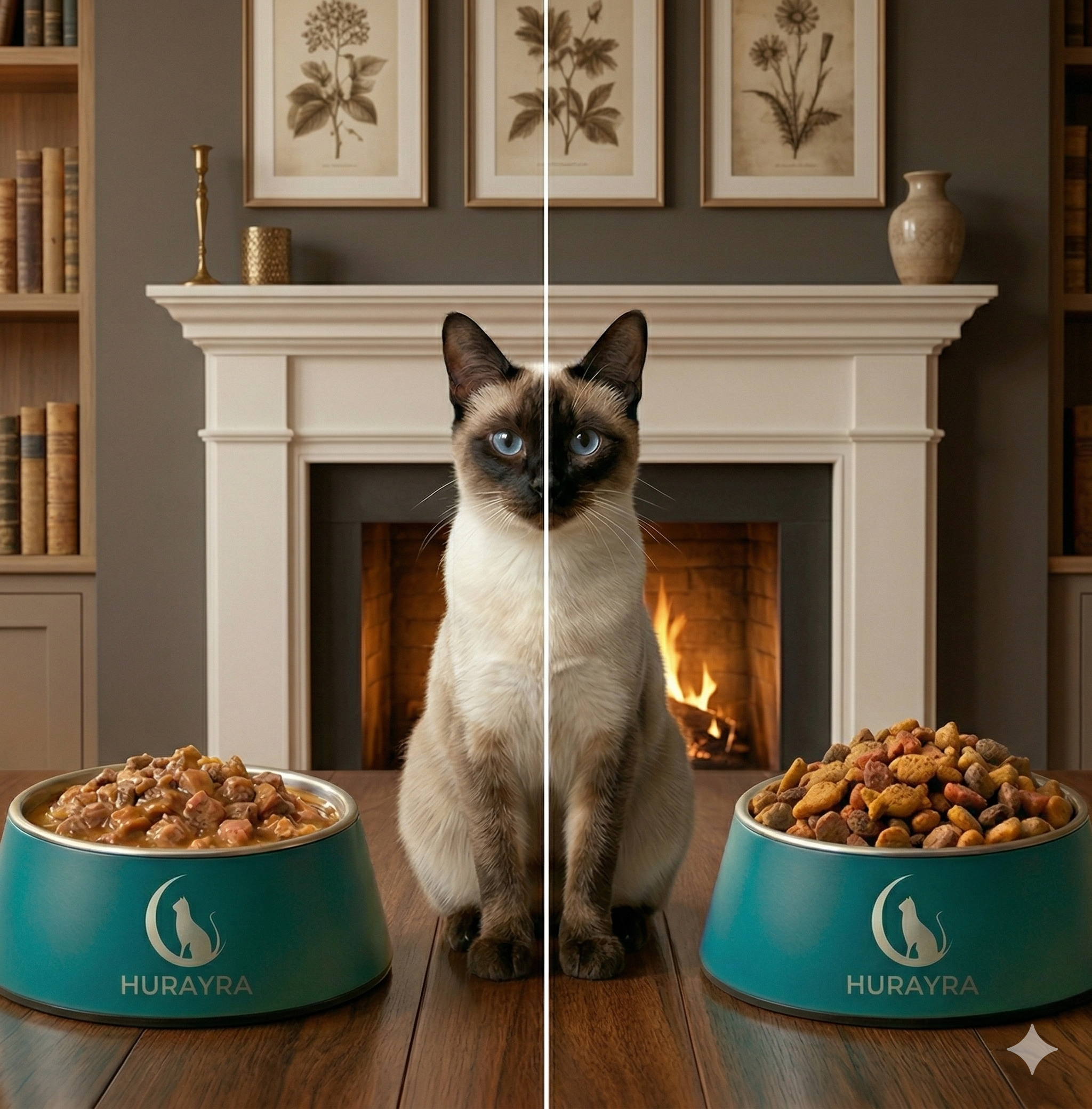
Yes. Many owners combine dry and wet food to increase moisture intake, particularly for cats who are reluctant drinkers. The key is maintaining nutritional balance rather than doubling protein beyond what the cat can process. If you are transitioning from a previous brand, a gradual 7 to 10 day switch helps avoid digestive disruption.
4 Is certified halal cat food significantly more expensive?
Premium, HMC-certified cat food does carry a higher price point than budget alternatives. The relevant comparison is value per feeding rather than price per bag. Hurayra’s chicken and tuna formulas are available from £19.80 per pack on subscription, which for a single cat represents roughly one box every two weeks, a feeding cost comparable to mid-range conventional brands at retail.
Recent Post
Subscribe & Save 25% Every Month
Never run out of your pet’s favourite dry cat food again. Enjoy scheduled deliveries right to your door & save 25% on every order. A win for you and your furry friend!
More Articles
- uzma
- /
- 07/04/2026
- uzma
- /
- 06/04/2026
- uzma
- /
- 06/04/2026
- uzma
- /
- 03/04/2026
- uzma
- /
- 02/04/2026
- uzma
- /
- 01/04/2026