
- Cat Health & Wellness, Pet health, Pet Nutrition
Chicken Cat Food: Why It’s the Best Protein for Your Cat
- Saniya Ahmed
Table of Contents
Cats are not small dogs. They are not flexible omnivores who can adapt to whatever protein happens to be cheapest that week. They are obligate carnivores: animals whose entire metabolic machinery is built around animal protein, and specifically around the amino acids that only meat provides in meaningful quantities.
Understanding that changes how you read a cat food label. And chicken, done properly, is where that understanding tends to land.
This article covers why chicken is so well-suited to feline nutrition, what separates genuine chicken cat food from chicken-flavoured products, how to read the ingredients that matter, and what the best options in the UK market actually look like.
Why Do Cats Need Real Animal Protein?
Cats cannot synthesise taurine. They cannot convert beta-carotene into vitamin A. They cannot make enough arachidonic acid from plant precursors to meet their needs. These are not opinions: they are documented physiological constraints that have shaped feline nutrition science for decades.
What this means practically: a cat food’s protein source is not decorative. It determines whether the amino acid profile actually works for a cat’s biology or whether the food is patching gaps with synthetic supplements throughout.
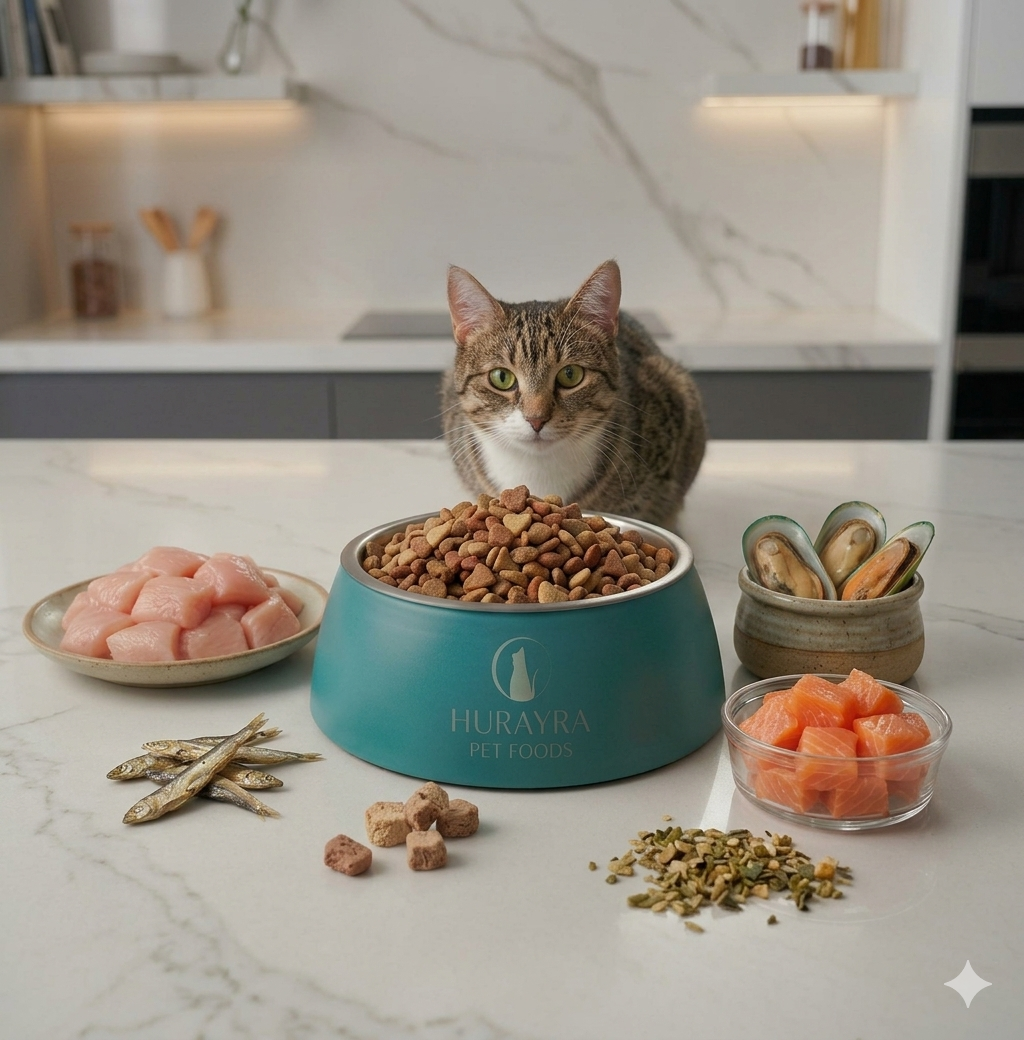
Chicken is particularly well-matched to feline requirements. It delivers a complete amino acid profile including taurine, methionine, and arginine: all essential for cats. It is highly digestible, with digestibility coefficients typically above 85%, meaning more of what goes in is actually absorbed. And it is one of the most palatable proteins for domestic cats across both wet and dry formats.
The argument for chicken is not that it is the only suitable protein. Salmon, turkey, duck, and lamb all have roles. The argument is that chicken’s profile makes it one of the most reliable foundations for a complete feline diet.
Why Does Chicken Work So Well for Cats?
This is where most buying decisions go wrong.
Under UK pet food labelling rules, a product labelled “chicken cat food” or “with chicken” can legally contain as little as 4% chicken. A product described as “chicken flavour” may contain no actual chicken whatsoever: only an additive that replicates the taste.
The term “rich in chicken” requires at least 14%. “With high chicken content” typically signals 26% or more, though this is not a regulated phrase. Only when chicken appears as the first named ingredient in the composition list, ahead of all others, can you reasonably assume it is the primary protein source.
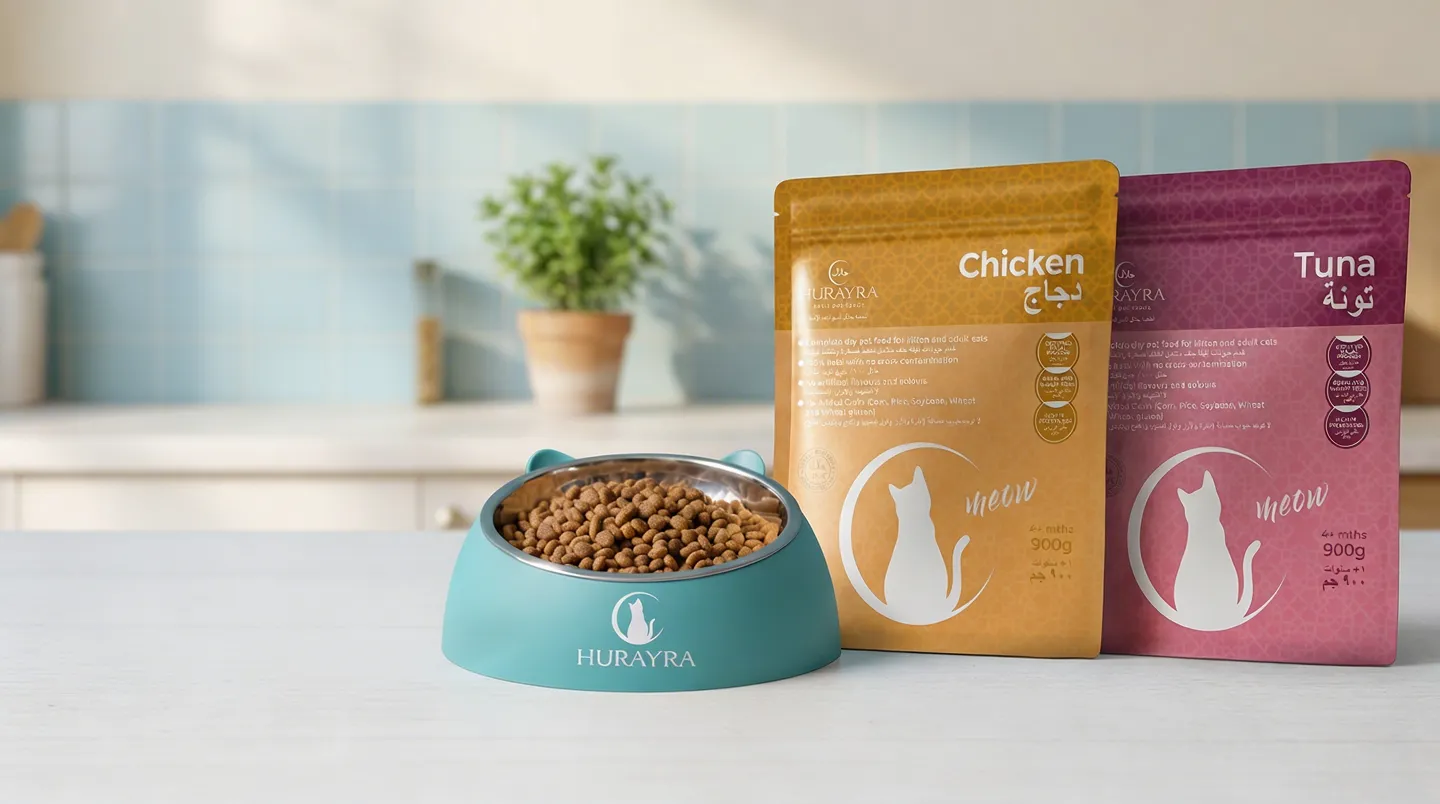
Hurayra as a brand sits within this transparency standard, single-source chicken protein with HMC certification, meaning the sourcing chain for every ingredient is traceable and independently verified. The HMC (Halal Monitoring Committee) standard is not simply a religious designation; it is an audit trail.
Chicken Cat Food
Pack of 2
It requires that every stage of the supply chain (farm, abattoir, processing) meets documented standards. For cat owners who want to know exactly what is in the bag, that audit trail has real value regardless of their background.
Difference Between Dry vs Wet Chicken Cat Food
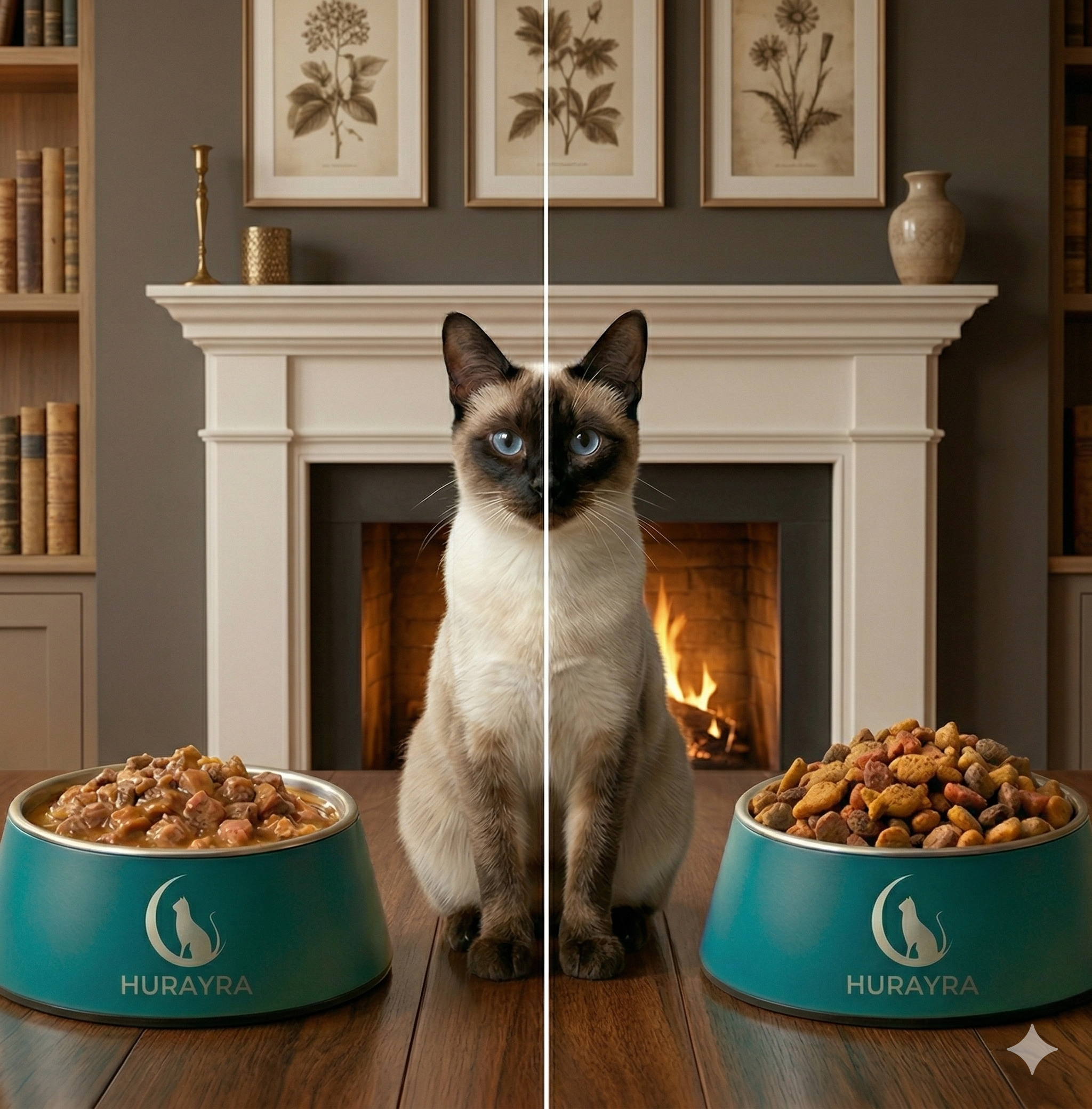
Dry chicken cat food is convenient, cost-effective, and dentally beneficial for some cats. Wet chicken cat food better supports hydration: which matters because cats evolved in arid environments and have a low thirst drive relative to their fluid needs.
It is important to clear one thing up early. Catnip is not a drug, a chemical, or an artificial stimulant designed to trigger a reaction. When people watch cats on catnip, the response can look intense, but it comes from a plant interacting with a cat’s natural senses, not from anything being forced into their system.
In everyday pet care, catnip is used as a gentle enrichment tool, the same way you might rotate toys or add a scratching post, and that is why it has a long track record of safe use with cats when it is clean and responsibly offered.
Does Catnip Intoxicate Cats?
So far it is established that catnip does not function like an intoxicant, yet the question still lingers because of how it looks at the moment. The instant burst of hyperactivity can feel exaggerated, especially when compared to how calm a cat usually is. That contrast is what often keeps the doubt alive.
Veterinary research supports this distinction clearly. It states catnip creates temporary stimulation, not intoxication, and the body returns to baseline on its own within minutes. In Islamic terms, this difference matters, because harm, impairment, and loss of control are what raise concern, not short lived sensory engagement that leaves no trace behind.
Is Catnip Bad For a Cat? An Islamic Perspective
From an Islamic lens, animal care is built on principles that are simple but powerful: mercy, avoiding harm, and responsibility (amanah). In other words, to answer ‘can cats eat catnip’, as long as it supports your cat’s wellbeing, does not risk it, catnip is safe for cats.
It fits comfortably within halal principles when it is natural, non toxic, and used in moderation. The plant is a form of enrichment that can encourage play, reduce boredom, and give indoor cats a healthy outlet, which is a kind thing to offer when done responsibly.
Where cat owners should be thoughtful is overuse, poor quality products, or treating catnip like a daily must-have. Too much can cause mild stomach upset in some cats, and low-grade blends may include fillers you do not want your cat ingesting.
A cat eating only dry food typically consumes 50–70ml of water per day from drinking. The same cat eating wet food passively takes in 150–200ml through the food itself. For cats prone to urinary tract issues, kidney stress, or constipation, that difference is clinically meaningful.
This is not an argument to abandon dry food. Many UK cat owners use both: a dry food as a free-fed base, wet food added once or twice daily. When both formats use named chicken as the primary protein, this approach supports both the cat’s hydration and the owner’s budget without sacrificing nutritional integrity.
For dry chicken cat food specifically, the protein percentage matters more than in wet format because dry food is more concentrated. FEDIAF (the European Pet Food Industry Federation) guidelines recommend adult cats receive a minimum crude protein of around 25% dry matter.
Quality dry chicken cat food from premium brands typically delivers 30–40% protein on a dry matter basis. Products at the lower end of this range, or below it, are worth scrutinising: particularly if plant proteins are listed high in the composition.
How to Spot Real Chicken and Not Fillers in Cat Food?
Grain-free has become a default premium signal in UK pet food, and the logic behind it deserves honest examination.
Cats do not have the same digestive capacity for starch as dogs or humans. Their salivary amylase is negligible. Pancreatic amylase output is lower. This means grains are not inherently problematic, but they are not the most efficient energy substrate for a cat’s system. Some cats digest them well; others show sensitivities, particularly to wheat gluten, that manifest as loose stools, skin irritation, or chronic vomiting.
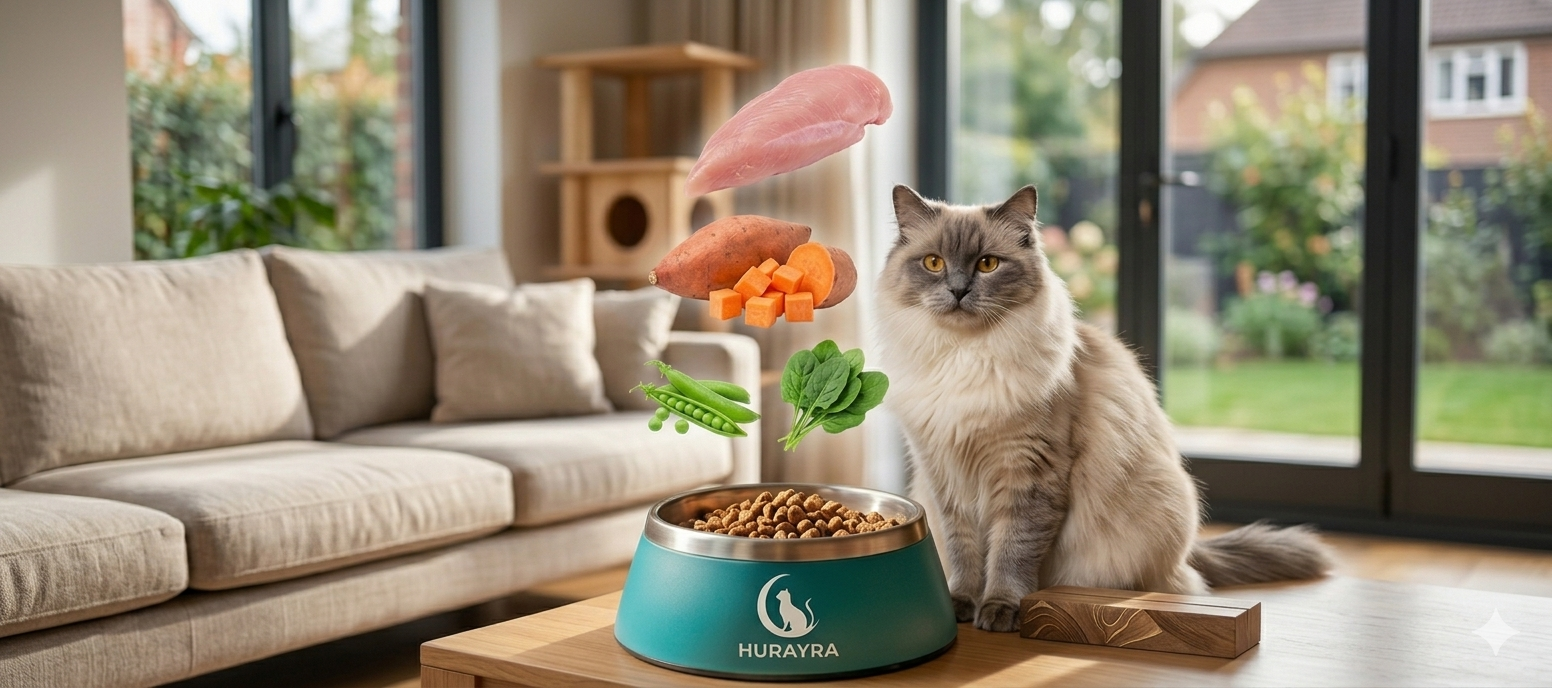
Grain-free formulations in cat food replace cereal starches with alternatives such as sweet potato, peas, or lentils. This is neither universally better nor inherently superior: it is a question of individual suitability.
For cats with diagnosed grain sensitivity or owners who prefer a diet that more closely mirrors feline evolutionary biology, grain-free chicken cat food is a sensible choice. And for cats with no observed sensitivities and no history of digestive issues, grains are not a reason to change a food that is otherwise working.
The more meaningful question is not whether a food is grain-free. It is whether the first ingredient is a named animal protein.
Hurayra’s grain-free formulation is designed with this in mind: the absence of grains is not a marketing decision; it reflects a choice to put named chicken protein at the centre of the diet without cereal dilution. Whether that is the right choice for your cat depends on your cat, not on a trend.
What to Notice in a Cat Food Label?
You do not need to spend fifteen minutes on every product you consider. Three checks cover most of the relevant ground.
#1 What is the first ingredient?
It should be a named protein: chicken, chicken meal, chicken breast. Not “poultry,” not “meat and animal derivatives.” The name is traceable. Generic is not.
#2 What is the declared protein percentage?
On a wet food, 8–14% crude protein in the as-fed analysis is roughly equivalent to 50–70% in dry matter terms. On dry food, look for 30% or above. Numbers below these thresholds warrant closer reading.
#3 Is the ingredient list ordered by weight before or after cooking?
Most UK brands list by weight as-fed, meaning fresh chicken (which is mostly water) may appear first but reduce significantly during processing. Brands that declare the percentage of meat used, or who publish dry matter analysis, are giving you better information.
Where to Buy Quality Chicken Cat Food in the UK?
The UK premium market has clarified what it expects from quality chicken cat food: named protein first, declared percentages, minimal synthetic supplementation, and no reliance on vague ingredient categories.
Hurayra is available through Morrisons, which matters for a practical reason. Retail presence in a major UK supermarket means the product has passed category buyer scrutiny, consistent supply chain validation, and shelf-facing audit. It is not a direct-to-consumer-only product operating outside mainstream food retail standards.
Subscription availability adds a further dimension: feeding consistency matters for cats, which have conservative digestive systems that respond poorly to frequent diet changes. A subscription removes the logistical risk of running out and rotating to whatever happens to be in stock.
The case for chicken cat food is, at its core, straightforward. Cats need animal protein. Chicken provides it efficiently. The best formulations declare what they contain, source it transparently, and deliver it in formats the cat will actually eat consistently.
If your cat is thriving on their current food, check the label to understand why. If they are not, the first place to look is what comes first in the ingredient list.
Explore Hurayra’s chicken cat food range, available in Morrisons stores and online with subscription options for consistent, reliable feeding.
Frequently Asked Questions
1 Is chicken the best protein for all cats?
It is well-suited to most cats because of its digestibility and amino acid profile. Cats with specific sensitivities, typically to chicken protein itself (which is rarer than owners assume), may do better on novel proteins like duck or salmon. If a cat is doing well on chicken, there is no reason to change.
2 Can I mix chicken dry and wet food?
Yes. This is a common and sensible approach. The dry food supports dental health and provides a convenient free-fed option; the wet food boosts hydration and palatability. Both should use named chicken as the primary protein for consistency.
3 What does HMC certification mean for my cat's food?
HMC certification means every stage of the supply chain, from farm to processing, has been independently audited and verified. For cat owners of any background, this is a traceability standard. It tells you the sourcing chain has been checked, not simply declared.
4 Is grain-free chicken cat food better for my cat?
It depends on your cat. Grain-free is not inherently superior: it is a suitability consideration. Cats with wheat sensitivity or digestive issues often improve on grain-free diets. Cats without those issues do not necessarily benefit from the switch.
5 What protein percentage should I look for in dry chicken cat food?
A minimum of 30% crude protein on a dry matter basis is a reasonable benchmark for a quality adult dry food. Many premium UK brands target 35–40%. This aligns with FEDIAF guidelines and reflects a diet where animal protein, not plant filler, is doing the nutritional work.
6 Why does chicken flavour cat food not count as real chicken cat food?
Under UK labelling rules, “chicken flavour” can mean no actual chicken is present: only flavouring. The taste may be similar; the nutritional contribution is not. If named chicken protein is the reason you are buying the food, “chicken flavour” on the label is not what you are looking for.
Recent Post
Subscribe & Save 25% Every Month
Never run out of your pet’s favourite dry cat food again. Enjoy scheduled deliveries right to your door & save 25% on every order. A win for you and your furry friend!
More Articles
- uzma
- /
- 03/04/2026
- uzma
- /
- 02/04/2026
- uzma
- /
- 01/04/2026
- uzma
- /
- 31/03/2026
- uzma
- /
- 30/03/2026
- uzma
- /
- 29/03/2026