Written by Saniya Ahmed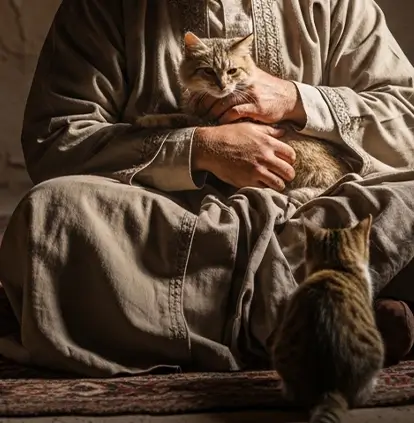
TL;DR
Abu Hurayrah was named “Father of the Kitten” because of his love for a small cat, and his narrations helped establish the Islamic tradition of mercy and responsibility toward animals. That same legacy inspired Hurayra Pet Foods, founded by Ahtisham Rashid, to create the UK’s first 100% HMC-certified halal cat food — built on traceable sourcing, high protein, grain-free recipes, and genuine care. The name Hurayra is not symbolic; it reflects a tradition where feeding your cat responsibly is part of living that mercy today.
Abu Hurayrah’s Story: A Sahabi Known for His Love of Cats
Did you know one of the most beloved figures in Islamic history was named after a kitten he cared for? Long before modern animal welfare movements, compassion toward animals was deeply embedded in faith traditions. Abu Hurayrah, a companion of the Prophet Muhammad (PBUH), earned his name for the small cat he carried in his sleeve. Hurayra, the Arabic word meaning “small cat” or “kitten,” is where Hurayra Pet Foods draws its name from.
Founder Ahtisham Rashid built the UK’s first HMC-certified halal cat food around this heritage: the idea that caring for animals is not a trend, but a timeless responsibility. This is the story behind that name, and why it still matters to every cat owner today.
Who Abu Hurayrah Was Before He Got His Name
Abd al-Rahman ibn Sakhr al-Dawsi came from Yemen, accepted Islam around 7 AH, and travelled to Medina with one intention: to stay close to the Prophet (PBUH). He slept in the mosque, went hungry, and chose proximity over comfort.
Before his conversion, as a young man in Yemen, he kept a small female kitten. He carried her in the sleeve of his robe during the day, set her down when he rested, and picked her up again when he moved on. When the Prophet (PBUH) noticed this, he began calling him Abu Hurayrah: Father of the Kitten. In a society where names carried genealogy and tribal weight, being remembered by your relationship with a cat was affectionate recognition from the most important person in that community.
Abu Hurayrah narrated over 5,000 hadiths. Sahih al-Bukhari and Sahih Muslim contain hundreds of his narrations. While other companions returned to businesses and families, he stayed. Imam al-Shafi’i called him the most careful preserver of hadith of his generation.
Why Are Cats Special in Islam?
The hadith on cats most cited in Islamic jurisprudence comes from Abu Hurayrah’s narrations. Recorded in Sunan Abu Dawud and Sunan al-Nasa’i, it describes the Prophet (PBUH) performing wudu with water a cat had already drunk from, and explaining that cats are tahir, ritually clean. This was not a minor ruling. It settled a practical question for Muslim households and placed cats in a distinct legal category that holds in Islamic law to this day.
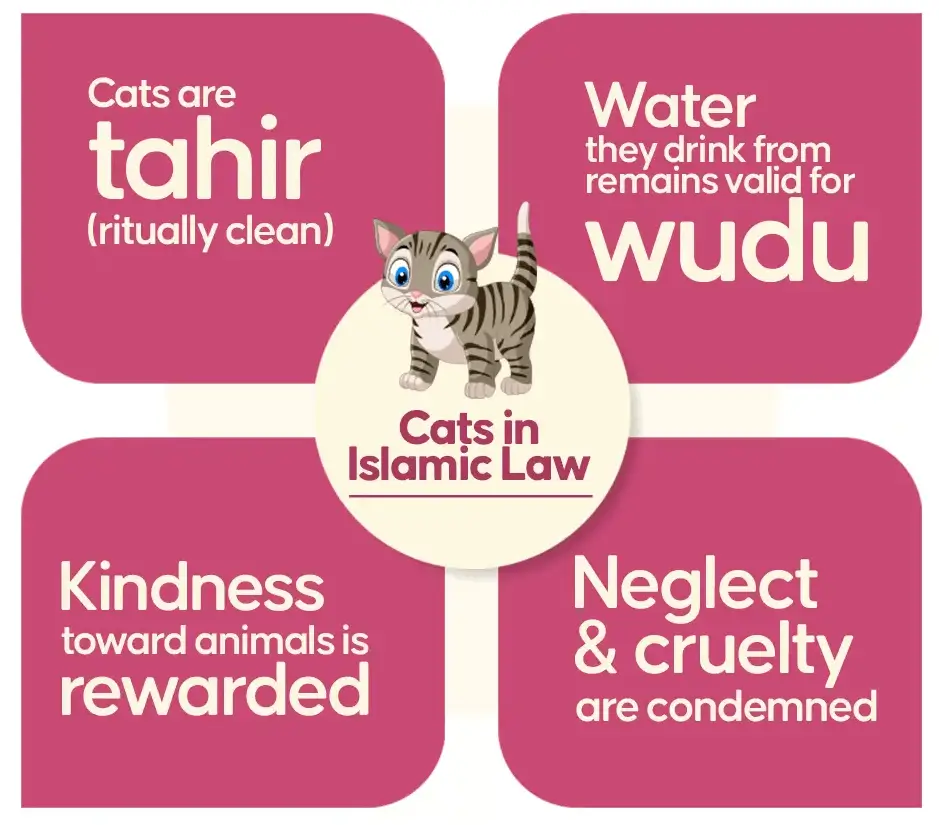
There is a separate account, narrated across several sources, of the Prophet (PBUH) cutting the sleeve from his garment rather than disturbing a cat sleeping on it. Scholars differ on the grading of this particular narration. What matters is that the pattern it describes is consistent with authenticated accounts of how the Prophet (PBUH) treated animals.
What Islamic Teaching Actually Says About Animals
Long before modern animal welfare movements emerged, Islamic tradition established clear principles about the treatment of animals. These were not abstract ideals. They were practical teachings transmitted through the companions of the Prophet (PBUH) and recorded in the earliest Islamic texts.
A woman was condemned in a hadith found in both Sahih al-Bukhari and Sahih Muslim for locking a cat in her home until it died of starvation. She neither fed it nor released it to find food for itself. A man who gave water to a thirsty dog was told his sins had been forgiven. The principle in both cases is stated without ambiguity: there is accountability in how we treat living creatures.
The Arabic word used across many of these narrations is rahma (mercy or compassion). Islamic scholars have consistently interpreted these accounts as a framework that extends to all animals, not just those kept as companions. This is not a modern reinterpretation. It has been embedded in Islamic law and practice since the seventh century.
Is Cat Food Required to Be Halal?
Scholars differ on this. Some argue that halal dietary laws apply only to human consumption. Others hold that if you are responsible for what an animal eats, ethical sourcing is part of that responsibility.
What is not debated: the obligation to feed animals properly. A hadith in Sahih al-Bukhari records the Prophet (PBUH) saying a person who keeps an animal must provide for it adequately. That includes food that supports its health and wellbeing, not just the minimum to keep it alive.
For many Muslim cat owners, halal certification is about transparency. It requires traceability, ethical sourcing, and ingredient verification at every stage of production. For a cat owner asking what is actually in the food they are buying, halal certification provides a clear answer.
How Hurayra Reflects This Legacy Today
The tradition of caring for cats with intention and responsibility did not end in the seventh century. It lives in the choices cat owners make every day, including what goes into their cat’s bowl.
When Ahtisham Rashid founded Hurayra Pet Foods in 2023, he was asking a simple question: why was there no cat food that delivered both ethical sourcing and genuine nutrition? He found products that claimed to be halal but lacked the nutrients cats need to thrive. He found high-protein recipes with no transparency about where the meat actually came from. So he built something that answered both.
How Hurayra delivers on this principle:
Single-source protein, not mixed meat derivatives.
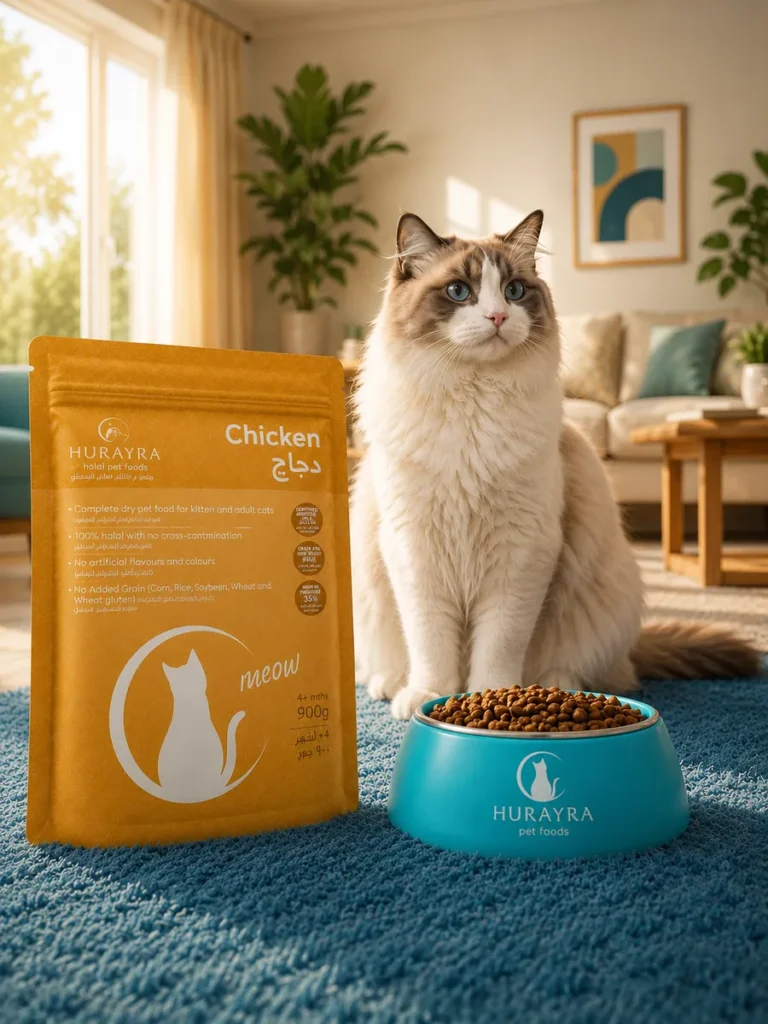
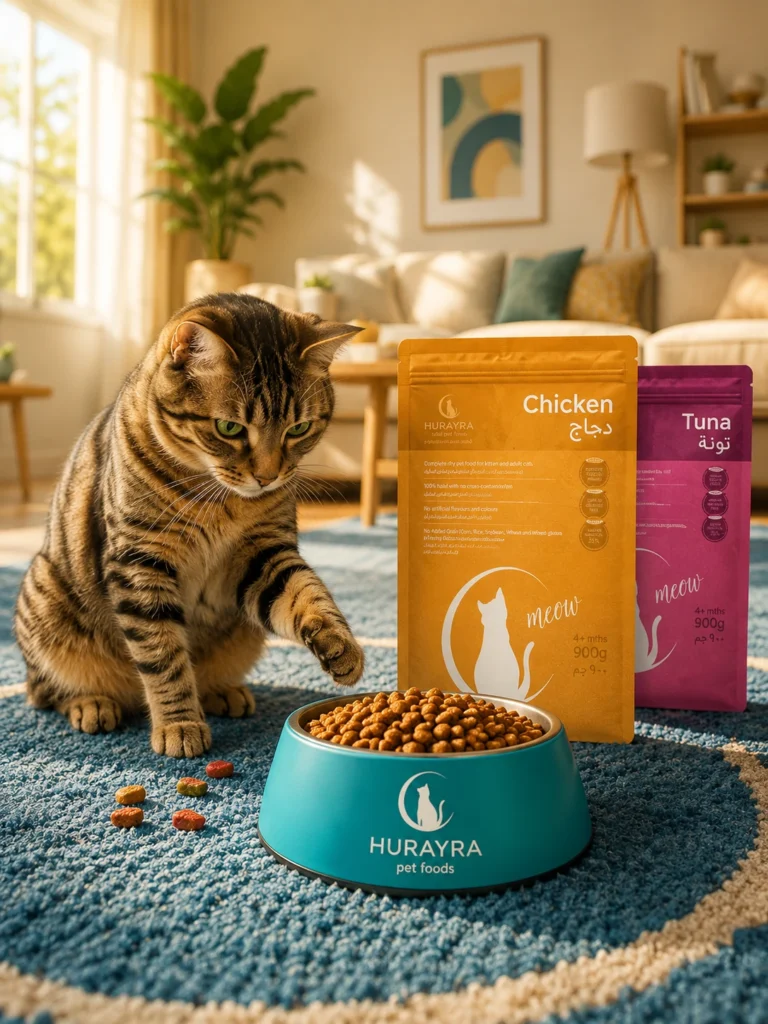
The recipes are grain-free and built around a cat’s biological needs: 35% protein, Omega 3-6-9 for coat and joint health, and vitamins A, D, and E for immunity. Every ingredient is traceable. Every batch is HMC-certified. The formulation is designed by nutritionists, not marketing teams.
Premium formulation at accessible pricing.
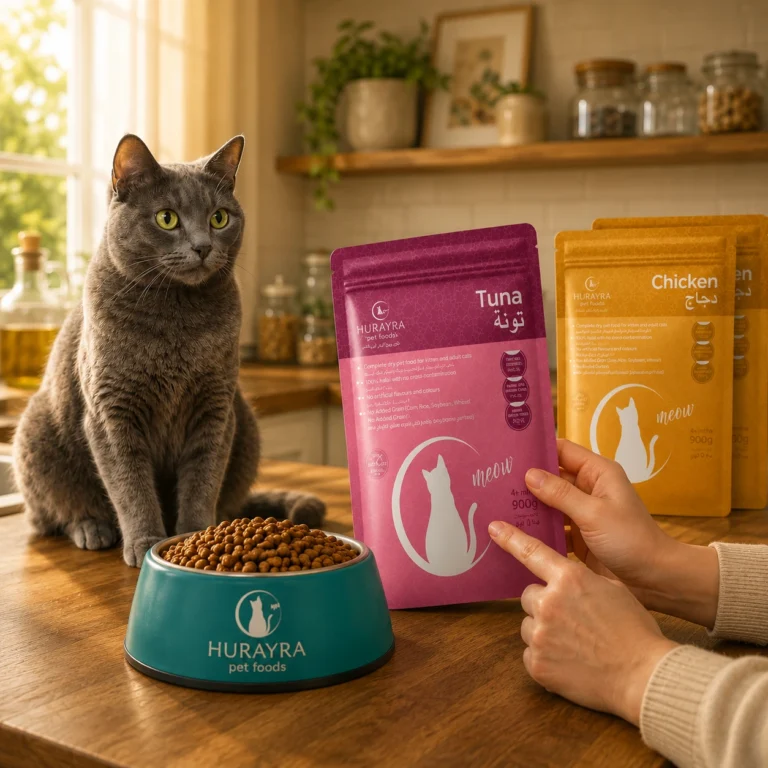
The standard should not be reserved for people who can afford to spend twice as much. Hurayra is stocked at Morrisons, available on Amazon UK, and delivered nationwide on subscription. It is the UK’s only 100% halal-certified dry cat food, built for cat owners who want to know exactly what they are feeding.
If you have been buying cat food without being sure what is in it, or how it was made, or whether it actually meets your cat’s nutritional needs, Hurayra is worth looking at. Not because it is the only option, but because it is the only one built around the kind of care this entire article has been describing.
Honor this tradition with Hurayra.
Hadiths cited in this article are drawn from Sahih al-Bukhari, Sahih Muslim, Sunan Abu Dawud, and Sunan al-Nasa’i. Scholars differ on the grading of individual narrations. Readers are encouraged to consult their own sources.
Frequently Asked Questions
1 Did Abu Huraira love cats?
Yes, Abu Hurayrah was known for caring for a small kitten he carried in his sleeve, and the Prophet ﷺ affectionately named him for it.
2 Which Sahaba loves cats?
Abu Hurayrah is the companion most famously associated with love and kindness toward cats in early Islamic history.
3 How many cats did Abu Huraira have?
Reports specifically mention one small female kitten; there is no authentic record stating he owned multiple cats.
4 Which Sahabi was the father of cats?
Abu Hurayrah, his name literally means “Father of the Kitten,” given to him by the Prophet ﷺ.
5 Why do Muslims love cats so much?
Because authentic hadith describe cats as ritually clean and emphasise mercy toward animals, shaping a long-standing tradition of compassion in Muslim households.
Yes, Abu Hurayrah was known for caring for a small kitten he carried in his sleeve, and the Prophet ﷺ affectionately named him for it.
Abu Hurayrah is the companion most famously associated with love and kindness toward cats in early Islamic history.
Reports specifically mention one small female kitten; there is no authentic record stating he owned multiple cats.
Abu Hurayrah, his name literally means “Father of the Kitten,” given to him by the Prophet ﷺ.
Because authentic hadith describe cats as ritually clean and emphasise mercy toward animals, shaping a long-standing tradition of compassion in Muslim households.