
- Cat Care, Pet Nutrition
Top 10 Myths About Cat Food Every Owner Should Know
- Saniya Ahmed
Table of Contents
TL;DR
Most cat food advice is noisy and often wrong. Adult cats don’t need milk, don’t require grain-free food by default, and need more moisture than dry-only diets provide. Named protein should lead any ingredient list, taurine should be present, and “complete” labelling matters. Price doesn’t guarantee quality, transparent sourcing and honest labelling do. Read the label, ignore the marketing, and you’ll feed your cat well.
Most cat owners are doing their best. The problem isn’t effort, it’s the noise. Pet food marketing, conflicting social media advice, and well-meaning recommendations from other owners have made cat nutrition genuinely confusing. And when you believe the wrong things, even the most caring owner can end up feeding their cat worse than they intend.
Here’s a clear-headed look at the most common cat food facts vs myths and what actually matters when you’re choosing what to feed.
Myth 1: Cats Need Milk
People believe this because of decades of imagery, the saucer of milk, the grateful cat. It feels natural. But adult cats mostly lack lactase, the enzyme needed to digest dairy. Cow’s milk commonly causes stomach upset and loose stools. What cats actually need is water, and many don’t drink enough of it. Wet food does far more for hydration than milk ever could.
When choosing food, hydration support matters more than tradition.
Myth 2: Grain-Free Food Is Always Better
This is one of the cat nutrition myths that sounds convincing. Cats are obligate carnivores with no biological need for grains, true. But grain-free doesn’t automatically mean better. Some grain-free products replace grains with starchy fillers like peas or potatoes that add calories without much nutrition. The label on the front matters far less than the ingredient list on the back.
Grain-free is only an advantage if quality protein leads the formula.
Myth 3: Dry Food Alone Is Enough
Convenience makes dry food appealing, and that’s fair. But the dry vs wet cat food question has a real answer: cats evolved to get most of their moisture from prey. A dry-only diet contributes to chronic low-level dehydration, which over time can stress the kidneys and urinary tract, particularly in male cats. Wet food, either as the main diet or alongside dry, much better reflects what cats’ bodies need.
Cats have a naturally low thirst drive. A diet with enough moisture is one of the simplest things you can do for their long-term kidney health.
If dry food is unavoidable, pairing it with wet food makes a meaningful difference.
Myth 4: Meat By-Products Are Bad
The word “by-products” sounds like scraps. That’s the marketing problem. In practice, the liver, heart, and kidney are classed as by-products and they’re some of the most nutrient-dense parts of an animal, richer in taurine and B vitamins than muscle meat alone. The real issue is vague labelling: “animal derivatives” from unnamed sources tells you nothing. Named, single-species by-products from a traceable source are a different matter.
Named ingredients and transparent sourcing are what matter, not avoiding by-products wholesale.
Myth 5: Human Food Is Safe For Cats
Some human food is fine occasionally. Most aren’t designed for cats, and some are genuinely dangerous like onions, garlic, grapes, and certain artificial sweeteners can cause serious harm. Beyond toxicity, the human food for cats myth ignores the nutritional side: human food isn’t complete for cats, and feeding it regularly tends to create imbalances or fussy eaters.
Single-ingredient meat treats are a safer, simpler way to give your cat something extra.
Myth 6: Expensive Food Is Always Better
Price can signal quality. It doesn’t guarantee it. Some premium-priced products carry impressive branding and middling ingredients. Some mid-range options have genuinely clean formulations. Cost is a rough guide, not a reliable one. The honest approach: read the label. Does named animal protein appear first? Is taurine listed? Are the sources clear? That tells you more than the price tag.
Why So Many Cat Food Myths Still Exist
Pet food marketing is designed to sell, not educate. Words like “natural,” “premium,” and “wholesome” have no regulated definition in the UK. Social media spreads confident-sounding advice that often has no basis in evidence. And the assumption that expensive equals better is everywhere. Emotionally, we want to give cats something that feels like love, which is why milk and fish feel right even when they’re not ideal.
None of this makes cat owners foolish. It makes the industry harder to navigate than it should be.
Myth 7: Cats Need Variety In Their Diet
This one usually comes from projecting human preferences onto cats. In practice, cats don’t need variety and many do worse with it. Sudden food changes cause digestive upset, and cats offered lots of different foods often become fussy, refusing anything that isn’t exactly what they’re used to. What cats need is a complete, consistent diet. If you change food, do it slowly over 7–10 days.
Consistency serves cats better than rotation.
Myth 8: Wet Food Is Bad For Teeth
The logic is that dry food crunches and cleans. Most cats barely chew the kibble they crack and swallow. There’s no meaningful abrasive benefit. Dental health in cats is largely genetic, and is much better addressed through regular vet check-ups, appropriate dental chews, or tooth brushing than through food texture. Wet food has no proven negative effect on dental health.
If dental health is a concern, speak to your vet about dental chews or brushing, not food texture. Wet food is not the problem.
Myth 9: Preservatives In Cat Food Are Harmful
Not all preservatives are the same. Artificial preservatives like BHA and BHT have raised questions in some research, and it’s reasonable to avoid them. Natural preservatives like mixed tocopherols (a form of vitamin E) and rosemary extract are widely used in quality foods and considered safe. The real test is whether a brand is transparent about what it uses.
Clear labelling on preservatives is a basic marker of an honest brand.
Myth 10: Cats Should Eat Only Fish
Fish is so associated with cats that many owners assume it’s their natural diet. It isn’t. Wildcats don’t fish. Fish-heavy diets can cause taurine deficiency, vitamin E depletion, and mercury accumulation over time. Fish as an occasional protein is fine. As the sole diet, it’s not complete. Cats thrive on meat-based protein from a named, single animal source.
Choosing Food Without Second Guessing
If you’ve read this far and feel slightly overwhelmed, that’s reasonable. There’s a lot to consider. But it does simplify down to a few things: named protein first, taurine present, complete labelling (not just complementary), and a brand that’s honest about sourcing.
Hurayra was built around exactly that; grain-free, single-source protein, halal and ethically sourced, with no unnecessary additives. No fear-based marketing, no vague claims. Just straightforward nutrition cats do well on.
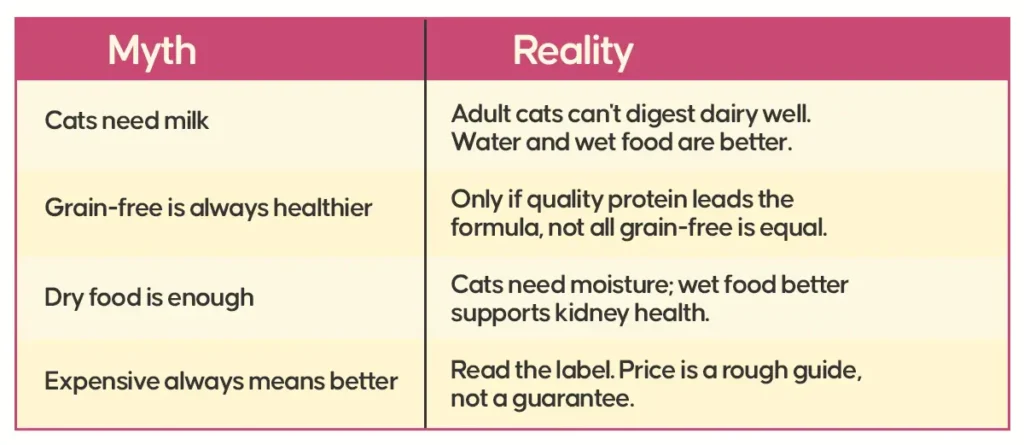
Quick Myth Vs Reality Summary
Frequently Asked Questions
1 Do cats really need milk?
No. Adult cats are largely lactose intolerant and cow’s milk commonly causes digestive upset. Wet food supports hydration far better.
2 Is grain-free food always better for cats?
Not automatically. Some grain-free foods replace grains with starchy fillers. What matters is that quality animal protein leads the ingredient list.
3 Is dry food enough for cats?
It can meet nutritional needs if complete, but dry-only diets often cause low-level dehydration. Wet food, or a combination, is better suited to a cat’s physiology.
4 Are meat by-products bad for cats?
Named by-products like liver and heart are nutrient-dense. The issue is vague labelling — “animal derivatives” from unnamed sources tells you nothing. Look for named, single-source ingredients.
5 Can cats eat human food safely?
Some is fine in small amounts, but human food isn’t nutritionally complete for cats and some items are genuinely toxic. It’s not a reliable feeding strategy.
6 Is expensive cat food always better?
No. Read the label rather than rely on price. Named protein first, taurine listed, sourcing clear — that tells you more than cost.
7 Do cats need variety in their diet?
Cats do better with consistency. Frequent changes cause digestive upset and fussiness. A single, complete food is usually the right approach.
8 Is wet food bad for teeth?
No. Cats rarely chew dry food long enough for any abrasive benefit. Dental health is better addressed through vet check-ups and dental chews.
9 Are preservatives harmful to cats?
Natural preservatives like mixed tocopherols are safe. Artificial ones like BHA and BHT are worth avoiding. Look for a brand that’s transparent about what it uses.
10 Should cats eat only fish?
No. A fish-heavy diet can cause taurine deficiency and vitamin imbalances over time. Meat-based single-source protein is a more complete foundation.
Recent Post
Subscribe & Save 25% Every Month
Never run out of your pet’s favourite dry cat food again. Enjoy scheduled deliveries right to your door & save 25% on every order. A win for you and your furry friend!
More Articles
- uzma
- /
- 29/03/2026

- uzma
- /
- 29/03/2026
- uzma
- /
- 27/03/2026
- uzma
- /
- 27/03/2026
- uzma
- /
- 26/03/2026
- uzma
- /
- 20/03/2026