
- Cat Nutrition, Feeding Guides
How Much Protein Is in Dry Cat Food vs Wet Cat Food?
- uzma
Table of Contents
TL;DR
Dry food shows higher protein on the label. Wet food often matches or beats it once moisture is removed from the equation. Format matters less than ingredients, always check the first three and look for a named animal protein first.
How Much Protein Is in Dry Cat Food vs Wet Cat Food?
Most cat owners compare protein in dry vs wet cat food by looking at the number on the label. That number rarely tells the full story.
The figure printed on a pet food pack, whether it reads 9% or 32%, is almost meaningless without understanding the moisture content sitting behind it. A wet food listing 9% protein and a dry food listing 30% may actually deliver remarkably similar protein density once water is removed from the equation. And yet most cat owners never make that calculation.
This article explains precisely how dry and wet cat food protein percentages compare, why the difference is consistently misrepresented, and what to look for when assessing whether a food genuinely meets your cat’s biological needs. Whether you feed dry, wet, or a combination of both, this is the framework that matters.
Why Protein Matters More for Cats Than for Any Other Pet
Cats are obligate carnivores. This is not a marketing phrase. It is a biological classification with direct implications for how you feed them.
Unlike dogs or humans, cats cannot synthesise certain amino acids internally. Taurine, arginine, and methionine must come from dietary animal protein. Cats also use protein, rather than carbohydrates, as their primary metabolic fuel. Their livers are permanently primed to process amino acids for energy, regardless of what is in the bowl.
The European Pet Food Industry Federation (FEDIAF) sets minimum protein guidelines for cat nutrition. For adult cats, a minimum of 25g of crude protein per 100g on a dry matter basis is recommended for maintenance. For growing kittens, that figure rises. This is a baseline, not an ideal. Premium high-protein dry cat food is typically formulated well above it.
The practical consequence of chronic protein under-feeding is gradual. Coat quality deteriorates first. Body condition, assessed on the validated 1–9 Body Condition Score (BCS) scale, begins to decline. A cat scoring 3 or below alongside dull coat quality is displaying dietary signals that are often attributed to ageing rather than food quality. They rarely are.
The Problem with Reading Protein Percentage at Face Value
Wet cat food typically contains between 70% and 80% moisture. A tin listing 9% crude protein is not a low-protein food. It is a high-moisture food in which protein appears diluted by water.
Dry cat food, by contrast, typically contains between 8% and 12% moisture. A bag listing 30% crude protein is working from a far drier base.
To compare the two meaningfully, both must be converted to what nutritionists call dry matter basis (DMB), which is the protein content with all moisture removed. The formula is straightforward:
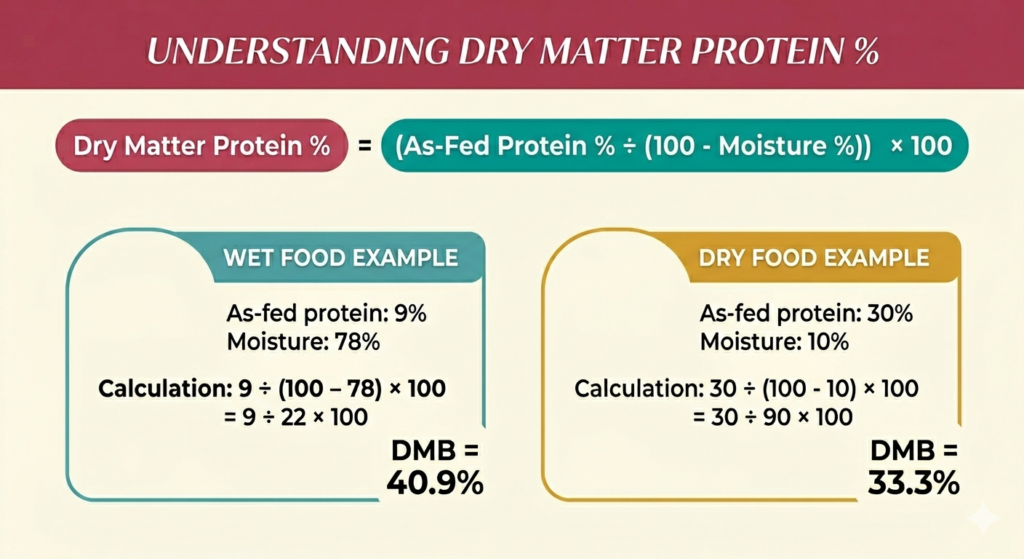
The wet food that appeared weaker on the label actually delivers more protein per gram of dry content. This is why the label number alone is an incomplete metric, and why any moisture cat food protein comparison requires this additional step before drawing conclusions.
What Is a Typical Dry Cat Food Protein Percentage
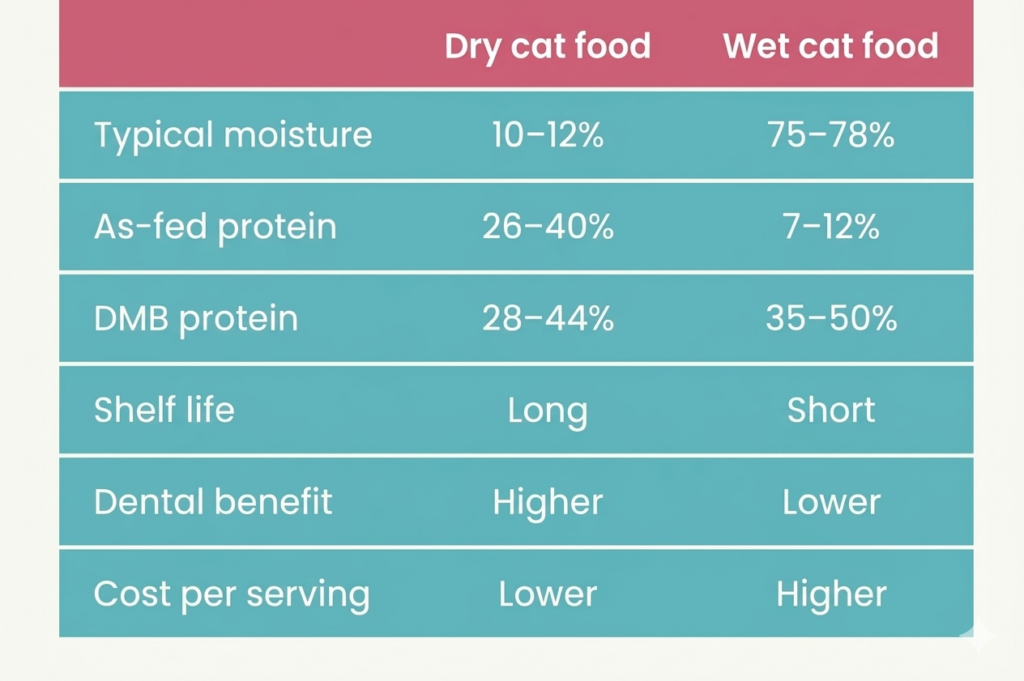
On an as-fed basis, dry cat food protein percentage typically ranges from 26% to 40%, depending on formulation tier and protein source. Budget dry foods often sit at the lower end and rely on plant-derived proteins or undeclared meal derivatives to reach their declared figure.
Premium dry formulations, those listing a named animal protein as the first ingredient, tend to cluster between 30% and 40%. This matters because cats absorb animal protein considerably more efficiently than plant protein. A food listing pea protein or soy as a primary ingredient may technically declare 32% crude protein but deliver meaningfully less bioavailable nutrition than a 30% food built around real chicken or tuna.
The practical instruction for label reading is straightforward: check the first three ingredients. If the first ingredient is a named protein source, not “meat meal,” not “animal derivatives,” not “cereals,” the formula is built on a meaningful protein foundation.
What Is a Typical Wet Food Protein Percentage for Cats
On an as-fed basis, wet cat food protein typically sits between 7% and 12%. Converted to dry matter basis, quality wet foods often reach 35–50%, which is meaningfully above many dry food equivalents when measured on the same scale.
Wet food’s higher DMB protein figure comes with trade-offs. The moisture content that inflates protein density also shortens shelf life, raises the cost per serving, and makes consistent daily feeding less practical for working households. Wet food also does not support dental health in the same way that dry kibble does, a consideration that compounds over a cat’s full lifetime.
For owners evaluating a grain-free dry cat food against a wet food alternative, neither format holds an automatic advantage. The question is always whether the formulation within that format, the actual ingredients, the protein source quality, and the absence of unnecessary fillers, meets your cat’s specific needs.
Neither format is categorically superior. The format is secondary. The formula is what matters.
How Much Protein Does a Cat Need Each Day
A useful working figure, based on FEDIAF nutritional guidelines, is approximately 5–6 grams of protein per kilogram of body weight per day for an adult cat in good condition. A 4kg domestic cat therefore requires roughly 20–24g of crude protein daily as an absolute minimum.
To put that in practical context: a 400-calorie daily intake from a quality dry food providing 35% protein on a dry matter basis will comfortably exceed that figure. The same cannot always be said for a lower-protein dry food where the declared protein is partially plant-derived.
Body condition scoring remains one of the most reliable tools for assessing whether a cat’s current diet is working. On the validated 1–9 BCS scale, a healthy adult cat should sit between 4 and 5. A score of 3 or below, alongside poor coat quality, is often a dietary signal worth examining, beginning with protein source and ingredient quality. Vitamins A, D, and E play a supporting role in coat and muscle condition that works in concert with adequate protein. No single nutrient operates in isolation.
How to Read a Cat Food Label for Protein Quality
The declared protein percentage on a pet food label is a starting point, not a conclusion. Four steps make the full assessment.
Step 1 — Check the first three ingredients. These constitute the majority of the formula by weight. If a named protein (chicken, tuna, salmon) appears first, the food is protein-led. If “cereals,” “derivatives,” or unnamed “meat” appear before protein, the formulation is likely bulked with filler.
Step 2 — Note the moisture percentage. This tells you immediately whether the as-fed protein figure is inflated by water content, which is essential for any honest wet food protein comparison.
Step 3 — Identify the protein source, not just the protein level. A food listing 34% crude protein from plant sources is nutritionally inferior to one listing 30% from named animal meat. The number is not the whole answer.
Step 4 — Note what is absent. Soy, wheat, and corn are common protein-padding ingredients in lower-tier formulas. Understanding why soy is a problem in cat food is as important as knowing what should be present. Their absence from a formula is a positive signal, not a gap.
What a Well-Formulated Dry Cat Food Looks Like in Practice
Hurayra’s dry cat food is formulated to 35% protein on an as-fed basis, a figure that places it comfortably above the FEDIAF adult maintenance minimum when converted to dry matter basis. Both the Chicken and Tuna variants list animal protein as the primary ingredient, with no grain, wheat, or soy in the formula.
The HMC certification applied across the range provides full traceability from farm to bag. For owners who prefer to purchase in store, Hurayra is available in Morrisons. For those who want consistent delivery without managing reorders, a subscription ensures the same formula arrives on a regular schedule, an underrated factor for cats who respond poorly to abrupt food changes.
For owners currently transitioning a cat from a wet-only diet or from a different dry formula, the cat transition guide covers a 7–10 day adjustment approach that protects digestive comfort during the switch.
Chicken Cat Food
Subscribe & Save 25%
What This Means in Practice
The comparison between protein in dry vs wet cat food is more complex than most label-reading suggests. Dry matter basis is the only reliable unit of comparison. Protein source quality matters as much as protein quantity. And the format of the food, dry or wet, is a secondary question to the quality of the formula within it.
The most useful habit any cat owner can develop is checking the first three ingredients before the headline protein figure. A clearly labelled formula with a named protein source, a declared moisture percentage, and no reliance on plant-based protein padding will consistently outperform a higher-number food built on ambiguous ingredients.
Feeding well is not complicated. It requires a clear framework and the consistency to apply it. If you are ready to take a closer look at what goes into your cat’s bowl, Hurayra’s full ingredients breakdown is a useful place to start.
Tuna and Chicken Combo
Subscribe & Save 25%
Frequently Asked Questions
1 What is a good protein percentage for dry cat food?
On an as-fed basis, a quality dry cat food should contain a minimum of 28–30% crude protein, with premium formulations typically reaching 34–40%. More important than the headline figure is whether that protein derives primarily from named animal sources rather than plant-based alternatives.
2 Which has more protein, dry or wet cat food?
On an as-fed basis, dry food typically shows a higher protein percentage than wet food. When both are converted to dry matter basis, wet food often matches or slightly exceeds many dry food formulations. Neither format is inherently superior. The formula within each product determines the actual nutritional value.
3 How do I compare protein in dry vs wet cat food accurately?
Use the dry matter basis formula: divide the as-fed protein percentage by (100 minus the moisture percentage), then multiply by 100. For example: 9% as-fed protein at 78% moisture equals 40.9% on a dry matter basis, which may be higher than a dry food listing 30% at 10% moisture (33.3% DMB).
4 Why does my wet cat food list only 9% protein but still seem high quality?
If the moisture content is high, typically 70–80% in wet food, a 9% as-fed protein figure may represent 40% or more on a dry matter basis. The as-fed figure alone does not indicate whether a food is nutritionally adequate. Moisture percentage must always be considered alongside it.
5 Is 35% protein dry cat food enough for my cat?
For most healthy adult cats, yes. FEDIAF guidelines recommend approximately 5–6g of protein per kilogram of body weight per day for maintenance. A dry food at 35% protein from quality animal sources will comfortably meet this threshold for the majority of adult cats. Body condition score and coat quality are the most reliable ongoing indicators of whether the diet is working.
6 Does halal dry cat food have different protein levels to standard dry cat food?
Not inherently. HMC certification is a sourcing and traceability standard, not a nutritional one. A well-formulated halal dry cat food can achieve the same or higher protein percentages as any other premium dry formulation. What it adds is verifiable transparency about the origin and ethical handling of the animal protein used.
Recent Post

Subscribe & Save 25% Every Month
Never run out of your pet’s favourite dry cat food again. Enjoy scheduled deliveries right to your door & save 25% on every order. A win for you and your furry friend!
More Articles
- uzma
- /
- 31/03/2026
- uzma
- /
- 30/03/2026
- uzma
- /
- 29/03/2026

- uzma
- /
- 29/03/2026
- uzma
- /
- 27/03/2026
- uzma
- /
- 27/03/2026