Written by Uzma Aslam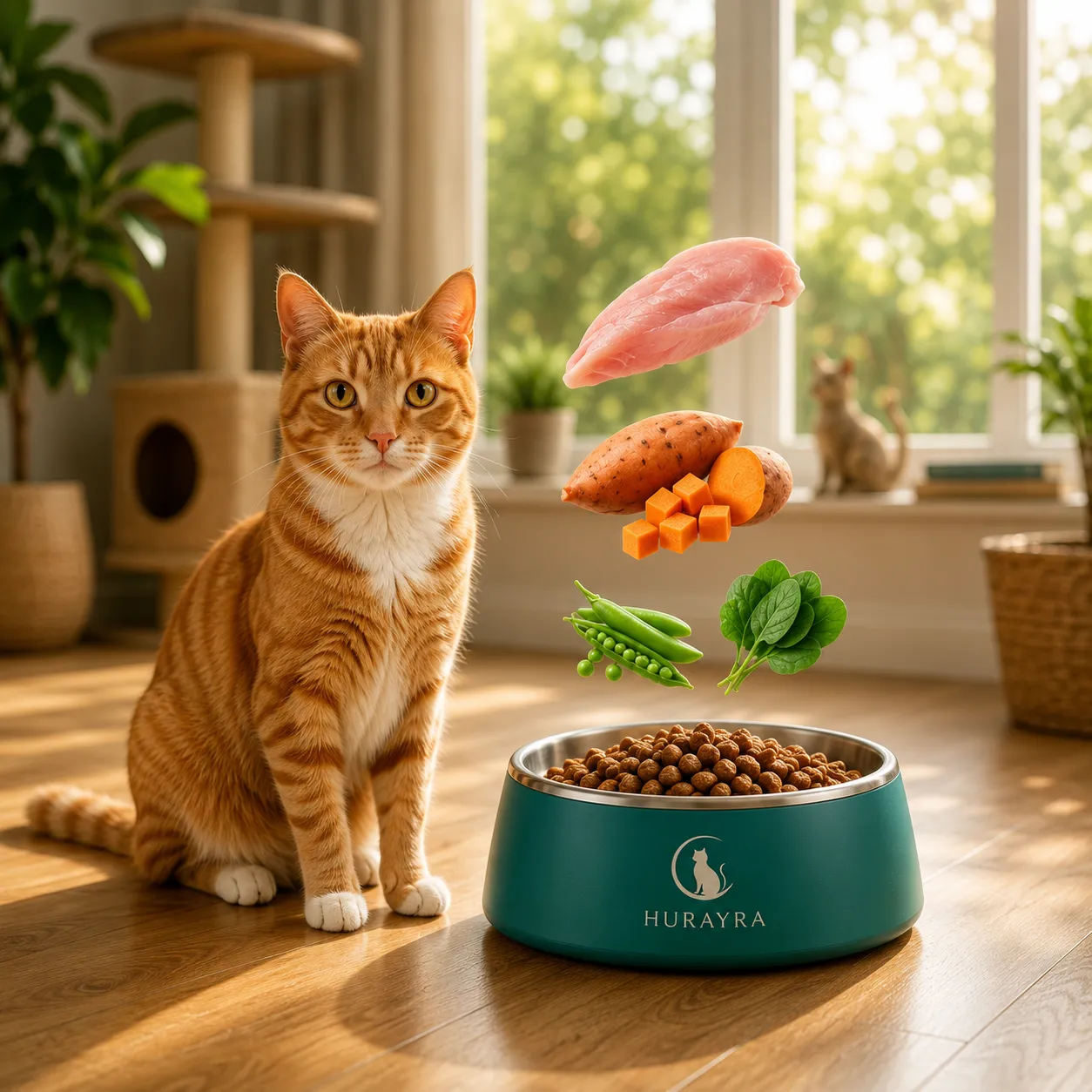
TL;DR
Grain-free cat food replaces grains with ingredients like sweet potato, tapioca, and legumes, but quality depends on balance. What matters most is high named animal protein, moderate fillers, and a well-structured ingredient list, not just the “grain-free” label.
What Ingredients Replace Grains in Grain-Free Cat Food?
Most cat owners read “grain-free” on a bag of kibble and assume they understand what’s inside. They rarely do.
Removing grains from a recipe creates a formulation gap. Something has to bind the kibble, provide structure, and contribute to the carbohydrate content the manufacturing process requires. What fills that gap varies considerably between brands, and the difference between a well-formulated grain-free recipe and a poorly considered one is not obvious at first glance.
This article explains what grain-free cat food ingredients actually are, how to assess them, and what to look for when choosing a grain-free kibble for your cat. Whether you are feeding for digestive sensitivity, dietary preference, or specific ethical requirements, understanding what replaces grains is the most practical thing you can do as a cat owner.
Why Cats and Grains Are a Complicated Combination
Cats are obligate carnivores. Their digestive systems are built around animal protein, not plant-derived starches. Unlike dogs or humans, cats produce limited quantities of the enzymes needed to break down carbohydrates efficiently. Their bodies extract energy almost entirely from protein and fat, which is a biological reality, not a dietary trend.
Grains such as wheat, maize, barley, and rice are included in many conventional cat foods primarily because they are cost-effective fillers and processing aids. They help the kibble hold its shape during extrusion. They are not inherently toxic to cats, but they serve no meaningful nutritional purpose for an obligate carnivore either.
This is why grain-free formulas exist. The intention is to remove plant ingredients with low biological value for cats and replace them with something more compatible. But “grain-free” does not automatically mean “high quality.” The question is always what the grains have been replaced with, and that answer is where most cat owners stop reading before they should. If you want to understand how a well-considered recipe answers that question, Hurayra’s premium ingredients include each component and the reasoning behind its inclusion.
The Most Common Grain-Free Cat Food Ingredients
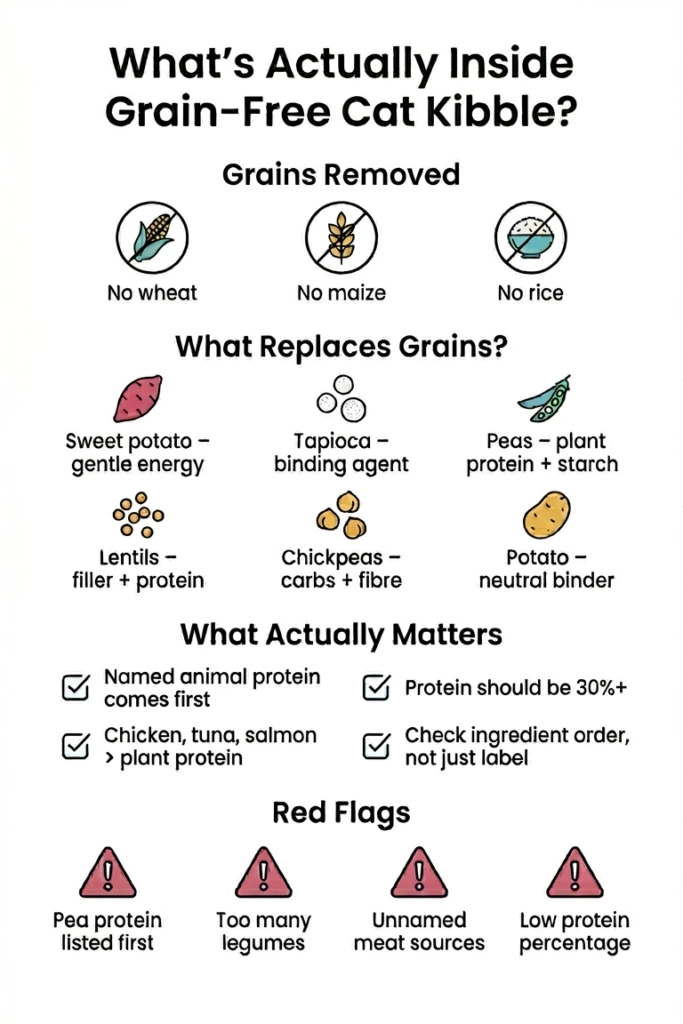
When manufacturers remove wheat, maize, or rice from a recipe, they typically replace them with one or more of the following.
Sweet potato is one of the more common substitutes. It is easily digestible, provides slow-release energy, and contains some dietary fibre. Cats do not require dietary carbohydrates, but sweet potato is generally well-tolerated and does not carry the same sensitivities associated with grains.
Tapioca is a starch derived from cassava root. It is almost entirely carbohydrate and contributes very little nutritional value beyond acting as a binding agent in kibble production. It is, however, extremely gentle on digestion and is unlikely to cause sensitivity reactions. You will see tapioca listed in many grain-free kibbles, including premium formulas.
Peas and pea protein are widely used in grain-free pet food across the UK and Europe. Peas provide both starch and protein, which makes them useful in formulation. Cat owners should be aware that pea protein is plant-derived and is not equivalent to animal protein in terms of amino acid profile. If pea protein appears high up in an ingredient list, it may be boosting the overall protein percentage figure without delivering the same biological value as chicken or fish.
Lentils function similarly to peas. They are a legume source of protein and starch, they are inexpensive to process, and they have become a standard ingredient in grain-free kibble across multiple price points. Lentils are not harmful, but they are not what a cat’s body is designed to process as a primary nutrient source.
Chickpeas appear in some grain-free formulations, particularly those positioning themselves as natural or plant-forward. As with lentils and peas, chickpeas contribute carbohydrates and some plant protein. They are generally well-tolerated but serve the manufacturer’s formulation needs as much as the cat’s nutritional needs.
Potato and potato starch are used as neutral binding agents. Potatoes contribute starch and minimal fibre. Some owners specifically look for potato-free cat food for sensitive cats, as potato can be a source of starch that some cats process less efficiently over time, though evidence on this remains limited.
Understanding which of these ingredients appears in your cat’s food, and where it sits in the ingredient list, is far more useful than the label “grain-free” alone.
Named Protein Still Comes First
The grain replacement is secondary. What matters more is what leads the ingredient list.
FEDIAF, the European industry body that sets nutritional guidelines for companion animal food, recommends that adult cat food contains a minimum of around 25% crude protein on a dry matter basis. A well-formulated grain-free kibble should comfortably exceed this. Hurayra’s recipes deliver 35% protein derived from named animal sources, which positions them clearly above the baseline threshold.
The distinction between “named protein” and “meat and animal derivatives” is meaningful. Named protein means the specific animal is identified: chicken, tuna, salmon. Unnamed derivatives can include any combination of animal material from unspecified species. When assessing any grain-free kibble, the first thing to check is whether the first ingredient is a named, named-source animal protein.
If the first three ingredients include a named protein, a grain replacement such as sweet potato or tapioca, and a secondary nutrient source such as fish meal or salmon oil, the formula is likely well-structured. If the ingredient list leads with pea protein or potato starch before any animal source appears, the “grain-free” label is doing more marketing work than nutritional work. For felines with a history of digestive sensitivity, grain-free cat food is usually a safer and healthier option.
What Legumes Actually Do in Grain-Free Cat Food
Legumes deserve a section of their own because they are now so prevalent in grain-free formulas and because the conversation around them has become more nuanced.
Peas, lentils, and chickpeas appear in grain-free cat food because they are functional. They bind kibble. They add bulk. They contribute to the protein percentage figure on the label. They are also considerably less expensive than animal protein.
This does not make them inherently problematic. But it does mean they are not in the recipe primarily for your cat’s benefit.
There is ongoing discussion in veterinary nutrition circles about the long-term implications of high-legume diets in cats, partly connected to concerns raised in the canine space regarding grain-free diets and cardiac health. The science is not settled, and the evidence specific to cats remains limited. What is clear is that legumes should not constitute the majority of a grain-free formula, and that the protein contribution from legumes should not be used to disguise a low animal-protein content.
When reading a legume cat food ingredient list, look at how far down the legume ingredients appear. If peas or lentils come after a named animal protein, a named meat meal, and a functional fat source, they are playing a secondary formulation role. If they appear in the first two or three positions, they are the primary filler.
Does Grain-Free Suit Every Cat
This is the honest answer: not necessarily.
Some cats do very well on grain-free diets. Cats with documented grain sensitivities, wheat intolerance, or recurring digestive upset often respond positively when grains are removed. Cats that were previously on high-grain diets and showed signs such as loose stools, excessive shedding, or low energy sometimes see genuine improvement on a grain-free formula.
Other cats thrive equally well on a diet that contains a small amount of whole grain. A cat with no sensitivities, strong digestion, and a robust body condition, assessed on the standard 1 to 9 body condition score scale, with 4 to 5 being ideal for most adult cats, may show no measurable difference in health or coat quality between a grain-inclusive and grain-free diet, provided the protein content and ingredient quality are comparable.
The key variable is not grain presence or absence. It is ingredient quality, protein content, and how the individual cat processes the food. Grain-free is a suitability question, not a universal recommendation. Soy is a separate ingredient category that follows a similar logic, and if you are reviewing your cat’s full ingredient profile, this guide to soy-free cat food explains why soy is removed from well-formulated recipes and what that means for digestion.
A Note on Halal and Grain-Free Cat Food
These two attributes are sometimes discussed together, particularly by owners seeking both. They are, however, independent of each other.
Halal certification is about sourcing traceability, slaughter method, and production integrity. It answers questions about what the animal was, how it was processed, and whether cross-contamination occurred at any stage. HMC certification, which Hurayra carries, involves third-party auditing of the entire supply chain, not simply a self-declaration on the label. Hurayra’s halal formulation of dry kibble is supported by the certification process and what that level of verification means in practice for cat owners who want documented traceability.
Grain-free formulation is about ingredient composition and digestive suitability. These two things operate on separate axes.
Neither attribute makes a food automatically healthier than alternatives. A halal-certified grain-free kibble with a high legume content and low named animal protein is not superior to a conventionally sourced kibble with 40% named chicken and a small inclusion of brown rice. The certifications and formulation choices have to work together to produce a genuinely well-formulated product.
For Muslim cat owners, halal certification addresses a religious principle and provides assurance of ethical production. For non-Muslim owners, the same transparency around sourcing and supply chain integrity is increasingly valued on its own terms.
Chicken Cat Food
Subscribe & Save 25%
How to Read a Grain-Free Ingredient List
Most cat owners read ingredient lists from left to right and stop after the first two or three items. This works as a starting point, but a more complete read considers the following.
The first ingredient should be a named animal protein. Chicken, tuna, salmon, duck. Not “poultry” or “meat” without further specification.
The second and third ingredients reveal the structure of the formula. A named meat meal such as chicken meal or salmon meal in second position is a positive sign, as it concentrates the protein content after moisture is removed. A grain replacement such as sweet potato or tapioca in second position is acceptable, provided the first ingredient is named animal protein.
Protein percentage. Look for a minimum of 30% on a dry matter basis. Anything consistently below 28% in a grain-free kibble should prompt further investigation into how the remaining protein content is being met.
The fat source. Named fat sources such as chicken fat or salmon oil indicate quality. Unnamed animal fat is less informative.
The preservative method. Natural preservatives such as mixed tocopherols are preferable to synthetic alternatives.
If you are comparing fish-based protein options specifically, this breakdown of tuna versus salmon in cat food is worth reading before making a decision, as the amino acid profiles and Omega fatty acid contributions differ in ways that may be relevant depending on your cat’s age and condition.
Mixing Grain-Free Kibble with Wet Food
One question that comes up regularly is whether owners should mix grain-free dry food with wet food. The practical answer is that mixing is fine for most cats, provided the combined diet remains nutritionally complete.
Wet food contributes moisture, which supports kidney health and urinary tract function. Dry grain-free kibble contributes dental abrasion, convenience, and a consistent concentrated nutrient source. Many owners use a primary dry food with a small wet food addition at one meal per day. This is a reasonable approach provided the dry food remains the nutritional anchor of the diet.
Where mixing creates problems is when owners rotate between multiple dry foods frequently in search of variety. Cats are more sensitive to ingredient rotation than most owners expect, and regular formula changes can produce digestive inconsistency that is sometimes mistaken for food intolerance. Choosing a primary formula and maintaining it consistently is generally more beneficial than frequent switching. If you are making a change to a new food, Hurayra’s cat transition guide outlines the recommended seven to ten day approach for switching without digestive disruption.
How Hurayra Approaches Grain-Free Formulation
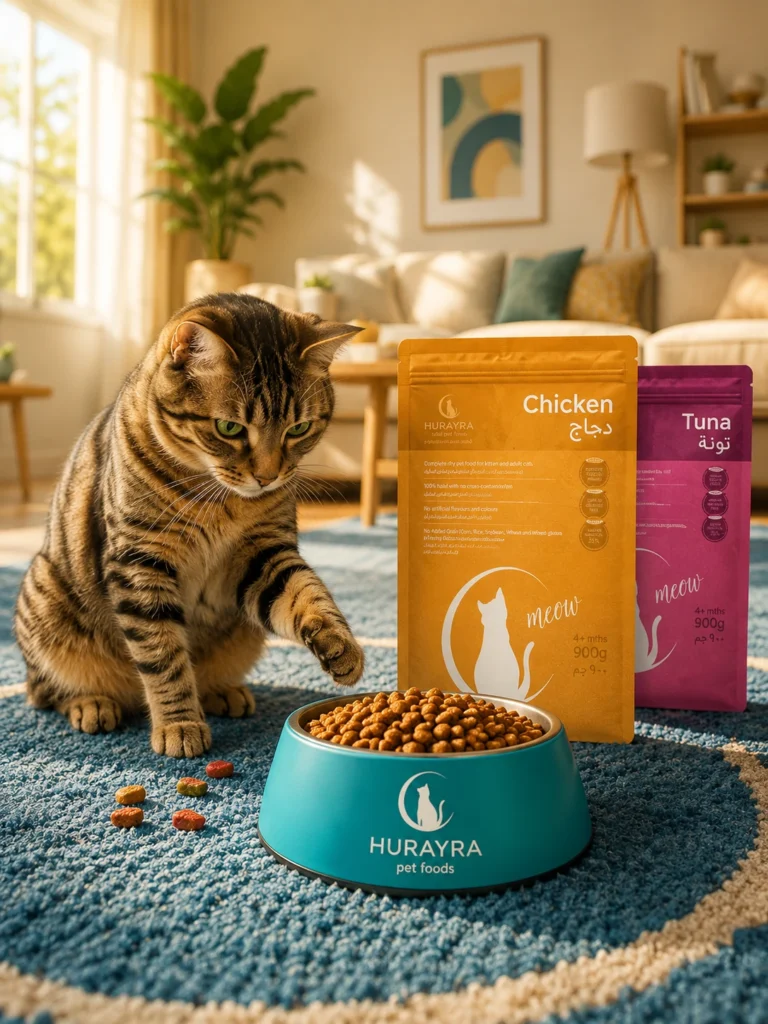
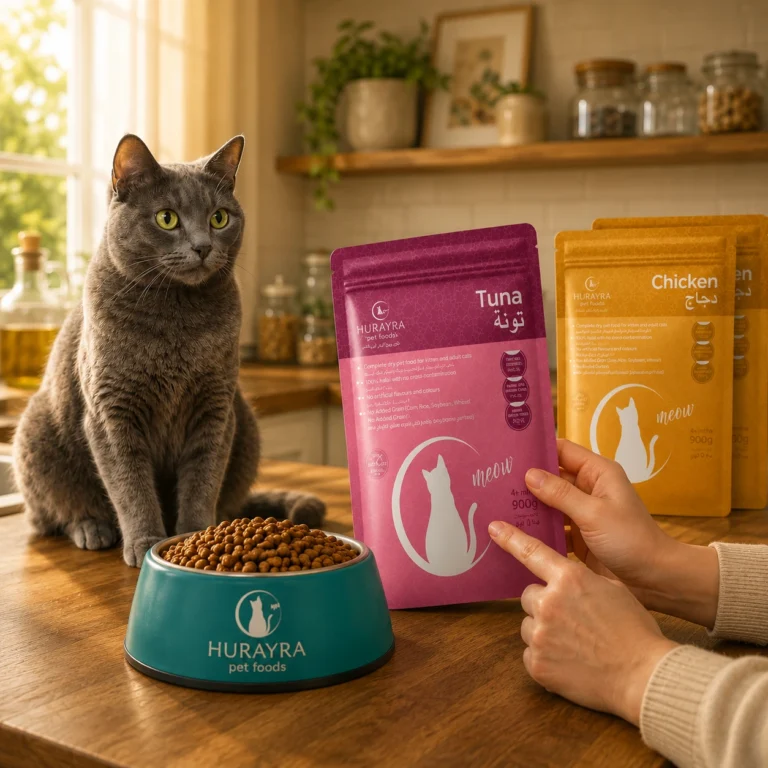
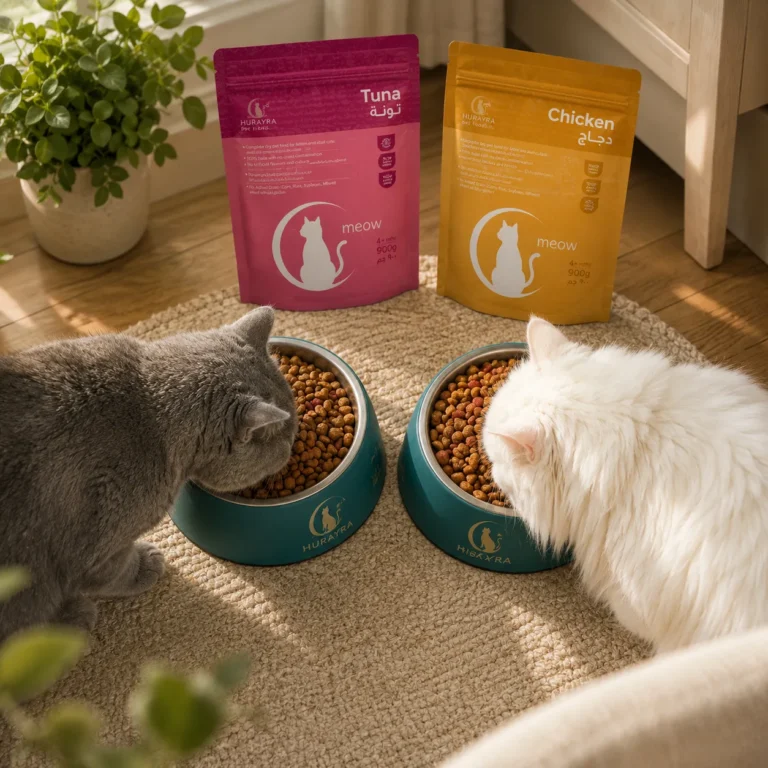
Hurayra’s dry kibble is formulated without grains, wheat, or soy. The recipes are built around named source animal protein, chicken and tuna in the current range, and the protein content sits at 35%, meaningfully above FEDIAF’s baseline for adult cats.
The grain-free structure is achieved without relying heavily on legumes as a primary filler. The formula also carries HMC certification, which means the entire supply chain from approved farm to finished product has been audited by a third-party body. This gives cat owners a level of traceability that goes beyond label claims.
Hurayra is available through direct subscription, delivering every four to eight weeks depending on the number of cats in the household. It is also stocked in selected Morrisons stores for owners who prefer to purchase in person before committing to a regular order. The subscription model carries a 25% saving on ongoing orders and removes the practical inconsistency that comes with buying different foods whenever a usual product is out of stock. A cat that eats the same well-formulated food regularly will generally show more stable digestion, coat condition, and energy than one whose diet changes based on availability.
What Good Grain-Free Cat Food Actually Looks Like
The honest summary is this: grain-free kibble is a formulation choice, not a guarantee of quality. The value of removing grains depends entirely on what replaces them.
A well-formulated grain-free recipe leads with named animal protein, uses grain replacements such as sweet potato or tapioca in a secondary supporting role, keeps legume content proportionate, delivers a protein percentage above 30%, and is transparent about every ingredient and its source. Hurayra’s full ingredient breakdown demonstrates what this looks like in practice, including the sourcing standards and nutritional composition behind each inclusion.
A poorly formulated grain-free recipe uses pea protein and lentils to inflate the protein figure, lists unnamed meat derivatives, and relies on the “grain-free” positioning to do work that the formulation itself does not.
The practical guidance is simple: read the ingredient list, check the protein percentage, and verify whether the first ingredient is a named animal protein. These three checks take less than two minutes and tell you almost everything you need to know about whether a grain-free kibble is worth its price point.
Choosing food for your cat is not complicated when you know what to look for. The label is where the marketing lives. The ingredient list is where the actual decision gets made.
If you are ready to try a grain-free formula built around 35% named animal protein and full supply chain transparency, Hurayra’s range is available to explore here.
Tuna and Chicken Combo
Subscribe & Save 25%
Frequently Asked Questions
1 What ingredients are typically used to replace grains in grain-free cat food?
The most common grain replacements are sweet potato, tapioca, peas, lentils, chickpeas, and potato starch. Each performs a different function. Sweet potato and tapioca are primarily digestive binders. Peas and lentils contribute starch and plant protein. The quality of the overall formula depends on how these ingredients are used relative to the animal protein content.
2 Is grain-free cat food automatically better for cats?
No. Grain-free is a suitability choice, not a universal upgrade. Cats with grain sensitivities or digestive issues often benefit from grain-free diets. Cats without these sensitivities may show no measurable improvement when grains are removed. Protein content, ingredient quality, and named sourcing matter more than whether grains are present or absent.
3 What is potato-free cat food and why do some owners choose it?
Potato-free cat food removes potato and potato starch from the grain-free formula, typically replacing them with tapioca or sweet potato. Some owners choose it for cats with starch sensitivities or those who respond poorly to potato-based diets. The evidence base for potato-specific sensitivity in cats is limited, but potato-free options are available for owners who have observed a connection in their own cat.
4 Are legumes safe in grain-free cat food?
Legumes such as peas, lentils, and chickpeas are safe for cats in moderate quantities. The concern is not safety but proportion. If legumes appear as the first or second ingredient in a grain-free kibble, they are likely functioning as a primary filler rather than a secondary supporting ingredient, which affects the overall nutritional balance of the formula.
5 How does grain-free cat food relate to halal certification?
They are independent attributes. Grain-free describes ingredient composition. Halal certification, particularly HMC accreditation, describes how the animal protein was sourced, slaughtered, and processed. A product can be grain-free without being halal-certified, and vice versa. For owners who require both, each certification should be independently verified rather than self-declared.
The most common grain replacements are sweet potato, tapioca, peas, lentils, chickpeas, and potato starch. Each performs a different function. Sweet potato and tapioca are primarily digestive binders. Peas and lentils contribute starch and plant protein. The quality of the overall formula depends on how these ingredients are used relative to the animal protein content.
No. Grain-free is a suitability choice, not a universal upgrade. Cats with grain sensitivities or digestive issues often benefit from grain-free diets. Cats without these sensitivities may show no measurable improvement when grains are removed. Protein content, ingredient quality, and named sourcing matter more than whether grains are present or absent.
Potato-free cat food removes potato and potato starch from the grain-free formula, typically replacing them with tapioca or sweet potato. Some owners choose it for cats with starch sensitivities or those who respond poorly to potato-based diets. The evidence base for potato-specific sensitivity in cats is limited, but potato-free options are available for owners who have observed a connection in their own cat.
Legumes such as peas, lentils, and chickpeas are safe for cats in moderate quantities. The concern is not safety but proportion. If legumes appear as the first or second ingredient in a grain-free kibble, they are likely functioning as a primary filler rather than a secondary supporting ingredient, which affects the overall nutritional balance of the formula.
They are independent attributes. Grain-free describes ingredient composition. Halal certification, particularly HMC accreditation, describes how the animal protein was sourced, slaughtered, and processed. A product can be grain-free without being halal-certified, and vice versa. For owners who require both, each certification should be independently verified rather than self-declared.