Written by Maria Manshad
Your cat has never once said, “That’s enough.”
Your cat will watch you from the kitchen doorway at 5 a.m. Your cat will circle the bowl like it’s an emergency. Your cat will look at you as if your cat haven’t eaten since the weekend. And you’ll feel the tug to add just a little more.
However, what decides how much your cat needs is their weight, their age and how active they are. This guide gives you a number to feed by, and a few quick checks to confirm it’s right.
The short answer: weigh each portion in grams, and adjust for your cat’s weight, age and activity. Split it into two meals. Then check the result with your hands, not just the scale.
Why portions matter
Feeding your cat the right amount helps maintain a healthy weight and prevents overfeeding. Even small extras, such as topping up the bowl or offering treats throughout the day, can add up over time.
Rather than guessing how much your cat needs, measure each portion and adjust it according to your cat’s weight, activity level and body condition.
Start with the pouch guide
Every Hurayra pouch comes with a feeding guide: grams per day, matched to your cat’s weight. Vets give the same advice: follow the instructions on the packet for how much to feed.
Feeding Guide
| Cat Weight | Daily Amount |
| 1–3 kg | 25 g–50 g |
| 3–5 kg | 50 g–75 g |
| 5+ kg | 75 g+ |
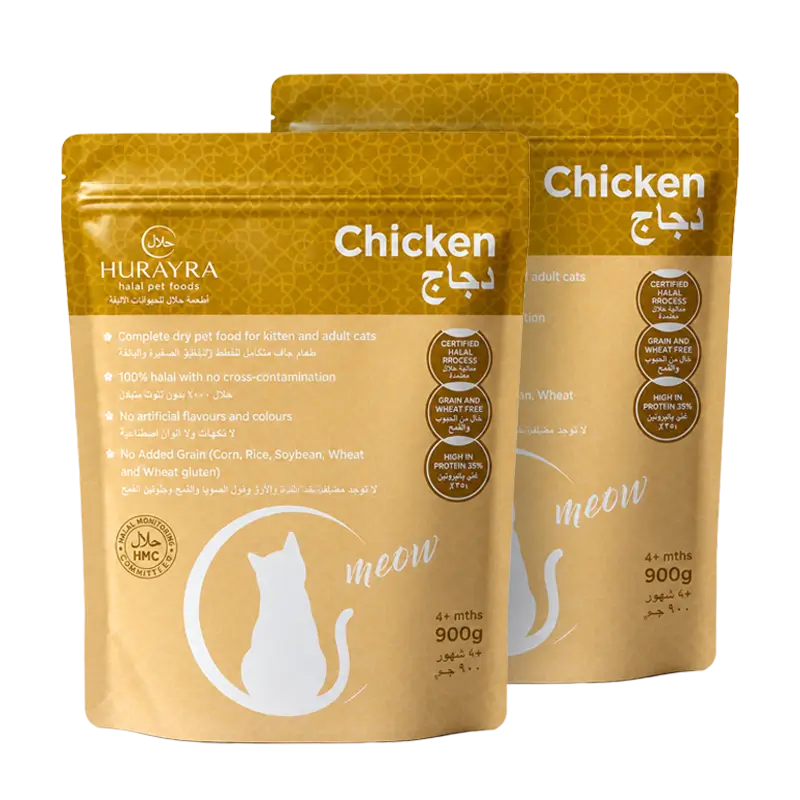
Dry Chicken Cat Food
Subscribe & Save 25%
The pouch maths
Hurayra comes in one pouch size: 900 g.
Daily grams from the guide ÷ 900 = the share of a pouch your cat eats each day.
900 ÷ daily grams = how many days one pouch lasts.
Same pouch, three cats
- Mishti, 4 kg, indoor, spayed, sofa specialist. Hurayra’s guide says to adjust portions if your cat is more or less active than average. Mishti is on the less active side, so your cat will do well on the guide amount, with a close eye on their shape.
- Simba, 6 kg, neutered, zooms around at night. He’s more active than average, so he may need a little more than the guide’s starting amount.
- Coco, 7 months, still growing. They follows the kitten column, not the adult one.
What changes the amount
- Weight: the guide is built on it. Weigh your cat, don’t guess.
- Age: kittens and adults have different amounts.
- Activity: more active cats may need more, and sofa cats may need less.
- Treats and extras: they count. Veterinary nutrition guidelines flag treats, snacks and table food above 10% of total daily calories as a risk factor. Stay under that line.
- Health: if your cat has a medical condition, ask your vet before you set the portion.
Wet, dry or both?
Vets and cat welfare experts generally recommend feeding healthy cats a variety of wet and dry food, so mixing is fine.
Treat it as one daily allowance, not two. If you add dry food, cut the wet portion so the total doesn’t climb. Your vet can help you split it.
Two meals, same times
Hurayra’s guide recommends dividing the daily amount into two balanced meals. It also suggests feeding at the same times each day, so your cat settles into a routine.
Weigh it, don’t scoop it
Feeding management can include weighing the food, or less ideally measuring it. A kitchen scale takes five seconds and removes the guesswork.
Weigh the portion for a week and you’ll learn what one serving looks like.
Free-feeding: yes or no?
Some vet professionals note that many cats do fine on free-choice feeding, where food is always available. But overweight cats may need set meals instead.
If your cat is gaining weight, measured meals are the safer move.
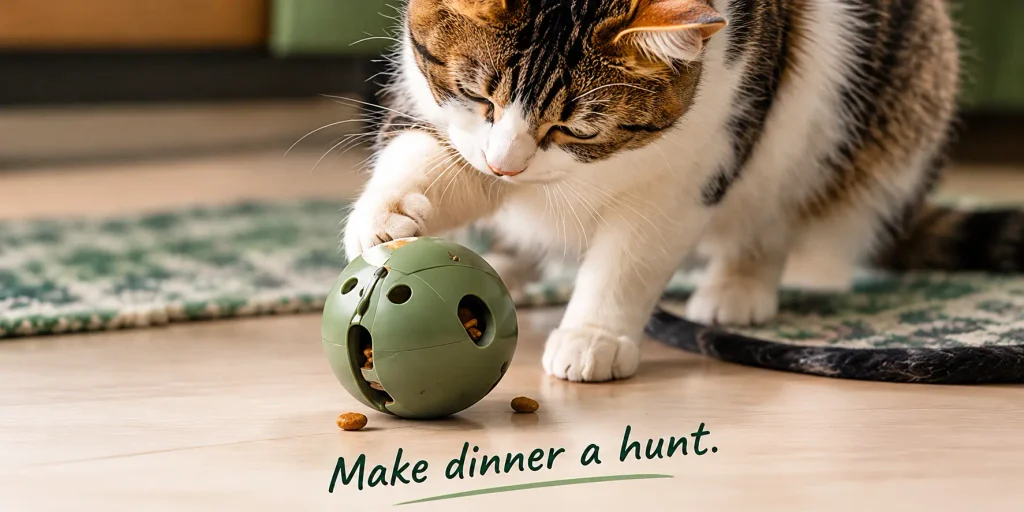
Make dinner a hunt
Cats are designed to work for their food. Vet nutrition teams suggest food toys, raising the bowl on a perch, or hiding pieces of food around the home. Feeding balls have been noted to increase activity and reduce how much cats eat.
The Rib test
Scales are useful. Your hands tell you more. Vets suggest these checks:
- Run your hands along your cat’s sides. You should feel the ribs with a light touch.
- Feel the spine and hipbones under the skin. You shouldn’t see them.
- Feel under the tummy. It should go in, not bulge out.
- Look from above and from the side. You should see a waist.
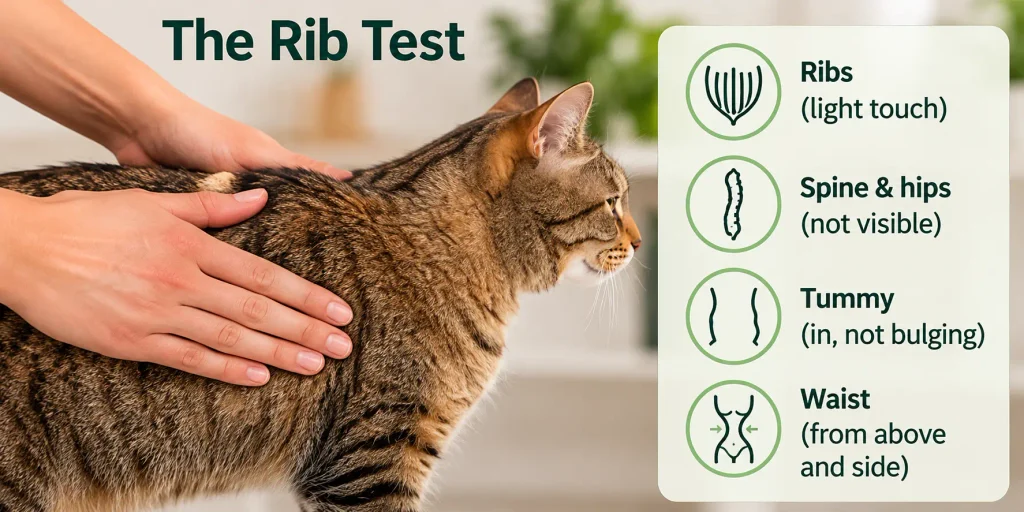
Here’s a vet trick. Hold one hand flat, palm down, and run your other hand over the back of it. That’s how padded a healthy ribcage should feel. Flip your hand palm up and do it again. If your cat’s ribs feel like that, your cat may be overweight.
Vets score all this on a 9-point body condition scale, and a score of 5 is ideal.
Too much or too little?
Possibly too much: no visible waist, or ribs you can only feel with firm pressure.
Possibly too little: a visibly bony cat, with ribs, hips and backbone you can see.
If your cat loses weight suddenly or very quickly, see your vet.
Need to lose weight? Start with your vet
Most adult cats weigh around 3.6–4.5 kg, but the ideal weight varies by breed and body frame. Your vet can determine your cat’s target weight and calculate the daily food portion needed to reach it safely. Avoid cutting food drastically, as cats need enough nutrients to stay healthy.
Switching to Hurayra: the 7-day plan
A gradual switch helps your cat’s digestion adjust and makes the change less stressful. Hurayra recommends this:
| Day | Hurayra | Old food |
|---|---|---|
| 1 to 2 | 25% | 75% |
| 3 to 4 | 50% | 50% |
| 5 to 6 | 75% | 25% |
| 7 onward | 100% | 0% |
Watch your cat’s appetite, stool and behaviour. If you see discomfort, hold the current ratio for an extra day or two. If symptoms persist, call your vet.
Always keep fresh water available.
Ready to make the switch?
Give your cat a meal worth looking forward to.Explore Hurayra Wet Cat Food and find your cat’s next favourite.
Five mistakes to avoid
- Guessing the portion. Weigh it.
- Forgetting the extras. Treats and table food count.
- Ignoring activity. The guide is a starting point. Adjust for your cat.
- Skipping the hands-on check. The scale doesn’t show body shape.
- Changing the bowl without your vet when weight is a worry.
The bottom line
Don’t ask “how many pouches?” Ask “how many grams?”
Find your cat’s amount on the guide, weigh it, split it into two meals, and check their shape. Adjust slowly, and call your vet if something changes.
Frequently Asked Questions
Yes. They count toward the daily total, and veterinary nutrition guidelines flag treats and extras above 10% of daily calories.
Hurayra’s guide recommends two balanced meals, at the same times each day.
Yes. Weighing food is better than measuring it.
Yes. Treat them as one daily allowance, not two. Ask your vet how to split it.
Check the amount against the guide and the weight trend first. If the hunger is new or persistent, ask your vet.