Written by Saniya Ahmed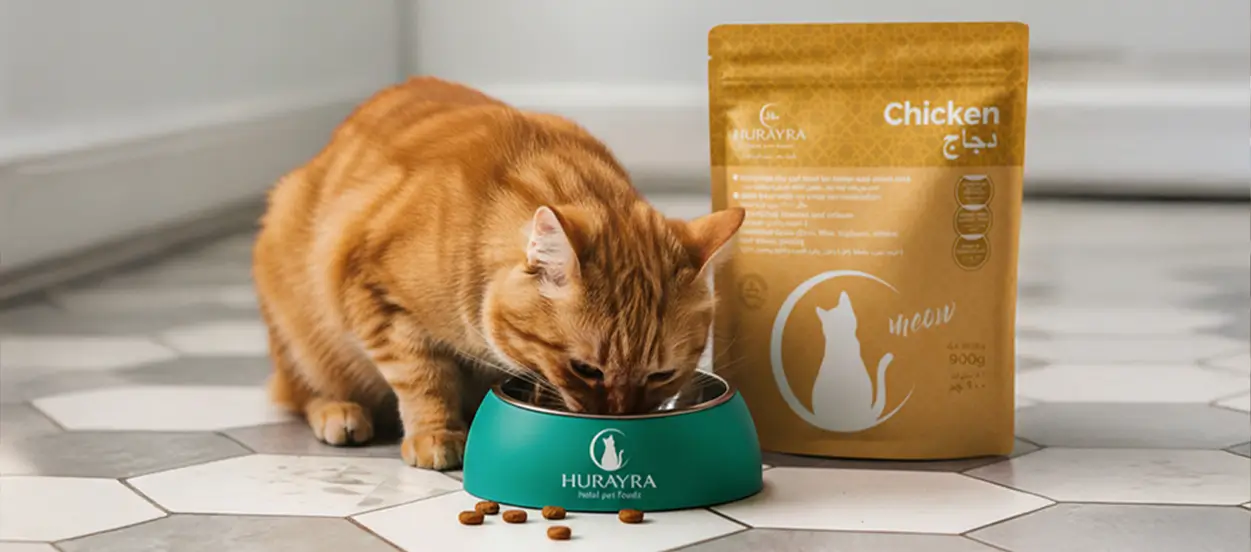
TL;DR
Dry cat food contains little moisture, so cats must drink enough water to stay hydrated. Hurayra’s high-protein, grain-free formulations support health while feeding dry food. Monitoring water intake, offering multiple bowls or fountains, and mixing wet meals when needed helps maintain hydration and urinary health for thriving cats.
If you feed your cat dry food and you’re wondering whether that’s enough to keep them properly hydrated, you’re asking the right question, and you’re not alone. There’s a lot of conflicting advice out there, some of it well-meaning, some of it designed to alarm rather than inform. The short answer is: dry cat food hydration is a genuine consideration, not a myth, but it doesn’t automatically make dry feeding harmful. What matters is understanding how your cat drinks, what the numbers actually look like, and where real risk begins. This article covers all of that, plainly.
How Cats Naturally Get Their Water
Cats are descended from desert-dwelling animals. Their wild ancestors got most of their moisture from prey (raw meat typically contains around 70–75% water) rather than from standing water sources. This is why domestic cats often have a low drive to drink from a bowl. They didn’t evolve to.
This biological background is an important context. It means cats can manage their fluid intake efficiently, but it also means they’re somewhat reliant on their food to do a portion of that work. A cat that’s eating prey-like food with high moisture content may barely touch its water bowl. A cat on dry food has to compensate by drinking more voluntarily, and not all cats do.
This isn’t cause for panic. It’s just useful biology to know.
The Moisture Difference Between Dry And Wet Food
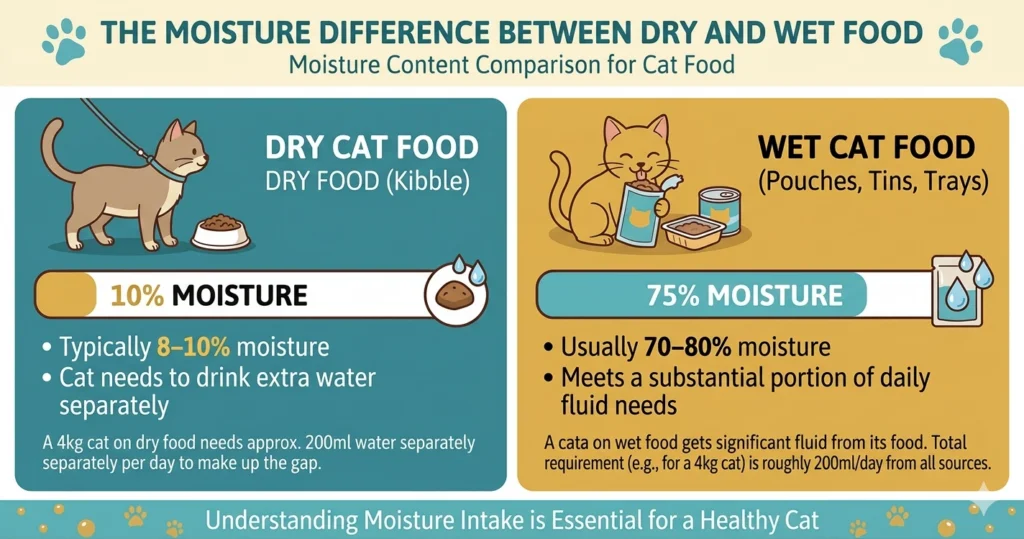
Dry cat food typically contains around 8–10% moisture. Wet food (pouches, tins, trays) usually comes in at 70–80%. That’s a significant gap, and it’s the central fact in any honest conversation about dry cat food hydration.
To put it in practical terms: a cat eating wet food gets a substantial portion of its daily fluid needs met by the food itself. A cat on dry food needs to drink enough water separately to make up that difference. The total daily water requirement for a typical adult cat is roughly 50ml per kilogram of bodyweight. For a 4kg cat, that’s around 200ml per day from all sources combined.
Whether a dry-fed cat meets that target depends largely on how much water is available, how accessible it is, and whether the individual cat is inclined to drink. Some cats drink well. Others don’t, and that’s where problems can develop over time.
Dry Cat Food Water Intake: What The Numbers Look Like
A dry-fed cat eating a standard 60g portion per day takes in roughly 5–6ml of moisture through its food. A wet-fed cat eating the equivalent in pouches takes in closer to 140–150ml from food alone. That’s a gap of around 135–145ml that a dry-fed cat needs to source from its water bowl.
That’s not impossible. Many cats do manage it, particularly when water is plentiful, fresh, and offered in a way that appeals to them. But it does require more active drinking than wet-fed cats need to do, and cats that are older, less mobile, or simply not inclined to drink are at higher risk of falling short.
The key is honest monitoring rather than assumption. If your cat is eating dry food, keeping an eye on how much it drinks is a practical part of day-to-day care.
The Link Between Cat Urinary Health And Dry Food
The connection between cat urinary health and dry food is probably the area where concern is most legitimate, and also most frequently overstated.
Cats that are chronically mildly dehydrated produce more concentrated urine. Concentrated urine increases the likelihood of mineral crystals forming in the bladder, which can contribute to lower urinary tract disease, including feline idiopathic cystitis and urolithiasis. Studies in feline medicine, including research published in the Journal of Veterinary Internal Medicine, have found associations between dry food consumption and increased urinary crystal formation in some cats.
That said, diet is one factor among several. Genetics, stress, age, and individual biology all play a role. Many cats eat dry food their entire lives without any urinary issues. Others develop problems despite eating wet food. The relationship is probabilistic, not deterministic.
What’s fair to say is that for cats with a history of urinary problems, or for owners concerned about prevention, paying attention to fluid intake is sensible. It’s not a reason to condemn dry food wholesale.
Signs Of Dehydration In Cats
Knowing the cat dehydration signs to look for is more useful than worrying in the abstract. Mild dehydration in cats can be easy to miss because cats are good at masking discomfort.
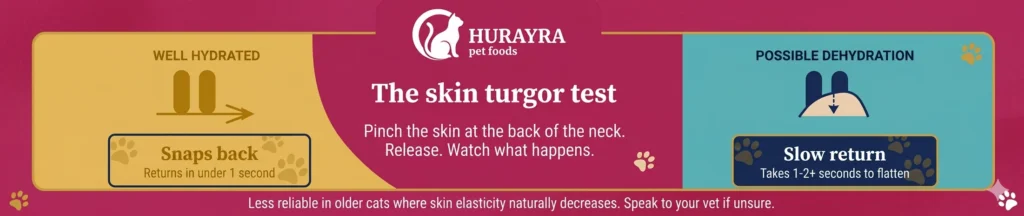
The skin turgor test is a simple starting point: gently pinch the skin at the back of the neck and release it. In a well-hydrated cat, it snaps back immediately. Slow return (more than a second or two) can indicate dehydration. This isn’t definitive on its own, particularly in older cats where skin elasticity naturally decreases.
Other signs include dry or sticky gums (they should feel moist), sunken eyes, lethargy, and reduced or darker-coloured urine. A cat that’s drinking noticeably more than usual can also signal an underlying issue. Diabetes and kidney disease both cause increased thirst and warrant a vet visit.
If you notice several of these signs together, speak to your vet. Dehydration that progresses beyond mild can become serious quickly.
When Dry Food Can Work Well
Dry food works well for many cats when conditions support adequate fluid intake. Cats that drink freely and consistently, live in homes where fresh water is always available, and have no predisposing urinary conditions often do perfectly well on dry food long-term.
Dry food also has practical advantages. It’s convenient to portion, stores well, is often more cost-effective, and some cats find the texture preferable. From a dental perspective, some studies suggest the mechanical action of chewing kibble may have modest benefits for gum health, though this is less clear-cut than was once believed.
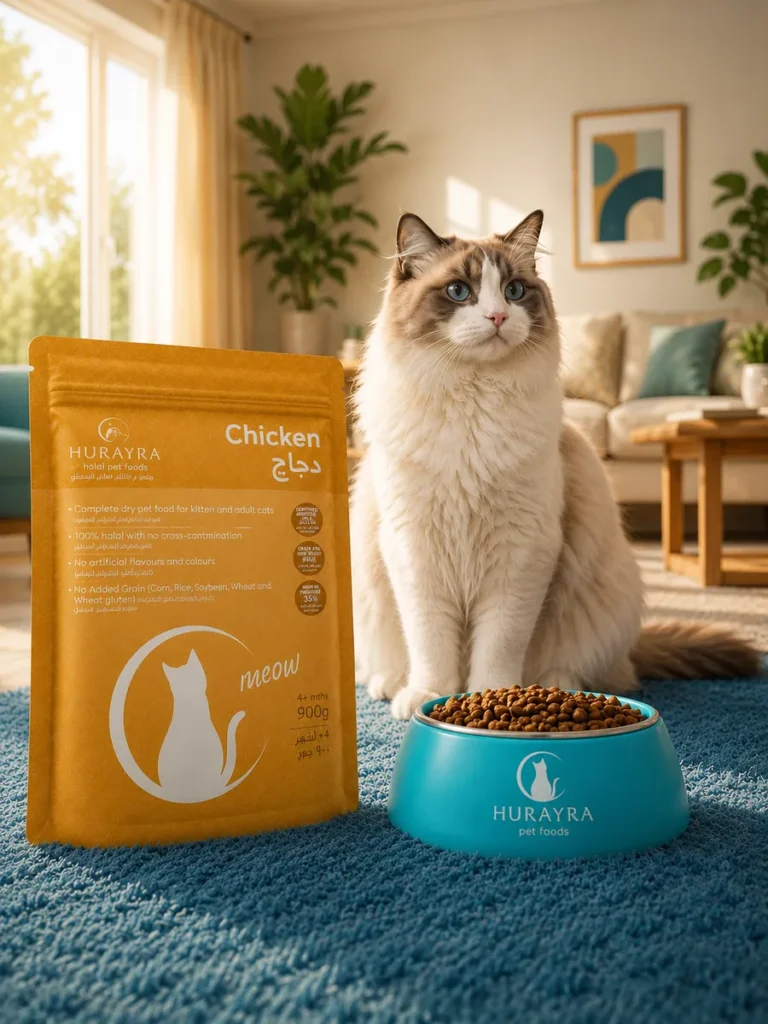
Formulation quality matters here too. A dry food made with high-quality protein and a clear, simple ingredient list is a different proposition from one built around cheap fillers. Hurayra, for example, uses high-source protein with a grain-free formulation and is ethically and halal sourced, which means the ingredient list is something owners can read and trust. That matters both nutritionally and for households where sourcing standards are part of how they make purchasing decisions.
Chicken Cat Food
Subscribe & Save 25%
When Wet Food May Be A Better Fit
Wet food is worth considering, or adding to the diet, in several situations. Cats with a history of urinary tract problems benefit from the higher moisture content, as does keeping urine less concentrated. Older cats, whose thirst response can diminish with age, are another group where wet food can help bridge the gap.
Cats recovering from illness, pregnant or lactating queens, and cats in hot climates or heated homes also have higher fluid requirements that wet food helps meet more passively. Some cats are simply reluctant drinkers regardless of what you try, and for those cats, moisture through food is the more reliable route.
There’s no rule that says you have to choose one or the other. A mixed feeding approach, such as dry food during the day and a wet meal in the evening, is a reasonable middle ground that many UK cat owners find practical.
Practical Ways To Support Hydration For Dry-Fed Cats
If your cat eats dry food and you want to support better fluid intake, a few straightforward changes make a real difference.
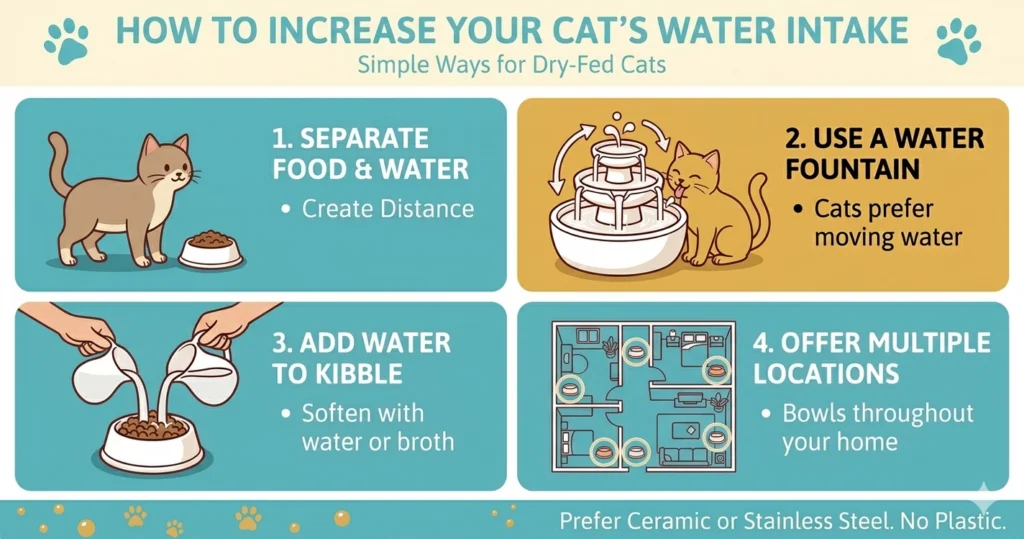
Water placement matters more than most people expect. Cats often refuse to drink from a bowl placed next to their food. In the wild, water near a carcass is likely contaminated. Placing water bowls in separate locations around the home can increase how much a cat drinks.
Many cats prefer moving water. A cat water fountain that circulates and filters continuously tends to attract more attention than a static bowl, and there’s reasonable evidence it increases daily intake in reluctant drinkers.
Adding a small amount of water to dry food, enough to soften it slightly without making it unpleasant, is another option some cats accept without complaint. It won’t match the moisture content of wet food, but it’s a step up from dry alone.
Ceramic or stainless steel bowls are preferable to plastic. Plastic can develop micro-scratches over time that harbour bacteria and affect taste. Some cats, particularly those with sensitive noses, notice this.
The Honest Answer On Dry Cat Food Hydration
Dry cat food hydration is a genuine consideration, but it’s not the straightforward health risk it’s sometimes made out to be. Cats can and do stay healthy on dry food when they drink adequately and their food is nutritionally sound. The challenge is that not all cats drink as much as they should, and that’s worth actively monitoring rather than assuming.
Understanding your own cat, how much it drinks, whether it has any urinary history, how it responds to water placement, puts you in a much better position than blanket rules about what to feed. Most cats do well with a thoughtful approach rather than an anxious one.
Hurayra is formulated with that kind of considered approach in mind: simple ingredients, honest nutrition, and a formulation built around what cats actually need. It’s one option among several for UK cat owners looking for a dry food they can feel confident about.
The goal, whatever you feed, is a cat that’s well-nourished, adequately hydrated, and thriving. That’s achievable. You just need the right information to get there.
If you’re looking for a dry cat food formulated with that in mind, Hurayra is worth exploring.
Tuna and Chicken Combo
Subscribe & Save 25%
Frequently Asked Questions
1 Do cats get hydrated from dry food?
Dry food contains very little moisture, so cats must drink enough water separately to stay properly hydrated.
2 What is the silent killer of cats?
Chronic kidney disease is often called the silent killer because it develops gradually with subtle early symptoms.
3 What is the 25 rule for cat food?
The 25 rule means a product labelled with an ingredient like “Chicken Dinner” must contain at least 25% of that ingredient.
4 Why is dry food not recommended for cats?
Dry food is sometimes discouraged because its low moisture content may not support optimal hydration for all cats.
5 Why is kibble so bad for cats?
Kibble isn’t inherently bad, but poor-quality formulas can be high in carbohydrates and low in animal protein.
6 Do cats live longer on wet or dry food?
Longevity depends more on overall nutrition and health care than food type, though wet food can better support hydration in some cats.
Dry food contains very little moisture, so cats must drink enough water separately to stay properly hydrated.
Chronic kidney disease is often called the silent killer because it develops gradually with subtle early symptoms.
The 25 rule means a product labelled with an ingredient like “Chicken Dinner” must contain at least 25% of that ingredient.
Dry food is sometimes discouraged because its low moisture content may not support optimal hydration for all cats.
Kibble isn’t inherently bad, but poor-quality formulas can be high in carbohydrates and low in animal protein.
Longevity depends more on overall nutrition and health care than food type, though wet food can better support hydration in some cats.