
 Written by Uzma Aslam
TL;DR
Omega-3 from marine sources like tuna and salmon can make a noticeable difference to your cat’s coat within weeks. The active forms, EPA and DHA, nourish skin cells and reduce inflammation. Cats cannot convert plant omega-3 from flaxseed into usable forms, so marine sources matter. Pairing quality protein with marine omega-3 supports stronger, shinier fur.
Why Your Cat’s Coat Tells You More Than You Think
A healthy cat coat is dense, smooth, and catches the light. Run your hand along the fur and it should lie flat, feel soft, and spring back into place.
A coat that looks dull, feels rough to the touch, or sheds in clumps is usually telling you something. Not about grooming frequency but about diet.
Skin is a living organ. It produces sebum, the natural oil that makes fur glossy and soft. It houses hair follicles that grow, shed, and regrow on biological cycles. And like every living system in your cat’s body, it depends on the right nutrients to do its job.
Omega-3 fatty acids, specifically EPA and DHA from marine sources, are the nutrients that most directly support skin health and coat condition. They’re also the ones most commonly absent or present in a useless form in mainstream cat food.
What Omega-3 Actually Does Inside the Skin
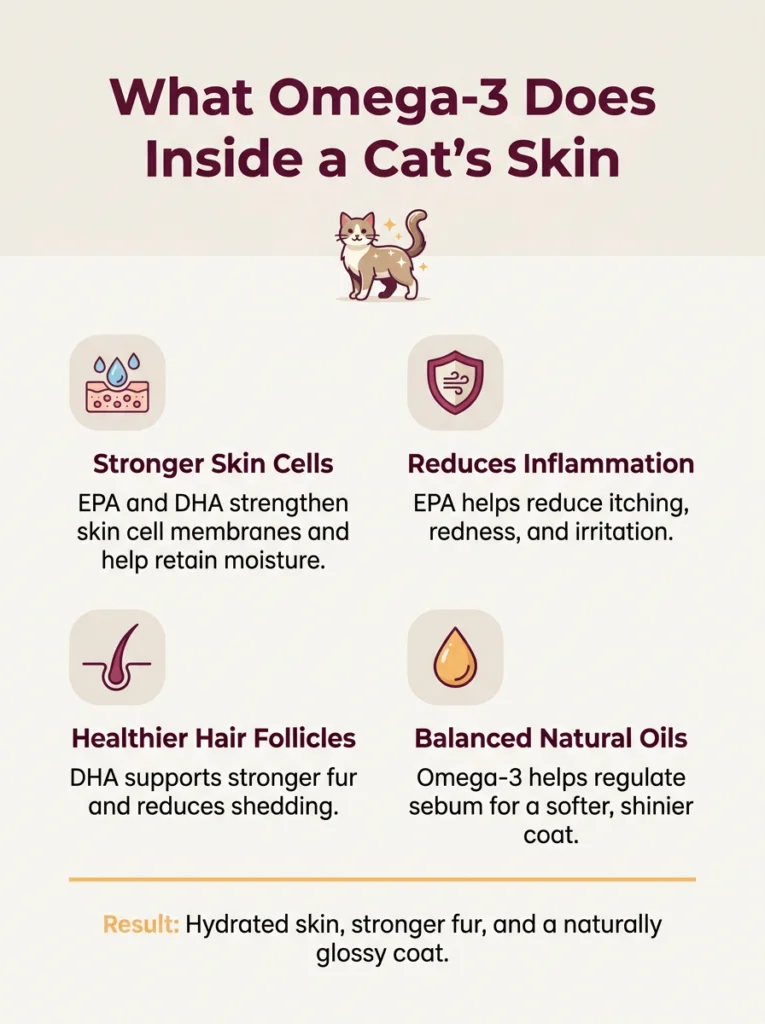
Omega-3 fatty acids are a family of fats. The ones that matter for cats are two specific long-chain forms: EPA (eicosapentaenoic acid) and DHA (docosahexaenoic acid). These are found naturally in cold-water fish, fish oils, and marine sources.
Here is what they do at the cellular level.
What Low Omega-3 Looks Like Versus What It Should Look Like
|
Signs of low or poor-quality omega-3 |
Signs of good omega-3 intake |
|
Dry, dull, or greasy coat |
Glossy, smooth coat with visible sheen |
|
Excessive shedding |
Normal, manageable shedding |
|
Flaky or itchy skin |
Supple skin with no visible flaking |
|
Brittle fur that breaks easily |
Strong, resilient hair that holds its length |
|
Brownish tinge on black fur |
True, rich coat colour maintained |
|
Frequent hairballs from excess grooming |
Less compulsive grooming, fewer hairballs |
Why Plant-Based Omega-3 Does Not Work for Cats
This is one of the more important things to understand when reading a cat food label.
Omega-3 comes in several forms. In plants like flaxseed, linseed, and hemp, the form is ALA (alpha-linolenic acid). In humans and dogs, ALA can be partially converted by the body into the EPA and DHA it actually uses. In cats, that conversion pathway barely functions at all.
Cats are obligate carnivores. They are biologically adapted to obtain nutrients directly from animal tissue, not to convert plant precursors into active forms. The delta-6 desaturase enzyme required for ALA conversion is essentially non-functional in cats. When a cat eats flaxseed oil, virtually none of the ALA becomes usable EPA or DHA.
So a label that says ‘omega-3: 0.7%’ might look reassuring. But if that omega-3 comes entirely from flaxseed, the cat gets almost none of the coat benefit. Marine sources, including fish meal, salmon oil, fish oil, and anchovy oil, deliver EPA and DHA directly. The cat can use them immediately.
This is the difference between omega-3 on paper and omega-3 that actually reaches the skin.
How Protein and Omega-3 Work Together for Coat Health
Omega-3 gets most of the attention in coat health conversations. But it only tells half the story.
The hair shaft itself is made primarily of keratin, a structural protein. A cat eating a diet low in quality protein will produce thinner, weaker hair that breaks and sheds more easily, regardless of how much omega-3 is in the food.
High-meat-content cat food with clearly named protein, chicken breast, tuna, fish meal, provides the amino acid building blocks that hair actually needs to grow strong. Vague ingredients like ‘meat derivatives’ or ‘animal protein’ give no indication of what the cat is actually eating.
The combination that works for coat health: high-quality named protein for hair structure, and marine omega-3 for skin hydration and shine. Either one alone is better than nothing. Both together is what visibly transforms a coat.
This is why the protein source and the omega-3 source on a label both deserve scrutiny.
Two Recipes, One Omega-3 Approach
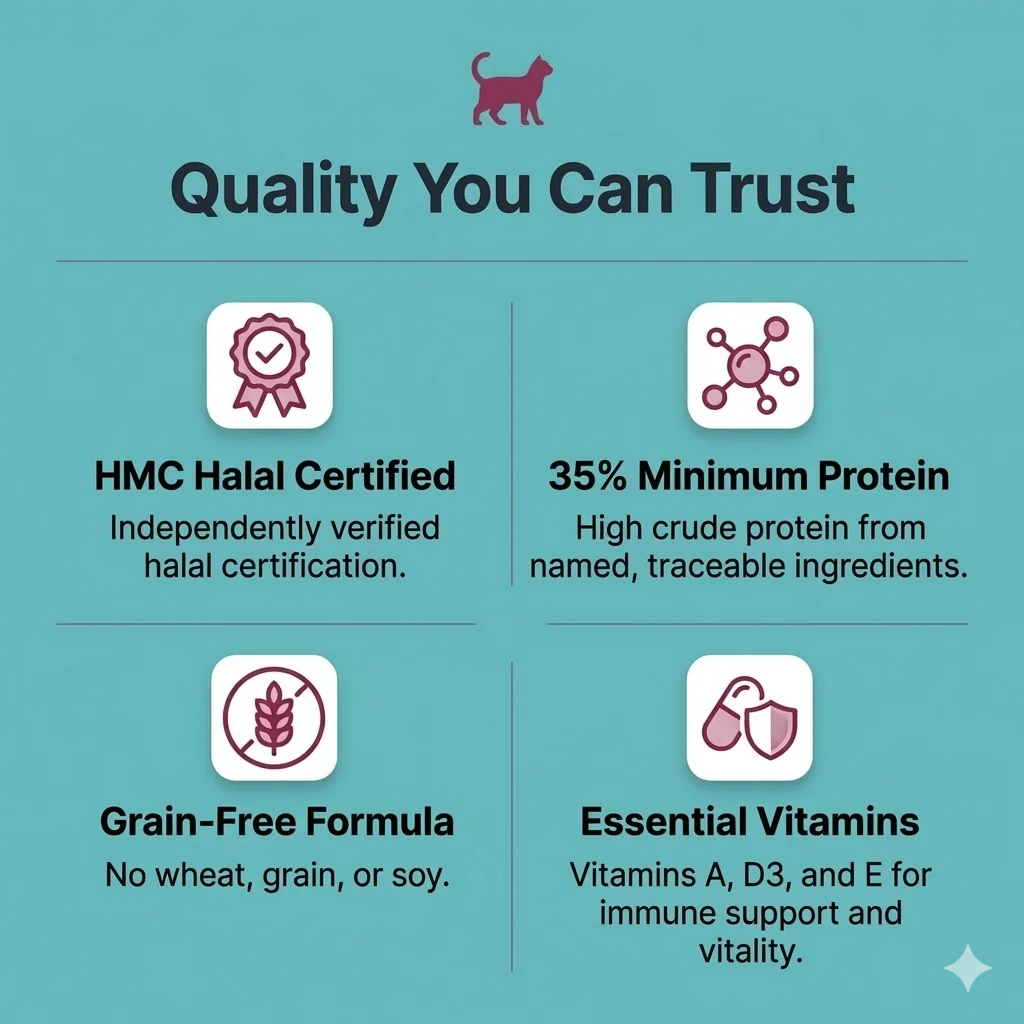
Hurayra Pet Foods produces HMC Halal-certified dry cat food in two flavours. Both are grain-free, wheat-free, and soy-free. Both use salmon oil as their declared marine omega-3 source.
Here is how the two recipes compare.
|
Feature |
Dry Chicken Cat Food |
Dry Tuna Cat Food |
|
Primary protein |
Poultry Meal (35%) |
Fish Meal (30%) + Tuna Meal (10%) |
|
Omega-3 source |
Salmon Oil (2%) |
Salmon Oil (1.5%) + Fish Meal |
|
Crude protein |
35% minimum |
35% minimum |
|
Grain, wheat & soy |
Free |
Free |
|
Halal certification |
HMC Certified |
HMC Certified |
|
Taurine |
1,500 mg/kg |
1,500 mg/kg |
|
Format |
Dry kibble, 2 x 900g bags |
Dry kibble, 2 x 900g bags |
|
Subscription price |
£19.80/month (10% off) |
£19.80/month (10% off) |
Dry Chicken Cat Food
The chicken recipe leads with Poultry Meal at 35%, delivering a 35% minimum crude protein level. Salmon Oil at 2% provides the marine omega-3 and omega-6 source for skin and coat support. The recipe also includes Digested Animal Protein (Fish), adding further marine nutrition.
For cats that prefer or do well on poultry-based food, this recipe gives them the protein foundation for strong hair growth and the marine fatty acids their skin needs to produce natural oils.
Taurine, an essential amino acid that cats cannot produce in sufficient quantities themselves, is included at 1,500 mg/kg to support heart and eye health alongside the coat benefits.
Chicken Cat Food
Subscribe & Save 25%
Dry Tuna Cat Food
The tuna recipe builds its omega-3 story more directly from fish. Fish Meal at 30% and Tuna Meal at 10% together account for 40% of the recipe by weight. Salmon Oil at 1.5% provides additional marine omega-3 and omega-6 on top of what is naturally present in the fish meals.
For cats with a preference for fish-based food, or for owners specifically focused on coat health through omega-3, the tuna recipe delivers EPA and DHA from multiple marine sources in a single food.
Protein level and taurine content match the chicken recipe at 35% minimum crude protein and 1,500 mg/kg taurine, respectively.
Dry Tuna Cat Food
Subscribe & Save 25%
HMC (Halal Monitoring Committee) certification is sometimes understood only in relation to religious requirements, but its practical value is broader. It is a supply chain audit, not just a slaughter verification. That level of traceability is relevant to any cat owner who wants to know where their cat’s food actually comes from.
What HMC Certification Actually Means?
Halal certification does not mean a cat food is nutritionally superior to a non-halal alternative. It means the sourcing, handling, and processing of ingredients have been independently verified against defined standards. For a tuna-based product, this means the fish species, sourcing method, and production process are documented and audited.
Non-Muslim cat owners sometimes find that certified products suit their preferences too, because the traceability requirements that underpin certification often align with the ingredient transparency they are already looking for. The reasons differ. The outcome, a product with clearer provenance, is the same.
Grain-free Cat Food Suitability?
Grain-free cat food is sometimes discussed as though it is categorically better than grain-inclusive food. That framing is not accurate.
Cats have a limited capacity to digest large quantities of starch and do not require grains in their diet. A grain-free formulation is appropriate for cats with known sensitivities or digestive issues. It is not automatically the right choice for every cat.
Where grain-free formulations tend to offer a genuine advantage is in the protein-to-carbohydrate ratio. When grains are excluded, the caloric contribution from protein and fat increases, which is closer to a cat’s natural dietary profile.
The Body Condition Score (BCS) scale, running from 1 (emaciated) to 9 (severely obese), with 4 to 5 as ideal, is a practical tool for assessing whether a diet is working. Your vet can demonstrate how to use it.
What Does This Mean in Practice?
The science around tuna and cats is not alarming. It is more specific than the marketing imagery suggests.
Tuna is a legitimate protein source for cats when sourced responsibly, processed appropriately, and included within a balanced diet. The associated risks are largely risks of excess and poor formulation, not of tuna itself.
For cat owners reading labels: look for named protein first, check whether the food is complete or complementary, and if tuna features regularly in your cat’s diet, ensure it comes from a product where sourcing is transparent and the formulation meets FEDIAF or equivalent standards.
Hurayra’s tuna dry food is available in Morrisons and via subscription. high protein, grain-free, HMC-certified. If you are looking for a tuna-based option with clear ingredient provenance, it is worth a look.
The best cat food is the one that consistently meets your cat’s nutritional needs. That consistency matters as much as the formula itself.
Tuna and Chicken Combo
Subscribe & Save 25%
What Chicken & Tuna Recipes Have in Common
Five Things That Tell You If a Food Will Support Coat Health
- Named protein first: Named protein first, and high.
Chicken breast, salmon, tuna, fish meal, not ‘meat’, ‘animal derivatives’, or ‘poultry by-products’. The first ingredient by weight sets the nutritional tone of the whole food.
- Omega-3 declared: Omega-3 declared on the guaranteed analysis.
If a brand lists omega-3 on the label, they are confident enough in the level to publish it. If it is absent, it either is not there in meaningful amounts or comes from a source they would rather not explain.
- Marine, not plant: Marine source, not plant source.
Look for salmon oil, fish oil, fish meal, anchovy oil, tuna meal. Avoid relying on linseed, flaxseed, or hemp oil as the primary omega-3 source. These contribute to an omega-3 number on the label but provide a cat with next to nothing.
- Complete food: Complete food, not complementary.
A complete and balanced food has been formulated to meet all your cat’s nutritional needs on its own. A complementary food has not. It needs to be paired with other foods to avoid long-term deficiencies.
- No animal derivatives: No animal derivatives in the ingredient list.
This term is a legal catch-all that can include low-quality animal parts such as beaks and hooves. Named ingredients tell you what you are actually feeding.
How Long Does It Take to See Results?
Coat improvements from dietary changes do not happen overnight. Skin cells and hair follicles operate on biological cycles. Here is a realistic timeline.
- Weeks 1 to 2: Skin hydration starts improving. Less flaking, less scratching.
- Weeks 3 to 6: New hair growth begins to come through with better texture. Existing fur may still look as it was. The improvement is in what is growing, not what is already there.
- Weeks 6 to 12: The coat visibly changes. Shine returns. Shedding normalises. Hairballs may reduce.
- 3 to 4 months: Full benefit is visible across the whole coat as old fur cycles out and new, omega-3-nourished growth takes over.
Give any dietary change at least two to three months before deciding whether it is making a difference. Switching foods and judging results after a fortnight is not a fair test.
Conclusion
A dull coat is a food problem, and a solvable one.
Marine omega-3 (EPA and DHA) nourishes skin cells, regulates natural oils, and strengthens hair follicles from the inside out. Plant-based sources like flaxseed won’t cut it, cats can’t convert them into a usable form, whatever the label suggests.
Look for named protein at the top of the ingredient list and a clearly declared marine omega-3 source. That’s what a real coat-support diet looks like.
Hurayra Pet Foods is formulated with exactly that in mind, named protein, marine omega-3, nothing doing the heavy lifting that can’t deliver. Available in store at Morrisons.
Tuna and Chicken Combo
Subscribe & Save 25%
Frequently Asked Questions
1 Can I just add a fish oil supplement to my cat’s existing food?
Yes, and it works. But there are caveats. Fish oil oxidises quickly once opened and can go rancid, which is both unpleasant and potentially harmful. Supplements made specifically for cats are a safer choice than products designed for humans. If you are already feeding a food with declared marine omega-3, an additional supplement may not be necessary. Too much omega-3 can cause digestive upset and affect blood clotting.
2 Why does my black cat have a brownish tinge to their coat??
A reddish or brownish tinge in a black cat is often a sign of tyrosine deficiency. Tyrosine is an amino acid involved in melanin production, the pigment that gives black fur its depth. Studies have shown that low dietary tyrosine causes a measurable shift from black eumelanin to brownish pheomelanin. It can also appear alongside low omega-3 or insufficient high-quality protein. Switching to a higher-meat-content food typically resolves this within a few months.
3 Does wet food help more than dry food for coat health?
Hydration matters. A cat eating dry food exclusively often drinks less than they need, and dehydration itself can contribute to dry, dull skin and coat. Wet food significantly increases total water intake, which supports skin health from the inside. If your cat is on dry food, ensuring they have constant access to fresh water and encouraging drinking helps. Some owners add a small amount of water or low-salt fish broth to dry food to increase moisture intake.
4 My cat doesn’t like fish. Can they still get enough omega-3?
Yes. Salmon oil can be incorporated into chicken-based recipes without significantly changing the flavour profile. Most cats do not notice it when it is blended into a food rather than presented as a standalone ingredient. Hurayra’s Chicken recipe, for example, includes Salmon Oil as a coat-support ingredient without the food tasting like fish.
5 Is omega-3 just a coat thing, or does it do more?
Much more. EPA and DHA support joint health, which matters particularly for older cats. They also play roles in kidney function, heart rhythm regulation, immune response, and cognitive function. The coat is the most visible indicator but the benefits run throughout the body. A cat with a genuinely great coat from good omega-3 intake is almost certainly healthier in ways that are harder to see.
Yes, and it works. But there are caveats. Fish oil oxidises quickly once opened and can go rancid, which is both unpleasant and potentially harmful. Supplements made specifically for cats are a safer choice than products designed for humans. If you are already feeding a food with declared marine omega-3, an additional supplement may not be necessary. Too much omega-3 can cause digestive upset and affect blood clotting.
A reddish or brownish tinge in a black cat is often a sign of tyrosine deficiency. Tyrosine is an amino acid involved in melanin production, the pigment that gives black fur its depth. Studies have shown that low dietary tyrosine causes a measurable shift from black eumelanin to brownish pheomelanin. It can also appear alongside low omega-3 or insufficient high-quality protein. Switching to a higher-meat-content food typically resolves this within a few months.
Hydration matters. A cat eating dry food exclusively often drinks less than they need, and dehydration itself can contribute to dry, dull skin and coat. Wet food significantly increases total water intake, which supports skin health from the inside. If your cat is on dry food, ensuring they have constant access to fresh water and encouraging drinking helps. Some owners add a small amount of water or low-salt fish broth to dry food to increase moisture intake.
Yes. Salmon oil can be incorporated into chicken-based recipes without significantly changing the flavour profile. Most cats do not notice it when it is blended into a food rather than presented as a standalone ingredient. Hurayra’s Chicken recipe, for example, includes Salmon Oil as a coat-support ingredient without the food tasting like fish.
Much more. EPA and DHA support joint health, which matters particularly for older cats. They also play roles in kidney function, heart rhythm regulation, immune response, and cognitive function. The coat is the most visible indicator but the benefits run throughout the body. A cat with a genuinely great coat from good omega-3 intake is almost certainly healthier in ways that are harder to see.

One comment
Comments are closed.