Written by Saniya Ahmed
The debate has been running for years. Pet food shelves now split almost evenly between grain-free and grain-inclusive options, and the marketing on both sides has made the choice harder, not easier.
Grain-free is pitched as more natural. Grain-inclusive is defended as nutritionally complete. Neither framing tells you what your cat actually needs.
This article explains the grain-free vs grain cat food question from first principles: what cats are built to eat, what role grain plays in commercial formulas, when grain-free is genuinely the better option, and how to read a label well enough to make an informed choice.
What Cats Are Built To Eat
Cats are obligate carnivores. This is not a lifestyle preference. It is a fixed physiological fact.
Unlike dogs, cats cannot synthesise certain amino acids from plant sources. Taurine, arginine, and arachidonic acid must come from animal tissue. A cat fed without sufficient animal protein will develop deficiencies that affect cardiac function, vision, and immune response.
In the wild, a cat’s diet is roughly 52% protein, 46% fat, and under 2% carbohydrate. This breakdown is cited consistently across recent feline nutrition literature, including a 2025 meta-analysis in the Journal of Animal Science examining carbohydrate intake across 16 cat diet studies.
Commercial cat food cannot replicate those ratios exactly. Kibble requires a binding agent to hold its shape, and carbohydrates, including grains, serve that structural function.
This is where the grain-free vs grain cat food conversation actually starts: not with health ideology, but with manufacturing practicality and nutritional priority.
What Grain Does In Cat Food And What It Does Not Do
Grain in cat food is primarily a carbohydrate source. Corn, wheat, rice, and barley all appear in grain-inclusive formulas. They provide energy, help bind kibble, and in some cases contribute small amounts of fibre.
What grain does not do is make a formula nutritionally superior. The quality of any food is determined by what comes before the grain on the ingredient list.
Specifically: is the first ingredient a named animal protein such as chicken, salmon, or turkey? Or is it a vague derivative such as meat meal or animal protein?
Cats can metabolise dietary carbohydrates, but their physiology is not designed for high-carbohydrate loads. A 2025 meta-analysis in the Journal of Animal Science, reviewing 16 controlled studies, found that carbohydrates ranging from 2.8% to 57% metabolisable energy did not increase body fat, fasted insulin, or blood glucose in cats.
Grain is not inherently harmful. The problem arises when grain displaces protein, when a formula uses wheat or corn to bulk out a recipe that should be leading with meat.
The question is never simply “does this contain grain?” It is “what percentage of this food is quality animal protein, and what is it displaced by?”
The Grain-Free Vs Grain Cat Food Debate, Explained Clearly
Grain-free cat food replaces traditional grains with alternative carbohydrate sources: sweet potato, peas, lentils, chickpeas, or tapioca. These ingredients serve the same structural purpose as grain. They bind the product.
They are not inherently lower in carbohydrate than grain-inclusive alternatives. This matters because grain-free is often conflated with low-carb or even raw-equivalent nutrition. It is not.
A grain-free kibble with pea protein as its second ingredient may have a lower quality protein profile than a grain-inclusive formula with salmon as its first ingredient and brown rice further down the list.
FEDIAF, the European Pet Food Industry Federation that sets nutritional standards across the UK and EU, recommends minimum crude protein levels of 25% for adult cats on a dry matter basis.
The actual protein source and its digestibility matter as much as the percentage. When comparing grain-free vs grain cat food, the more productive question is: what does the first named ingredient tell you about this product’s nutritional intent?
When Grain-Free Is The Right Choice
Grain-free formulas are genuinely useful in specific circumstances.
Some cats develop intolerances to particular grains, most commonly wheat. Symptoms include loose stools, excessive flatulence, skin irritation, or a dull coat.
If these signs appear and cannot be explained by other causes, a trial on a single-protein, grain-free formula can help identify whether grain is involved.
Cats with known food sensitivities often do better on limited-ingredient diets, which are frequently grain-free by design. Single-source protein formulas, meaning one named meat with no secondary protein sources, make it easier to identify and eliminate dietary triggers.
Grain-free is also a reasonable choice for cats that are overweight or assessed at a higher body condition score. Veterinary body condition scoring uses a 1 to 9 scale, where 5 is ideal.
Cats scoring 6 or above can benefit from a lower-carbohydrate diet. Grain-free formulas with named protein sources making up above 70% of the recipe support that goal more directly.
For cats without food sensitivities and at a healthy body condition score, grain-inclusive food is not a lesser choice. It depends entirely on formulation quality.
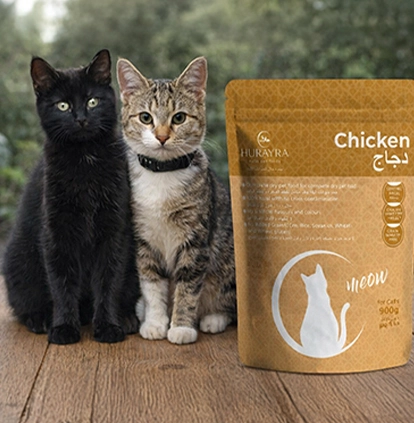
Chicken Cat Food
Pack of 2
View Product
What To Look For In Either Formulation
Whether you choose grain-inclusive or grain-free, the evaluation process is the same.
Check the first three ingredients. In UK pet food, ingredients are listed in descending order by weight before cooking. A named meat first — chicken, salmon, duck, or lamb — is a good sign. “Animal derivatives” or “cereals” is not.
Look for crude protein above 30% on dry matter. Reputable grain-free formulas for adult cats typically sit between 32% and 42%. Quality grain-inclusive formulas sit between 28% and 36%.
Avoid anonymous ingredients. “Meat and animal derivatives” is a catch-all that can change between batches. Named proteins do not. If the label says chicken, the protein source is chicken, batch to batch.
Consistency matters for gut health. Frequent formula changes disrupt the gut microbiome. If you find a food that works, maintaining it reduces digestive disruption.
This is one reason subscription feeding has practical nutritional logic beyond convenience. The same formula, reliably, is better for your cat’s digestive stability than variety for its own sake.
A Note On Halal Certification And Ingredient Traceability
Some cat owners, Muslim and non-Muslim alike, choose halal-certified pet food not primarily for religious reasons but because of what certification implies about supply chain oversight.
HMC (Halal Monitoring Committee) certification in the UK requires audit of the entire production chain, from slaughter method to processing to packaging. The protein source is traceable, the slaughter is monitored, and the facility meets defined hygiene and handling standards.
That traceability is the practical value of certification.
Halal certification does not make a formula nutritionally superior. A halal-certified food with poor protein sourcing is still a poor-quality food.
The benefit is transparency and supply chain confidence, particularly relevant for owners who want to know exactly where the meat in their cat’s food came from.
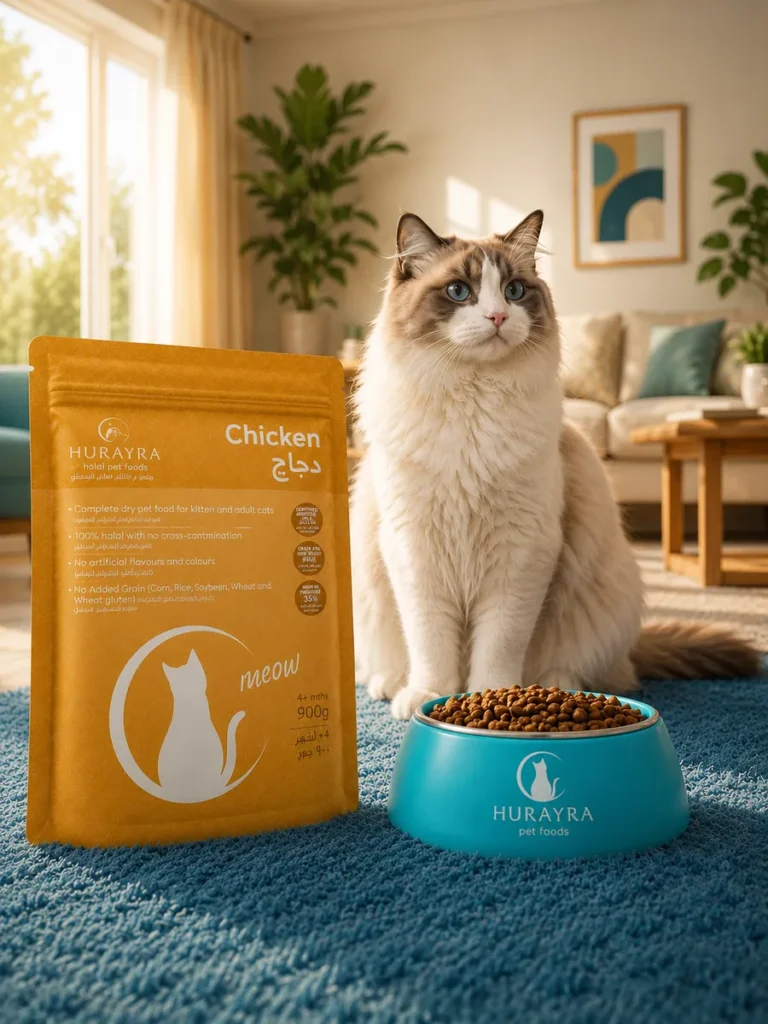
Hurayra uses HMC-certified high protein with full traceability from farm to formula. Available in Morrisons stores, Hurayra’s grain-free recipes contain no wheat, corn, or soy, with named chicken or salmon as the primary ingredient.
Subscription is available for owners who want feeding consistency without the weekly decision.
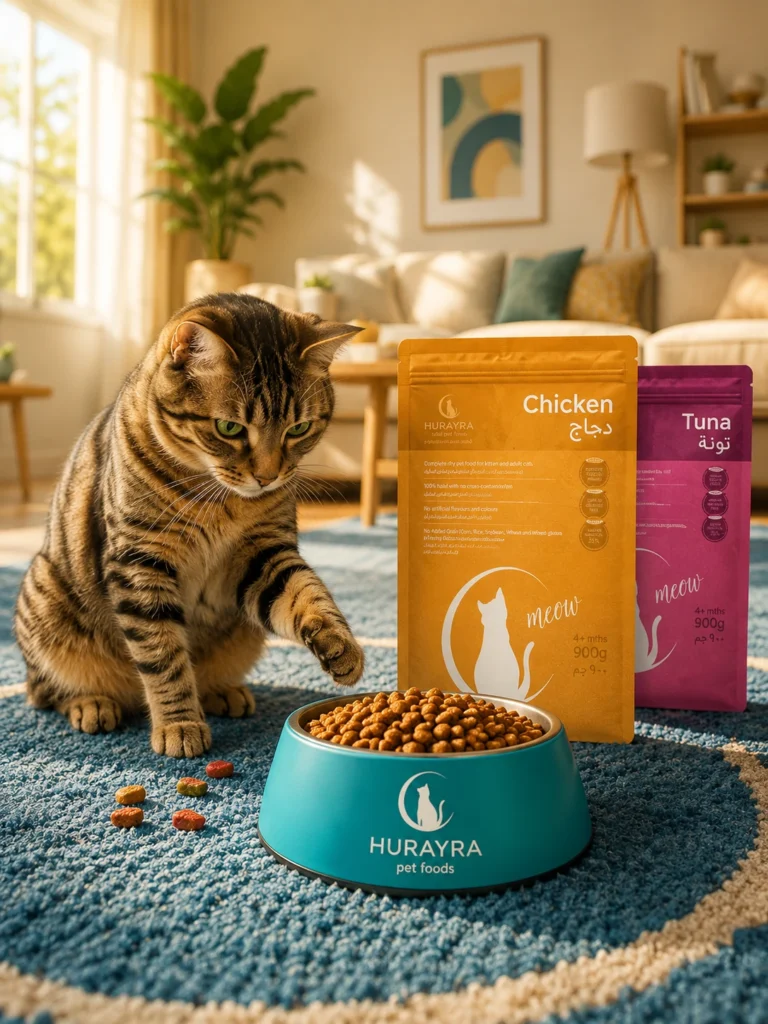
Dry Tuna Cat Food
Subscribe & Save 25%
View Product
Gluten-Free Vs Grain-Free: Not The Same Thing
Gluten-free cat food removes gluten-containing grains, specifically wheat, barley, and rye, but may retain others such as rice or corn. Grain-free cat food removes all grains entirely. They are not interchangeable terms.
Most cats are not gluten-sensitive in the way some humans are. True gluten intolerance in cats is rare and distinct from general grain sensitivity.
If your vet suspects a specific gluten reaction, a gluten-free grain-inclusive formula may resolve the issue without requiring full grain elimination.
If you are unsure, a structured elimination diet supervised by a vet or veterinary nutritionist is the reliable way to identify the trigger. Switching to grain-free on assumption is not.
Conclusion
The grain-free vs grain cat food question does not have one answer. It has a process.
Start with protein source and quality. Check the first three ingredients. Know your cat’s body condition score and adjust for it. If your cat shows signs of food sensitivity, investigate rather than assuming.
Grain-free is not automatically better. Grain-inclusive is not automatically inferior. Both categories contain excellent foods and poor-quality ones. The label tells you which is which, if you know what to read.
Hurayra’s grain-free formulas are available in Morrisons and on subscription at hurayra.co.uk. high protein, HMC-certified, no wheat, corn, or soy.
Tuna and Chicken Combo
Pack of 2
View Product
Frequently Asked Questions
1 Is grain-free cat food better than grain-inclusive cat food?
Not automatically. Protein quality determines the winner, not whether the formula contains grain.
2 Can cats digest grain?
Yes, cooked starches are digestible for most cats. The problem is when grain displaces protein, not when it sits alongside it.
3 Is grain-free cat food the same as gluten-free?
No. Grain-free removes all grains. Gluten-free removes only wheat, barley, and rye. Most cats need neither distinction.
4 What should I look for in grain-free cat food?
A named meat as the first ingredient, crude protein above 30% dry matter, and no anonymous derivatives.
5 Is halal cat food nutritionally different from standard cat food?
No. HMC certification is a traceability standard, not a nutritional one.
6 How do I know if my cat has a grain sensitivity?
Persistent loose stools, skin irritation, or a dull coat without another explanation are the signs worth investigating with your vet.
Not automatically. Protein quality determines the winner, not whether the formula contains grain.
Yes, cooked starches are digestible for most cats. The problem is when grain displaces protein, not when it sits alongside it.
No. Grain-free removes all grains. Gluten-free removes only wheat, barley, and rye. Most cats need neither distinction.
A named meat as the first ingredient, crude protein above 30% dry matter, and no anonymous derivatives.
No. HMC certification is a traceability standard, not a nutritional one.
Persistent loose stools, skin irritation, or a dull coat without another explanation are the signs worth investigating with your vet.