
 Written by Uzma Aslam
Vitamin D for Cats: Why Most Indoor Cats Are Deficient
Your cat is not a small dog. And they are not miniature humans. The way their body processes sunlight, one of the most common assumptions pet owners carry reflects this difference in a way that genuinely matters for their long-term health.
Most indoor cats in the UK and US are vitamin D deficient. The research supports this, and the physiology explains it. Yet the topic rarely appears on food packaging, and most owners only encounter it after a vet flags a problem. This article addresses that gap.
What follows is a straightforward account of how cats obtain and use vitamin D, why indoor life creates a structural deficiency, what to look for in cat food, and how to assess whether your cat’s current diet is actually meeting their needs.
Why Cats Cannot Rely on Sunlight for Vitamin D?
This is the point most people get wrong, and it is worth being direct about it.
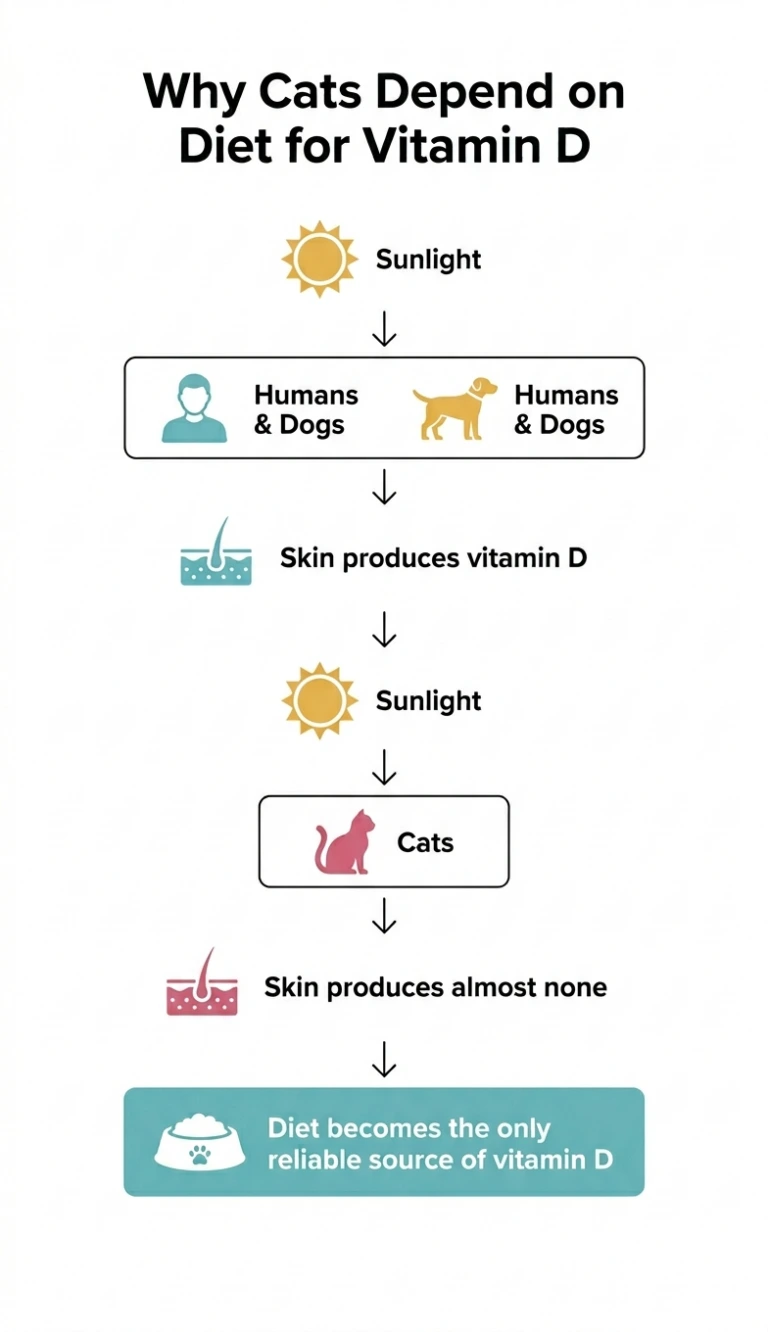
Humans and dogs synthesise vitamin D when UV-B light hits the skin. The skin converts a cholesterol precursor into a usable form of the vitamin, which then enters circulation. It is an efficient system, and for those species, outdoor time genuinely contributes to vitamin D status.
Cats do not work this way. Feline skin has very limited capacity to synthesise vitamin D from sunlight. A 1999 study published in the Journal of Nutrition confirmed that UV-B exposure does not raise serum 25-hydroxyvitamin D levels in cats. The biological pathway is present but functionally negligible.
What cats produce through sun exposure is negligible. What they absorb through grooming is also negligible, because the vitamin D that does form on the fur surface is not efficiently converted once ingested. Cats are, in this respect, almost entirely dependent on dietary sources.
This matters particularly for indoor cat vitamin D status, where even the limited UV-B exposure from outdoor life is removed. But it matters equally for outdoor cats, whose sun exposure was never providing much to begin with.
The honest conclusion: if vitamin D is not in the food, your cat is not getting it.
What Vitamin D Does in a Cat’s Body?
Vitamin D is not simply a bone nutrient, though bone health is where deficiency tends to become most visible. In cats, it operates across several physiological systems.
Calcium and phosphorus regulation. Vitamin D governs how much calcium and phosphorus the intestine absorbs, and how the kidneys manage their excretion. Without sufficient vitamin D, calcium absorption falls even when dietary calcium is adequate. Bones lose density. In young cats, this can produce rickets. In older cats, it accelerates skeletal degradation.
Immune function. Vitamin D receptors are present on immune cells, and adequate levels are associated with normal immune responses. The link between chronic vitamin D deficiency and increased disease susceptibility in cats is not fully characterised, but the receptor presence is not incidental.
Muscle function. Low vitamin D affects skeletal muscle performance. In cats showing generalised weakness or reluctance to jump, nutritional causes including vitamin D status are worth considering.
Cardiovascular health. Research in feline cardiology has associated low vitamin D levels with hypertrophic cardiomyopathy, one of the most common heart conditions in domestic cats. The relationship is observational, not fully causal, but it appears in the literature with sufficient consistency to be taken seriously.
FEDIAF, the European trade body that sets nutritional guidelines for pet food, specifies minimum vitamin D levels in complete cat food. For adult cats, the recommended minimum is 280 IU per kilogram of dry matter. For growing kittens, the requirement is higher. A complete cat food that meets FEDIAF standards will carry this on its label or in its nutritional specification. If the vitamin D content is not listed, that is itself informative.
How Cat Vitamin D Deficiency Develops
Deficiency is rarely acute. It accumulates.
A cat fed a nutritionally incomplete diet, or a diet that technically lists vitamin D but in insufficient quantities, will deplete its stores over months. The early signs are non-specific: reduced activity, subtle changes in coat condition, reluctance to engage in normal movement. By the time bone changes are visible on radiograph, the deficiency has been present for some time.
Cats fed exclusively on home-cooked or raw diets are at particular risk, unless the diet has been formulated by a veterinary nutritionist. Plain chicken breast, for example, contains very little vitamin D. Muscle meat in general is a poor source. Liver from certain fish species contains meaningful amounts, but liver is also high in vitamin A, and excess vitamin A in cats produces its own toxicity. Getting the balance right without professional formulation is genuinely difficult.
Cats fed a commercial complete diet that meets recognised nutritional standards should, in theory, be receiving adequate vitamin D. The word should is doing some work there. Not all commercial diets are formulated to the same standard, and not all labelling is clear about the specific nutrient profile.
If your cat has reduced appetite, moves stiffly, or seems reluctant to use stairs or jump to familiar surfaces, a vet assessment that includes a vitamin D blood panel is worth requesting. Normal feline serum 25-hydroxyvitamin D values are typically considered to fall in the range of 60–150 nmol/L, though reference ranges vary by laboratory.
It is also worth noting that vitamin D status is just one piece of the nutritional picture. Common cat food myths around complete nutrition can lead owners to overlook gaps like this one for years.
Reading Cat Food Labels for Vitamin D
The practical question for most owners is: how do I know whether the food I am buying contains enough?
A few points of guidance.
First, look for foods labelled as “complete” rather than “complementary.” A complementary food is formulated to be fed alongside other foods. Only a complete food is designed to meet the full nutritional requirement. Most pouches and dry formulations are complete; many treats and toppers are not.
Second, check whether vitamin D is listed in the guaranteed analysis or nutritional declaration. In the UK, FEDIAF-compliant manufacturers are required to list vitamins in their formulations. If a brand does not publish this information and does not make it available on request, that is a reason to look elsewhere.
Third, consider the protein source. Vitamin D in cat food most commonly comes from animal tissue, particularly fish, organ meat, and fortified liver. A food with a named animal protein as its primary ingredient carries a more meaningful natural vitamin D contribution before fortification. A food where the first ingredient is a derivative or meal of unnamed origin offers less clarity.
Chicken and tuna are among the most common named proteins in quality cat food. Both carry nutritional profiles that contribute to a complete formulation when used correctly. The critical factor is that the protein is named, sourced transparently, and supported by a verified nutritional specification.
Understanding what goes into your cat’s food is worth the time. Hurayra’s full ingredient breakdown explains exactly what each component contributes to feline health and why ingredient transparency matters for owners who want confidence in what they are feeding.
What to Do Next
The gap in most indoor cats’ diets is not dramatic. It is structural and slow-moving, which is exactly why it goes unnoticed.
Start by checking your current food against FEDIAF nutritional standards. If the brand does not publish its vitamin and mineral profile, contact them and ask. A manufacturer confident in their formulation will answer that question directly.
If your cat shows signs consistent with deficiency, such as stiffness, lethargy, reduced appetite, or reluctance to jump, request a serum 25-hydroxyvitamin D panel from your vet. It is a straightforward blood test, and the result will tell you whether a dietary change is actually necessary.
If you are considering switching foods, the cat transition guide walks through how to introduce a new diet without disrupting your cat’s digestive health.
Hurayra’s formulations use single-source named protein, meet FEDIAF nutritional standards, and are fully HMC-certified for traceability. Products are available at Morrisons and through subscription on the Hurayra website. The nutritional specification is published. The protein source is named.
Your cat cannot tell you what is missing from their diet. That responsibility sits with the food you choose.
Tuna and Chicken Combo
Subscribe & Save 25%
Frequently Asked Questions
1 Does my indoor cat need a vitamin D supplement?
Possibly, but supplementation without veterinary guidance carries genuine risk. Vitamin D toxicity in cats produces hypercalcaemia, which can damage the kidneys. Do not supplement without a blood panel establishing that deficiency exists, and without professional guidance on dosing. The better route for most owners is to ensure the primary diet is nutritionally complete and independently verified.
2 Is grain-free cat food better for vitamin D levels?
Grain-free formulations can suit cats with specific intolerances or owners who prefer ingredient profiles closer to a cat’s natural diet, but grain-free is a suitability consideration, not a vitamin guarantee. For a fuller examination of this topic, the comparison between grain-free and grain-inclusive cat food is worth reading alongside this article.
3 Can halal cat food meet the same nutritional standards?
Yes. HMC-certified halal pet food, such as that produced by Hurayra, is certified for traceability and slaughter method. It has no bearing on the nutritional specification, which is determined independently by the formulation. Halal certification addresses how the animal protein is sourced and processed, not whether the food contains adequate vitamins.
Hurayra’s halal formulations are developed to the same FEDIAF standards as any complete cat food. Owners who choose halal pet food for ethical or religious reasons can do so without any nutritional compromise. The why halal page covers the certification process and what HMC traceability actually means in practice.
4 My cat eats both wet and dry food. Does that affect vitamin D intake?
It depends on whether both elements are complete foods and whether the combined feeding amounts add up to the recommended daily intake. If you feed half the recommended portion of wet food and half the recommended portion of dry food, the combined vitamin D intake should approximate what either would deliver at full portion, assuming both are complete.
Where owners run into problems is feeding a primary complete diet alongside a complementary product as though both are complete. Check the label before combining. The dry cat food hydration guide is also relevant here for owners managing mixed feeding routines.
5 How do I know if my cat’s body condition is connected to a nutritional problem?
Body condition scoring (BCS) uses a 1–9 scale. Scores of 1–3 indicate underweight, 4–5 are ideal, and 6–9 indicate overweight through obese. Cats with chronic nutritional deficiencies often present at the lower end of this scale, and low muscle mass is a particularly observable sign.
BCS alone does not indicate vitamin D status; a blood panel is needed for that. BCS is most useful for monitoring overall nutritional health over time, and it is worth reassessing seasonally. Seasonal feeding adjustments for UK cats are worth factoring into any nutritional review.
Possibly, but supplementation without veterinary guidance carries genuine risk. Vitamin D toxicity in cats produces hypercalcaemia, which can damage the kidneys. Do not supplement without a blood panel establishing that deficiency exists, and without professional guidance on dosing. The better route for most owners is to ensure the primary diet is nutritionally complete and independently verified.
Grain-free formulations can suit cats with specific intolerances or owners who prefer ingredient profiles closer to a cat’s natural diet, but grain-free is a suitability consideration, not a vitamin guarantee. For a fuller examination of this topic, the comparison between grain-free and grain-inclusive cat food is worth reading alongside this article.
Yes. HMC-certified halal pet food, such as that produced by Hurayra, is certified for traceability and slaughter method. It has no bearing on the nutritional specification, which is determined independently by the formulation. Halal certification addresses how the animal protein is sourced and processed, not whether the food contains adequate vitamins.
Hurayra’s halal formulations are developed to the same FEDIAF standards as any complete cat food. Owners who choose halal pet food for ethical or religious reasons can do so without any nutritional compromise. The why halal page covers the certification process and what HMC traceability actually means in practice.
It depends on whether both elements are complete foods and whether the combined feeding amounts add up to the recommended daily intake. If you feed half the recommended portion of wet food and half the recommended portion of dry food, the combined vitamin D intake should approximate what either would deliver at full portion, assuming both are complete.
Where owners run into problems is feeding a primary complete diet alongside a complementary product as though both are complete. Check the label before combining. The dry cat food hydration guide is also relevant here for owners managing mixed feeding routines.
Body condition scoring (BCS) uses a 1–9 scale. Scores of 1–3 indicate underweight, 4–5 are ideal, and 6–9 indicate overweight through obese. Cats with chronic nutritional deficiencies often present at the lower end of this scale, and low muscle mass is a particularly observable sign.
BCS alone does not indicate vitamin D status; a blood panel is needed for that. BCS is most useful for monitoring overall nutritional health over time, and it is worth reassessing seasonally. Seasonal feeding adjustments for UK cats are worth factoring into any nutritional review.

One comment
Comments are closed.