Written by Uzma Aslam
TL;DR
A dull coat is usually a diet problem. Cats need named animal protein, marine omega-3, and consistent feeding to maintain coat health. Check the first three ingredients, look for fish oil, and aim for 30% crude protein or above.
What Causes a Dull Cat Coat? Diet, Deficiencies & Fixes
A cat’s coat doesn’t lie. Before behaviour changes, before weight fluctuates, before a vet visit confirms anything, the coat signals it first.
If your cat’s fur has lost its sheen, feels coarser than it used to, or sheds more than seems normal, there’s usually a reason worth investigating. In most cases, that reason starts with what’s in the bowl.
This article explains the main causes of a dull cat coat, why diet sits at the centre of coat health, and what you can actually do about it, without overcomplicating the science.
Why Coat Quality Matters More Than It Looks
Most cat owners notice a dull coat but aren’t sure whether it warrants attention. It does.
A cat’s coat is one of the most resource-intensive tissues the body maintains. Keratin production, the structural protein that makes fur strong and smooth, depends on a continuous supply of amino acids, fatty acids, and fat-soluble vitamins. When any of these fall short, the body deprioritises the coat in favour of organs and systems that are more immediately critical to survival.
What you see on the outside is, in a real sense, a visible record of what has been happening on the inside for the past several weeks.
The Most Common Causes of a Dull Cat Coat
Dullness in a cat’s coat rarely has a named cause. It usually reflects one or more of the following:
Nutritional deficiency: the most frequent cause and the most correctable. Insufficient protein, missing fatty acids, or inadequate fat-soluble vitamins all degrade coat quality over time.
Low protein quality or digestibility: a food with a reasonable protein percentage on the label can still deliver poor amino acid availability if the protein source is plant-based, unnamed, or heavily processed. Cats are obligate carnivores. Their digestive systems are built to extract nutrition from animal tissue, not grain derivatives or soy.
Dehydration: dry, inelastic skin beneath a dull coat is often a sign of chronic low-level dehydration, particularly in cats fed exclusively dry food without adequate water intake.
Underlying health conditions: hyperthyroidism, kidney disease, parasites, and allergies all manifest in coat condition. If diet has been adequate and the coat continues to deteriorate, a veterinary check is the right next step.
Stress and environmental factors: multi-cat households, frequent routine changes, and indoor-only conditions without enrichment can all suppress grooming behaviour and cortisol regulation, with visible coat effects.
For the purpose of this article, we focus on diet, because it is both the most common root cause and the one most directly within your control.
How Nutritional Deficiency Causes Dull Cat Fur
Omega Fatty Acids
Omega-3, -6, and -9 fatty acids are structural components of skin cells. Without adequate levels, the skin barrier weakens, moisture escapes, and the coat becomes dry, brittle, and visually flat.
Omega-3 specifically has anti-inflammatory properties that help manage skin conditions associated with over-grooming, flaking, and redness. Omega-6, found in poultry fat and certain fish oils, supports sebum production, the natural oils that give fur its shine.
Most low-to-mid-range cat foods include some omega fatty acids. What varies significantly is the source quality and whether they survive the manufacturing process intact. Heat-degraded oils contribute little. Cold-processed or encapsulated omega sources retain their function.
You can read more about the role of omega-3, 6 and 9 in cat nutrition and why source quality matters.
Protein Level and Named Protein Sources
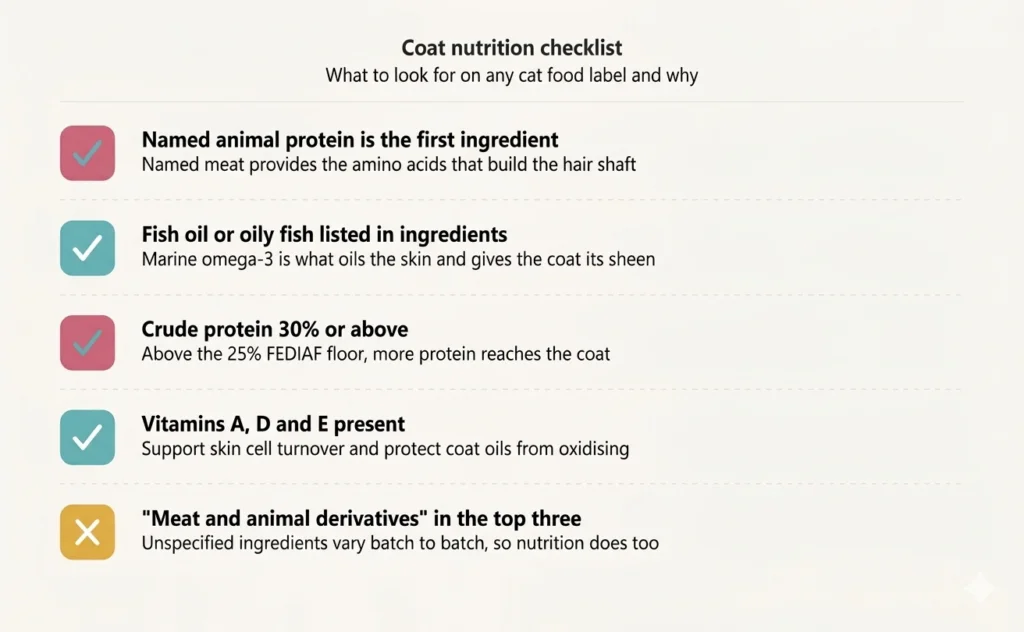
Amino acids are the building blocks of keratin. A food delivering less than 30% crude protein on a dry matter basis is unlikely to support consistent coat quality in an adult cat. FEDIAF, the European industry body that sets nutritional guidelines for companion animal food, sets minimum protein requirements for adult cats at 25g per 100g dry matter. Quality formulations typically exceed this.
But percentage alone does not tell the full story. Protein from named animal sources like chicken, tuna, salmon, and turkey carries a different amino acid profile than protein from unnamed “meat derivatives” or plant-based fillers. Taurine, methionine, and cysteine, all essential for feline coat and skin health, are found almost exclusively in animal tissue.
When checking a cat food label, the first ingredient should be a named protein. If it isn’t, or if the first named protein appears third or fourth on the list, that formulation is not primarily protein-driven.
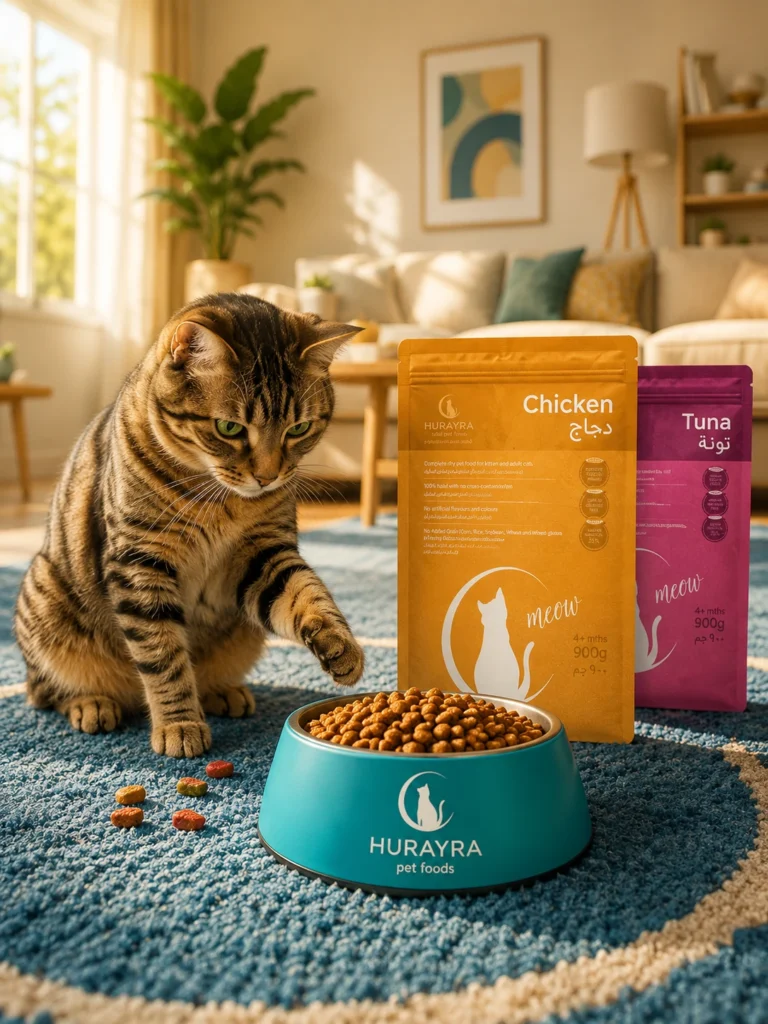
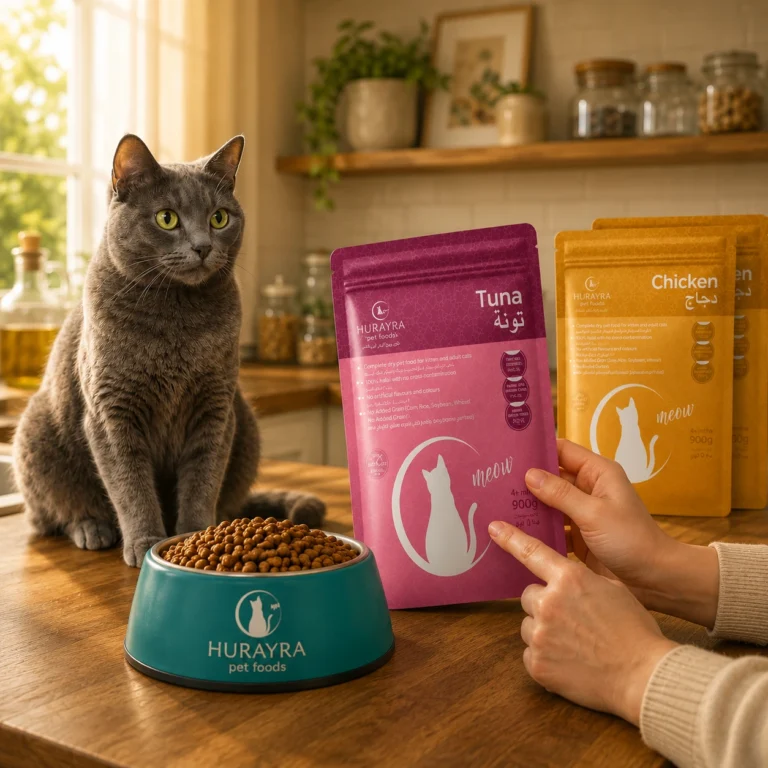
Hurayra’s dry cat food is formulated to 35% protein from named sources, chicken and tuna, which exceeds FEDIAF minimum recommendations for adult cats and ensures the amino acid profile required for coat maintenance is met consistently.
Chicken Cat Food
Subscribe & Save 25%
Vitamins A, D, and E
These three fat-soluble vitamins each play a specific role in skin and coat health. A deficiency in any one of them creates visible effects over time.
Vitamin A supports cell turnover in skin tissue. Deficiency leads to flaking, thickened skin, and a rough, unkempt coat appearance. Unlike dogs, cats cannot convert beta-carotene from plant sources into Vitamin A. They require pre-formed retinol from animal liver or fish. This makes named animal protein sources not just preferable but functionally necessary.
Vitamin D regulates calcium and phosphorus balance, which affects bone and muscle function but also skin cell regulation. Indoor cats in particular are at risk of subclinical deficiency, since they receive no UV exposure. Dietary provision becomes the only reliable source.
Vitamin E is an antioxidant that protects skin cell membranes from oxidative damage. It also stabilises omega fatty acids in food, which is why high-quality formulations include Vitamin E not just as a nutrient but as a natural preservation mechanism.
What to Feed Your Cat for a Better Coat
Diet changes to improve coat condition work gradually. Most owners see visible improvement within eight to twelve weeks of a consistent switch to a nutritionally complete, animal-protein-led diet. Expecting results in two weeks is unrealistic; expecting none after three months means the dietary change is insufficient or another cause is in play.
The most effective dietary approach combines four things:
Named animal protein as the primary ingredient. Chicken and tuna are the most commonly used in quality formulations and both deliver the taurine, methionine, and cysteine profile cats require. Look for these listed first on the ingredient panel. The protein-rich page goes into further detail on why source matters for cats specifically.
Omega fatty acids from quality sources. Fish-derived omega-3 is more bioavailable for cats than plant-derived alternatives. The omega-6 to omega-3 ratio in the food affects skin inflammatory response; a ratio between 5:1 and 10:1 is widely considered appropriate for skin health.
Fat-soluble vitamins present in the formula. Vitamins A, D, and E should appear on the guaranteed analysis or within the ingredient list. Formulations that include organ meat, liver in particular, as a named ingredient deliver Vitamin A in its most bioavailable form.
No unnecessary fillers. Grains, soy, and wheat occupy caloric space without contributing meaningfully to skin or coat nutrition. More on this below.
Is Grain-Free Cat Food Better for Coat Health
The honest answer is: for most cats, yes, but not because grain-free is inherently superior. The reason is more specific.
Cats have limited ability to digest complex carbohydrates. Their small intestine produces little amylase, the enzyme responsible for breaking down starch. Grains occupy a meaningful percentage of a formulation’s caloric content without contributing to the protein or fat profile that coat health depends on.
A grain-inclusive food at 25% protein and a grain-free food at 35% protein are not equivalent, even if the cat tolerates both without visible digestive upset. The grain-free formulation leaves more nutritional space for the amino acids and fatty acids that support the coat.
There is no evidence that grain causes systemic health problems in all cats. Some cats tolerate it without issue. The objection is nutritional efficiency, not toxicity.
For cats with sensitive stomachs, dull coats, and persistent shedding, grain-free cat food is worth trialling over a ten-week period with consistent feeding. The results, or absence of them, will be informative.
Feeding Consistency and Why It Matters
One aspect of coat health that rarely gets discussed is feeding consistency. Cats metabolise nutrients best on a stable schedule with a consistent formula. Rotating between multiple brands, frequent formula changes, and irregular feeding windows all disrupt the steady delivery of amino acids and fatty acids the coat depends on.
This is one of the practical arguments for a subscription model. Owners who maintain a consistent, auto-delivered supply are less likely to run out, less likely to substitute with a different product at short notice, and more likely to see the compounding benefit of eight-plus weeks on the same high-quality formula.
Hurayra’s subscription model delivers every four to eight weeks, at a 25% saving over one-off purchases and avoids the low-level disruption that comes with ad hoc buying. For owners trying to address coat issues through diet, this kind of feeding stability matters.
The Role of Transparency in Pet Food Decisions
A cat owner trying to improve their cat’s coat through diet needs to know what is actually in the food. That sounds straightforward, but it requires more than reading the protein percentage on the front of the pack.
The ingredient list tells you what protein is present, in what form, and in what order. Named protein first; chicken, tuna, salmon, signals a formulation built around animal tissue rather than filler. Unnamed “meat derivatives” or “animal by-products” do not give you that certainty.
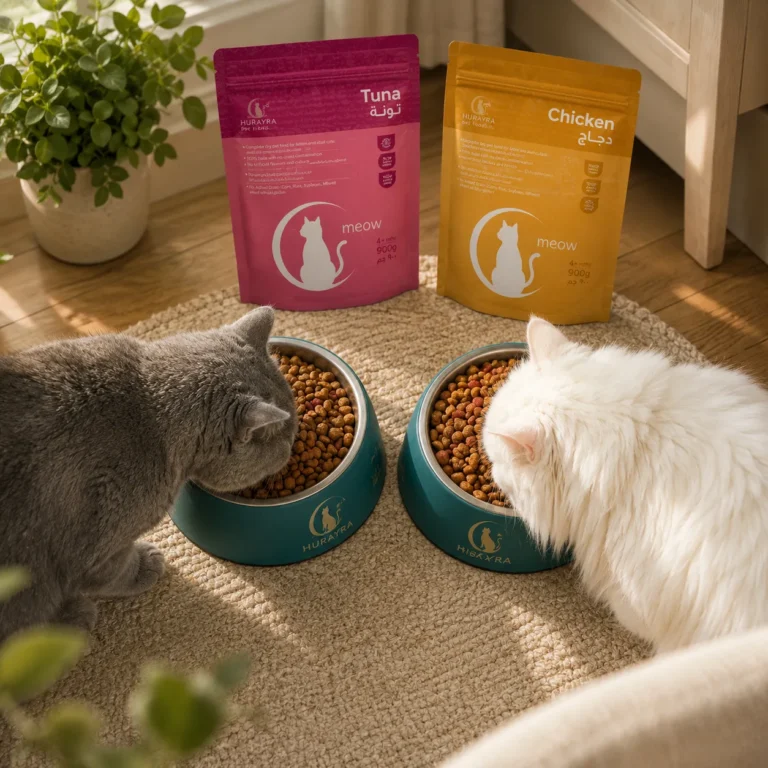
Hurayra lists its ingredients fully and uses named-source proteins; chicken or tuna, as the primary component in each formulation. This makes the nutritional profile predictable, which matters both for ongoing coat health and for managing food sensitivities.
You can review the full ingredient breakdown on the Hurayra ingredients page. For those who prefer to see the product in person before purchasing, it is stocked in Morrisons.
What Good Coat Health Actually Looks Like
Using a body condition score for coat health isn’t standardised in the way it is for weight, but veterinary nutritionists generally assess feline coat quality across a few consistent markers: sheen under natural light, uniform density without thin patches, absence of dandruff or visible skin irritation, and resilience to touch, the coat should spring back rather than feel brittle.
A well-fed cat on an adequate protein and omega intake will show these characteristics consistently. They’re not dramatic. They don’t require the coat to be extraordinary, just healthy.
That’s what a corrected diet delivers. Not transformation. Just function, consistently.
Conclusion
Dull cat coats usually come down to diet. Specifically, to one or more of these: insufficient protein from named animal sources, inadequate omega-3 and omega-6 fatty acids, or missing fat-soluble vitamins A, D, and E. Grains, soy, and unnamed protein fillers occupy space in a formulation without contributing meaningfully to these requirements.
The fix is not complicated. Check the first three ingredients on the label. Prioritise named animal protein. Confirm omega fatty acids are present. Give any dietary change at least eight weeks before assessing results, and keep feeding consistent throughout.
If you want to review what a formulation built to these standards looks like in practice, explore Hurayra’s range. Available online with subscription delivery, and in Morrisons for those who prefer to buy in store.
Tuna and Chicken Combo
Subscribe & Save 25%
Frequently Asked Questions
1 What is the most common cause of a dull cat coat?
Diet is the most frequent cause: a lack of named animal protein, omega fatty acids, or fat-soluble vitamins in the food. These deficiencies develop gradually, which is why coat dullness often appears weeks after a food change rather than immediately.
2 What should I feed my cat to improve its coat?
A dry or wet food where the first ingredient is a named animal protein (chicken, tuna, or salmon) and that includes omega-3 and omega-6 fatty acids alongside vitamins A, D, and E. A protein content of 30% or above on a dry matter basis is a reasonable baseline.
3 Does grain-free cat food improve coat health?
For many cats, yes. Not because grain is toxic, but because removing it from the formulation makes more nutritional space for the protein and fatty acids that directly support coat quality. Cats digest complex carbohydrates less efficiently than animal-sourced nutrition.
4 How long does it take to see coat improvement after changing food?
Generally six to twelve weeks. The coat grows slowly, and improvement depends on consistent feeding over time. Results within two weeks are unlikely; absence of results after three months suggests the change was insufficient or another cause is present.
5 Can poor cat coat quality indicate illness?
Yes. If coat condition deteriorates rapidly, is accompanied by patches of hair loss, or doesn’t improve after a sustained dietary change, a veterinary check is appropriate. Hyperthyroidism, kidney disease, and skin conditions all produce coat changes that diet alone won’t resolve.
6 Is halal cat food nutritionally different from standard cat food?
Not inherently. Halal certification is a standard of sourcing and production ethics. What distinguishes quality halal cat food nutritionally is the use of named, traceable protein sources, a result of the transparency the certification process requires, rather than unspecified derivatives.
Diet is the most frequent cause: a lack of named animal protein, omega fatty acids, or fat-soluble vitamins in the food. These deficiencies develop gradually, which is why coat dullness often appears weeks after a food change rather than immediately.
A dry or wet food where the first ingredient is a named animal protein (chicken, tuna, or salmon) and that includes omega-3 and omega-6 fatty acids alongside vitamins A, D, and E. A protein content of 30% or above on a dry matter basis is a reasonable baseline.
For many cats, yes. Not because grain is toxic, but because removing it from the formulation makes more nutritional space for the protein and fatty acids that directly support coat quality. Cats digest complex carbohydrates less efficiently than animal-sourced nutrition.
Generally six to twelve weeks. The coat grows slowly, and improvement depends on consistent feeding over time. Results within two weeks are unlikely; absence of results after three months suggests the change was insufficient or another cause is present.
Yes. If coat condition deteriorates rapidly, is accompanied by patches of hair loss, or doesn’t improve after a sustained dietary change, a veterinary check is appropriate. Hyperthyroidism, kidney disease, and skin conditions all produce coat changes that diet alone won’t resolve.
Not inherently. Halal certification is a standard of sourcing and production ethics. What distinguishes quality halal cat food nutritionally is the use of named, traceable protein sources, a result of the transparency the certification process requires, rather than unspecified derivatives.