Written by Maria Manshad
The Quick Answer
- 24 hours without eating is already a reason to contact your vet, especially if your cat is normally a good eater or seems unwell.
- Cats can develop serious complications from prolonged food refusal, including hepatic lipidosis (fatty liver disease).
- The often-repeated “cats can survive 1–2 weeks without food” figure should not be treated as a safe waiting period.
- Kittens, overweight cats and cats with conditions such as diabetes or kidney disease may need help sooner.
- If your cat is not eating and is vomiting, weak, dehydrated, struggling to breathe, hiding unusually, or showing other signs of illness, seek veterinary help promptly.
- Never assume a cat will eventually eat when it gets hungry enough. Finding out why your cat has stopped eating is just as important as getting food into them.
Your cat skipped breakfast, then dinner. Now the bowl is still full.
You’ll find online answers like “a week” or “two weeks,” but those figures only describe how long a cat might stay alive without food. They say nothing about how long it’s safe to go without eating. Cats can become seriously ill, even develop fatty liver disease, long before reaching that limit.
So the real question isn’t “How long can they survive?” It’s “How long is it safe to wait?”
Here’s what happens at 12, 24, 48 and 72 hours, when to call the vet, and what to do if your cat suddenly refuses food.
How Long Is It Safe for a Cat to Go Without Eating?
There is no universal countdown that applies to every cat. A healthy adult cat that skips one meal is not in the same situation as a diabetic cat that has refused food all day.
Use this timeline as a practical guide rather than a promise of how long a cat can survive.
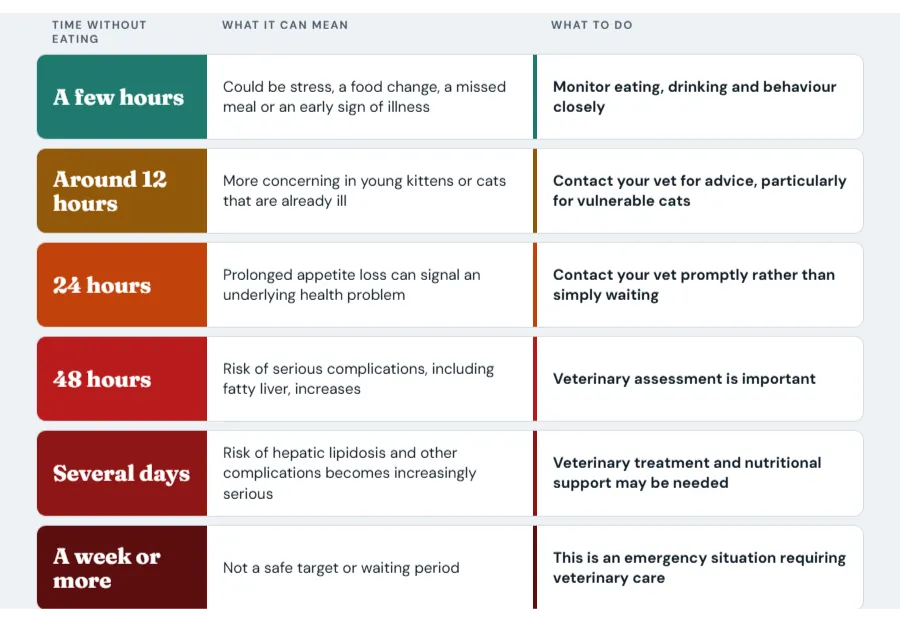
“Can survive” does not mean “safe to wait.”
A cat’s ability to survive starvation should never be used as a feeding deadline.
Can a Cat Really Survive 1–2 Weeks Without Food?
The often-repeated 1–2 week survival estimate can be misleading. How long a cat survives without food depends on its age, health, hydration and underlying condition.
A cat may survive for days while becoming dangerously unwell, and illnesses such as kidney disease or pancreatitis can worsen much sooner. Outdoor cats add further uncertainty because their last meal is often unknown.
The key question isn’t how long a cat can survive without food, but why it isn’t eating and how quickly it needs veterinary care.
What Happens When a Cat Stops Eating?
When a cat stops eating, its body begins looking for another source of energy. Fat stores are mobilised, but cats can struggle to process large amounts of fat through the liver.
This can lead to hepatic lipidosis, commonly called fatty liver disease.
The condition is particularly associated with cats that have stopped eating for several days, and overweight cats can be especially vulnerable.
That means “my cat is just being picky” isn’t always a safe assumption. The appetite loss itself may be the first visible clue that something else is wrong.
What Causes a Cat to Stop Eating?
Dental or mouth pain; nausea or vomiting; gastrointestinal problems; pancreatitis; kidney disease; diabetes; liver disease; hyperthyroidism; infection or fever; cancer; pain elsewhere in the body; stress or major changes at home; a change in food; anxiety; problems with the food bowl or feeding environment.
Understanding your cat’s usual feeding routine can also help you spot changes in appetite. Learn how often you should feed your cat to understand what a normal feeding schedule looks like.
What Happens After 24 Hours Without Food?
Twenty-four hours is an important point because it changes the situation from “keep an eye on them” to “find out what’s going on.”
A cat that has not eaten properly for a full day should not simply be left to see how long it can go.
This is especially important if your cat is overweight, very young, elderly, diabetic, has kidney or liver disease, has recently had surgery, is vomiting or has diarrhoea, seems painful, is unusually quiet or hiding, or is drinking much less or more than usual.
Call your vet and explain exactly how long your cat has gone without eating, whether they are drinking, and whether anything else has changed.
What Happens After 48 Hours Without Food?
At this stage, waiting becomes considerably more concerning.
Cats can develop hepatic lipidosis after a period of anorexia, with the risk particularly associated with several consecutive days of little or no food.
A cat that has reached the 48-hour mark without eating should receive veterinary advice rather than being treated with increasingly desperate home feeding attempts.
If your cat is already showing signs such as weakness, vomiting, dehydration or yellowing of the eyes or gums, don’t wait for another milestone.
What Happens After 72 Hours?
Three days without food is not a “let’s see if they get hungry tomorrow” situation.
At this point, the cat may need veterinary investigation and nutritional support, particularly if an underlying illness is preventing it from eating.
Hepatic lipidosis can interfere with normal liver function and may become life-threatening without appropriate treatment.
Some cats may still look surprisingly normal at first. That’s part of what makes appetite loss easy to underestimate.
How Long Can a Cat Go Without Drinking?
Food and water are two different problems. A cat can become dehydrated much more quickly than it can starve.
If your cat is refusing both food and water, or is losing fluids through vomiting or diarrhoea, the situation is more urgent.
Watch for dry or sticky gums, weakness, reduced urination, sunken-looking eyes, loss of normal skin elasticity, increased hiding or severe lethargy.
Home dehydration checks aren’t a substitute for veterinary assessment.
What Should You Do If Your Cat Suddenly Stops Eating?
Step 1: Check what “not eating” really means. Has your cat eaten nothing at all, or just less than usual? Note how much they actually eat.
Step 2: Look for other symptoms. Watch for changes in drinking, urination, stools, energy, breathing, grooming, movement or hiding, and for any vomiting or weight loss.
Step 3: Make food easy to get to. If your cat is otherwise well and you’re waiting for vet advice, offer their usual food somewhere quiet. Gently warming it or serving smaller, more frequent portions can help.
Step 4: Don’t force it. Forcing food into a reluctant cat’s mouth can deepen food aversion and risks food entering the airway.
Knowing your cat’s normal portions helps you spot a drop early. See how much wet food to feed a cat by weight.
Keep their everyday meals simple and nourishing
A good feeding routine starts with food your cat actually enjoys. Explore Hurayra’s cat food range and make everyday mealtimes something your cat looks forward to.

Explore Hurayra
Should You Force-Feed a Cat That Won’t Eat?
Don’t force-feed your cat unless your veterinarian has specifically instructed you how to provide nutritional support.
Putting food into a reluctant cat’s mouth can increase stress and food aversion. Syringe-feeding into the mouth is not automatically a safer version of force-feeding.
If a cat genuinely needs assisted nutrition, your vet may recommend a feeding tube instead.
If you’re considering offering a small amount of human food, check which options are safe and which should be avoided in our guide to human foods cats can and can’t eat.
What Happens at the Vet When a Cat Won’t Eat?
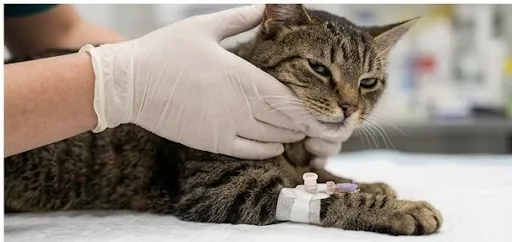
First, your vet needs to find the cause. Expect a physical exam, a check of the mouth and teeth, and possibly blood tests, urine tests, or an ultrasound or X-ray.
Then, treatment targets that cause. Your cat may need fluids, anti-nausea or pain relief, or treatment for an underlying illness. If they can’t eat enough, a feeding tube may be used.
For fatty liver disease, feeding is the treatment. Some cats need a tube for weeks while the liver recovers.
What Is Refeeding, and Why Shouldn’t You Rush It?
After a cat has gone a prolonged period without eating, simply giving them a huge meal isn’t necessarily the solution.
Their nutritional needs and tolerance need to be assessed by a veterinary professional, particularly if they have been severely anorexic or are already ill.
A veterinarian may establish a controlled feeding plan and gradually increase nutritional support while monitoring the cat’s response.
The longer a cat has gone without adequate nutrition, the more important professional guidance becomes.
Looking for cat food made with your cat’s needs in mind?
Explore Hurayra’s range and find out more about what’s in their food.
Products | Halal Cat Food
What About Diabetic Cats That Aren’t Eating?
A diabetic cat that suddenly stops eating should be treated as a veterinary concern.
Do not independently change, skip or double an insulin dose based only on general internet advice. Insulin requirements depend on the individual cat, its medication, blood glucose and circumstances.
Contact your veterinary team and tell them when your cat last ate, how much they ate, when they last received insulin, what insulin they use, any vomiting or unusual behaviour, and whether they are drinking and urinating normally.
What About Cats With Kidney Disease?
Cats with kidney disease may already have appetite and hydration challenges.
If a cat with known kidney disease suddenly stops eating, don’t assume it is simply being fussy.
Contact your veterinary team, particularly if the cat is also vomiting, lethargic, dehydrated or losing weight.
What About Kittens?
Kittens have less room for prolonged food refusal than healthy adult cats.
Very young kittens are especially vulnerable because they have smaller energy reserves and are still developing.
If a young kitten refuses food, contact a vet promptly.
What About Pregnant or Nursing Cats?
Pregnant and nursing cats have increased nutritional demands, so a significant drop in appetite deserves prompt attention.
If a pregnant or nursing cat refuses food, especially if the appetite loss is accompanied by weakness, vomiting, discharge, pain or unusual behaviour, speak to your veterinarian promptly.
What If You Find an Outdoor or Stray Cat That Hasn’t Eaten?
You may not know when the cat last ate, whether it has access to water, whether someone else is feeding it, whether it has an underlying illness, whether it is lost, or whether it has recently been injured.
A thin or weak outdoor cat that refuses food should not simply be left outside with the assumption that it will find something eventually.
If you have safely brought the cat inside, provide access to water and seek veterinary advice. A vet or rescue organisation can also help determine whether the cat needs urgent treatment and whether it may have an owner.
When Is a Cat Not Eating an Emergency?
If your cat is clearly unwell, don’t wait for a set number of hours.
Get urgent veterinary help if your cat isn’t eating and also has:
- Repeated vomiting or blood in vomit or stools
- Severe weakness, extreme lethargy or collapse
- Difficulty breathing
- Yellow eyes, gums or skin
- Signs of severe dehydration or significant pain
- Difficulty urinating
- A swollen or painful belly
- Seizures or sudden neurological changes
If your vet is closed, call an out-of-hours or emergency service. Don’t wait until morning if things look serious.
Can a Cat Die From Not Eating?
Unfortunately, yes. But the danger isn’t simply a countdown where a cat reaches a certain number of days and suddenly dies.
Prolonged food refusal can lead to dehydration, malnutrition and potentially life-threatening complications such as hepatic lipidosis. The underlying illness that caused the appetite loss can also become more serious.
The good news is that many cats can recover when the problem is recognised and treated promptly.
The earlier the cause is identified and appropriate nutritional support is provided, the better the opportunity to prevent complications.
The 3–3–3 Rule: Does It Apply to Cats?
You may come across the 3–3–3 rule online, usually in discussions about how long an animal can survive or adjust without food.
It isn’t a reliable veterinary rule for deciding how long your cat can safely go without eating.
Your cat’s age, health, hydration, body condition and the reason for the appetite loss all matter far more than a simple countdown.
The Bottom Line: Don’t Wait for the Survival Clock
If you remember one thing, make it this: surviving without food is not the same as being safe without it.
Twenty-four hours of real appetite loss is worth taking seriously, and kittens or cats with health problems may need help sooner.
So skip “How many more days can they survive?” The better question is “Why have they stopped eating, and what can we do about it?”
Catching the cause early can be the difference between a small problem and a serious one.
Frequently Asked Questions
A cat that hasn’t eaten for 24 hours should be assessed by a vet, particularly if it seems unwell or has an existing health condition. Kittens and medically vulnerable cats may need help sooner.
A cat may survive 48 hours without food, but that doesn’t mean it’s safe. Prolonged food refusal can lead to serious complications, including hepatic lipidosis (fatty liver disease). Contact your vet rather than waiting for your cat to become visibly ill.
There is no exact timeframe that applies to every cat. Hepatic lipidosis can develop after several days of inadequate food intake, particularly in overweight cats. Contact your vet promptly if your cat stops eating rather than waiting for signs of liver damage..
Kittens are more vulnerable to food deprivation than adult cats because they have smaller energy reserves. Very young kittens can become seriously ill within hours, so contact a vet promptly if a kitten refuses food.
Check whether your cat is drinking, behaving normally or showing other symptoms, and offer its usual food in a quiet environment. Don’t force-feed your cat. If it hasn’t eaten for 24 hours, contact your vet; seek urgent care sooner if your cat is weak, vomiting, struggling to breathe or showing other worrying signs.